Description:
Reviews:
5.0 out of 5 stars important book
Brilliant book, written in beautiful English but appallingly proof-read, with typos galore, grammatical errors and occasional idiomatic infelicities quite at odds with the intelligence of the author and his translator; it deserves a wide audience and an improved reprint would do it justice.It has been Germany's fate to destabilise Europe consistently for the last 100 years; it has been twice saved from itself by the United States, which was massively generous in promoting Germany's post- WW2 regeneration.It is time now for a rich Germany to be generous and pull is head out of its udders.As Goethe wrote: 'Edel sei der Mensch, hilfreich und gut'.it is quite nauseating to see Germany bring Europe to its knees for a third time in a hundred years: third time lucky?Kundnani points to Germany's selfish and short-term attitude as the cause of Europe's potential fatal malaise, which would have bad global consequences; an unimaginitive and petty-bourgeois Germany fails to acknowledge this sin.Germany needs to big up and rescue Europe by footing the bill it allowed its creditors to run up, save the Euro and re-stimulate the entire continental economy. The current situation is the waste of a wonderful Europe and Germany's fault.Kundnani elucidates Germany's dilemma and it causes.I hope he can become more vociferous and influential in this very important matter.
4.0 out of 5 stars Interesting Book - Well Worth Reading
Overall an interesting book. The book covers the period from German unification under Bismarck to the present day. The central theme of the book is the destabilizing influence, a strong and powerful Germany has on it's European neighbors.The author discusses at length two current aspects of Germany's economic and foreign policy.Firstly the reluctance of successive German governments in the modern era to take on a leadership role on the world political stage. Kundnani argues rightly or wrongly that the German government has too often adopted a submissive approach, for fear of derailing the country's business interests in major export markets, such as China, and Russia.Secondly, German economic policy post the Euro crisis. Hans Kundnani rightly states that debtor nations such as Greece, Spain, Portugal, and Ireland have suffered disproportionately from the Euro crisis. The author also mentions the reluctance of the Germany to increase it's domestic demand, to help debtor nations trade their way out recession.The one area where this book falls short for me is the lack of discussion around alternative policy. For example, if Germany had agreed to a debt write off for embattled debtor nations such as Greece in the aftermath of the Euro crisis, what would have been the impact on the solvency of German banks?In summary a good book, well researched, well written with the exception of some grammatical errors and typos!! Yes I would recommend this book to people who are interested in developing their understanding of modern European economic and political policy.
5.0 out of 5 stars Five Stars
great condition - looking forward to use it in comparison with Japan
5.0 out of 5 stars Five Stars
Great book. Delivery company not so good.
5.0 out of 5 stars Five Stars
ok
Flott und verständlich geschrieben
Interessante zeitgenössische Analyse der deutschen Stellung in Europa hinsichtlich historisch, politisch und ökonomischen Gegebenheiten. Es ist flott und verständlich geschrieben.
Germany, an Exporter's “Self-Centered, Short-Termism” Foreign Policy. A Cultural, Economic, Political History 1871-Present
Hans Kundnani writes of the shaping of German national identity, including its cultural history: from romantic ideas to nationalism to fascism to post war reunification. Germany's return to dominant economic strength again brings the “German question” which caused so much misery from 1871-1945.Most Germans have not fully benefited as national debt has reversed from highs which violated Euro agreements to an exporting behemoth's balance sheet. But exporters' needs win out as the post 1960's debates framed by Auschwitz and the “normal”, have evolved into a neo-mercantile, self-centered, “short-termism” foreign policy.German manufacturing is integrated with Eastern Europe. Its exports are advantaged by the euro's weaker members. It has special relationships with China, the world's other great net exporter, and India. Its arms merchants are successful in the MidEast and worldwide, driving government policy. (In The Full Catastrophe, Wall Street Journal writer, Angelos details German armament makers who have provided packages of unsustainable loan deals to Greece.) Germany has detached from the close relationship it had with the US from the Cold War to Iraq.Kundnani provides us with numbers, history, historiography and facts. This book is dense, closely reasoned and brief. It is complete. His last chapter “Conclusions: Geo-economic semi-hegemony” seems inevitable from his preceding chapters of German cultural and economic history become national psychology and policy. It is something to chew on. It places the reader in others' shoes: in the lathe of German history. I could ask for nothing better. Before forming an opinion on Europe and the global future- read this brilliant book.
Kurzweilig aber oberflächlich
Das u.a. im Wall Street Journal und in der Financial Times gelobte Buch des Autors Hans Kundnani verspricht ein auf 122 Seiten komprimiertes, kurzweiliges "Update" über die zeitaktuelle Lage Deutschlands in Europa.Wer ein knappes Buch über einige der wesentlichen, vor allem außenpolitischen bundesdeutschen Entwicklungen und Hintergründe von der Gründung des Deutschen Reiches 1871 bis in die Gegenwart sucht, ist hier richtig.Wer allerdings auf eine fundierte und etwas tiefgründigere Darstellung hofft, dürfte enttäuscht werden: Das Buch fokussiert im Wesentliche auf die Handlungen einer Handvoll Personen (Bismarck, Bahr, Schröder...) und es werden lediglich diejenigen geschichtspolitischen Ereignisse betrachtet, welche die Aussagen des Autors stützen. Das Werk ist sehr, sehr unterkomplex und behandelt z.B. zu keinem Zeitpunkt in ausreichender Weise Verknüpfungen zwischen der deutschen Innen- und Außenpolitik. Auch die institutionellen Arrangements auf EU-Ebene sowie die ökonomischen Sachverhalte werden nur vollkommen oberflächlich tangiert, wie auch die Gegebenheiten in anderen Staaten (Beispiel: Die Wahl von Tsipras zeigt, dass Deutschland zwar Regeln, aber keine Normen, in Europa durchsetzen kann). Es wird mit Schlagbegriffen (z.B. "Westbindung") operiert, die relativ beliebig verwandt werden. Darüber hinaus ist das Buch keineswegs objektiv gehalten, sondern der Autor möchte seine zentrale These, dass Deutschland eine geo-ökonomische Macht ist, die jedoch zu schwach ist, um Europa ihren Willen gänzlich aufzuzwingen und deshalb fortwährend Reibungsflächen und Konflikte hervorbringt, belegen.Fazit: Als "Lesesnack" für zwischendurch und für die eigene Gedankenanregung zu gebrauchen, mehr aber auch nicht.
sticky, disgusting
The book cover was sticky. Absolutely disgusting condition.
Five Stars
Book as advertised.
Visit the C Hurst & Co Publishers Ltd Store
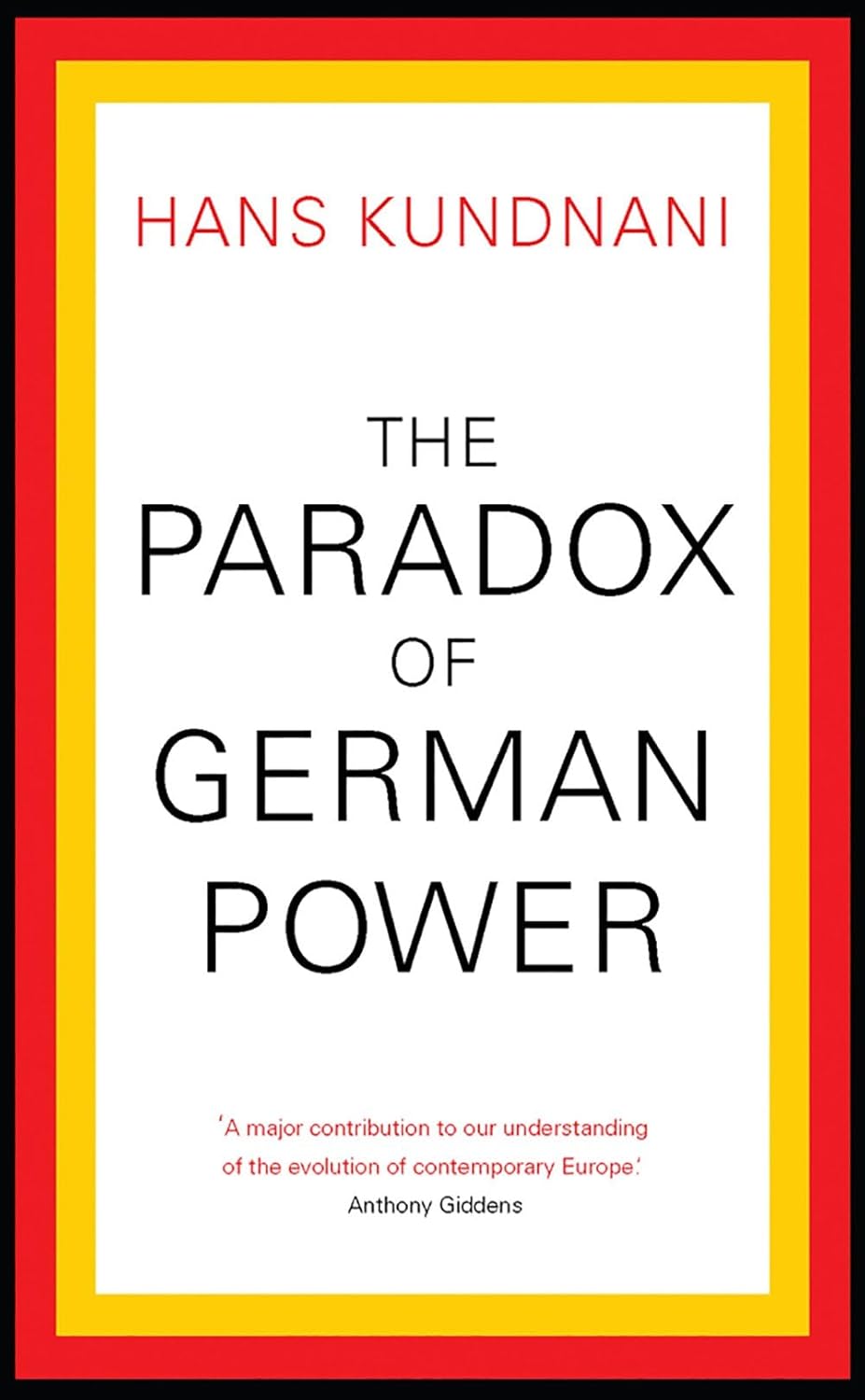
The Paradox of German Power
AED18827
Quantity:
Order today to get by 7-14 business days
Delivery fee of AED 20. Free for orders above AED 200.
Imported From: United Kingdom
At BOLO, we work hard to ensure the products you receive are new, genuine, and sourced from reputable suppliers.
BOLO is not an authorized or official retailer for most brands, nor are we affiliated with manufacturers unless specifically stated on a product page. Instead, we source verified sellers, authorized distributors or directly from the manufacturer.
Each product undergoes thorough inspection and verification at our consolidation and fulfilment centers to ensure it meets our strict authenticity and quality standards before being shipped and delivered to you.
If you ever have concerns regarding the authenticity of a product purchased from us, please contact Bolo Support. We will review your inquiry promptly and, if necessary, provide documentation verifying authenticity or offer a suitable resolution.
Your trust is our top priority, and we are committed to maintaining transparency and integrity in every transaction.
All product information, images, descriptions, and reviews originate from the manufacturer or from trusted sellers overseas. BOLO is not affiliated with, endorsed by, or an authorized retailer for most brands listed on our website unless stated otherwise.
While we strive to display accurate information, variations in packaging, labeling, instructions, or formulation may occasionally occur due to regional differences or supplier updates. For detailed or manufacturer-specific information, please contact the brand directly or reach out to BOLO Support for assistance.
Unless otherwise stated, all prices displayed on the product page include applicable taxes and import duties.
BOLO operates in accordance with the laws and regulations of United Arab Emirates. Any items found to be restricted or prohibited for sale within the UAE will be cancelled prior to shipment. We take proactive measures to ensure that only products permitted for sale in United Arab Emirates are listed on our website.
All items are shipped by air, and any products classified as “Dangerous Goods (DG)” under IATA regulations will be removed from the order and cancelled.
All orders are processed manually, and we make every effort to process them promptly once confirmed. Products cancelled due to the above reasons will be permanently removed from listings across the website.
More from this brand
Similar items from “Germany”
Share with
Or share with link
https://www.bolo.ae/products/K1849047197
Visit the C Hurst & Co Publishers Ltd Store
The Paradox of German Power

AED18827
Quantity:
Order today to get by 7-14 business days
Delivery fee of AED 20. Free for orders above AED 200.
Imported From: United Kingdom
At BOLO, we work hard to ensure the products you receive are new, genuine, and sourced from reputable suppliers.
BOLO is not an authorized or official retailer for most brands, nor are we affiliated with manufacturers unless specifically stated on a product page. Instead, we source verified sellers, authorized distributors or directly from the manufacturer.
Each product undergoes thorough inspection and verification at our consolidation and fulfilment centers to ensure it meets our strict authenticity and quality standards before being shipped and delivered to you.
If you ever have concerns regarding the authenticity of a product purchased from us, please contact Bolo Support. We will review your inquiry promptly and, if necessary, provide documentation verifying authenticity or offer a suitable resolution.
Your trust is our top priority, and we are committed to maintaining transparency and integrity in every transaction.
All product information, images, descriptions, and reviews originate from the manufacturer or from trusted sellers overseas. BOLO is not affiliated with, endorsed by, or an authorized retailer for most brands listed on our website unless stated otherwise.
While we strive to display accurate information, variations in packaging, labeling, instructions, or formulation may occasionally occur due to regional differences or supplier updates. For detailed or manufacturer-specific information, please contact the brand directly or reach out to BOLO Support for assistance.
Unless otherwise stated, all prices displayed on the product page include applicable taxes and import duties.
BOLO operates in accordance with the laws and regulations of United Arab Emirates. Any items found to be restricted or prohibited for sale within the UAE will be cancelled prior to shipment. We take proactive measures to ensure that only products permitted for sale in United Arab Emirates are listed on our website.
All items are shipped by air, and any products classified as “Dangerous Goods (DG)” under IATA regulations will be removed from the order and cancelled.
All orders are processed manually, and we make every effort to process them promptly once confirmed. Products cancelled due to the above reasons will be permanently removed from listings across the website.
Description:
Reviews:
5.0 out of 5 stars important book
Brilliant book, written in beautiful English but appallingly proof-read, with typos galore, grammatical errors and occasional idiomatic infelicities quite at odds with the intelligence of the author and his translator; it deserves a wide audience and an improved reprint would do it justice.It has been Germany's fate to destabilise Europe consistently for the last 100 years; it has been twice saved from itself by the United States, which was massively generous in promoting Germany's post- WW2 regeneration.It is time now for a rich Germany to be generous and pull is head out of its udders.As Goethe wrote: 'Edel sei der Mensch, hilfreich und gut'.it is quite nauseating to see Germany bring Europe to its knees for a third time in a hundred years: third time lucky?Kundnani points to Germany's selfish and short-term attitude as the cause of Europe's potential fatal malaise, which would have bad global consequences; an unimaginitive and petty-bourgeois Germany fails to acknowledge this sin.Germany needs to big up and rescue Europe by footing the bill it allowed its creditors to run up, save the Euro and re-stimulate the entire continental economy. The current situation is the waste of a wonderful Europe and Germany's fault.Kundnani elucidates Germany's dilemma and it causes.I hope he can become more vociferous and influential in this very important matter.
4.0 out of 5 stars Interesting Book - Well Worth Reading
Overall an interesting book. The book covers the period from German unification under Bismarck to the present day. The central theme of the book is the destabilizing influence, a strong and powerful Germany has on it's European neighbors.The author discusses at length two current aspects of Germany's economic and foreign policy.Firstly the reluctance of successive German governments in the modern era to take on a leadership role on the world political stage. Kundnani argues rightly or wrongly that the German government has too often adopted a submissive approach, for fear of derailing the country's business interests in major export markets, such as China, and Russia.Secondly, German economic policy post the Euro crisis. Hans Kundnani rightly states that debtor nations such as Greece, Spain, Portugal, and Ireland have suffered disproportionately from the Euro crisis. The author also mentions the reluctance of the Germany to increase it's domestic demand, to help debtor nations trade their way out recession.The one area where this book falls short for me is the lack of discussion around alternative policy. For example, if Germany had agreed to a debt write off for embattled debtor nations such as Greece in the aftermath of the Euro crisis, what would have been the impact on the solvency of German banks?In summary a good book, well researched, well written with the exception of some grammatical errors and typos!! Yes I would recommend this book to people who are interested in developing their understanding of modern European economic and political policy.
5.0 out of 5 stars Five Stars
great condition - looking forward to use it in comparison with Japan
5.0 out of 5 stars Five Stars
Great book. Delivery company not so good.
5.0 out of 5 stars Five Stars
ok
Flott und verständlich geschrieben
Interessante zeitgenössische Analyse der deutschen Stellung in Europa hinsichtlich historisch, politisch und ökonomischen Gegebenheiten. Es ist flott und verständlich geschrieben.
Germany, an Exporter's “Self-Centered, Short-Termism” Foreign Policy. A Cultural, Economic, Political History 1871-Present
Hans Kundnani writes of the shaping of German national identity, including its cultural history: from romantic ideas to nationalism to fascism to post war reunification. Germany's return to dominant economic strength again brings the “German question” which caused so much misery from 1871-1945.Most Germans have not fully benefited as national debt has reversed from highs which violated Euro agreements to an exporting behemoth's balance sheet. But exporters' needs win out as the post 1960's debates framed by Auschwitz and the “normal”, have evolved into a neo-mercantile, self-centered, “short-termism” foreign policy.German manufacturing is integrated with Eastern Europe. Its exports are advantaged by the euro's weaker members. It has special relationships with China, the world's other great net exporter, and India. Its arms merchants are successful in the MidEast and worldwide, driving government policy. (In The Full Catastrophe, Wall Street Journal writer, Angelos details German armament makers who have provided packages of unsustainable loan deals to Greece.) Germany has detached from the close relationship it had with the US from the Cold War to Iraq.Kundnani provides us with numbers, history, historiography and facts. This book is dense, closely reasoned and brief. It is complete. His last chapter “Conclusions: Geo-economic semi-hegemony” seems inevitable from his preceding chapters of German cultural and economic history become national psychology and policy. It is something to chew on. It places the reader in others' shoes: in the lathe of German history. I could ask for nothing better. Before forming an opinion on Europe and the global future- read this brilliant book.
Kurzweilig aber oberflächlich
Das u.a. im Wall Street Journal und in der Financial Times gelobte Buch des Autors Hans Kundnani verspricht ein auf 122 Seiten komprimiertes, kurzweiliges "Update" über die zeitaktuelle Lage Deutschlands in Europa.Wer ein knappes Buch über einige der wesentlichen, vor allem außenpolitischen bundesdeutschen Entwicklungen und Hintergründe von der Gründung des Deutschen Reiches 1871 bis in die Gegenwart sucht, ist hier richtig.Wer allerdings auf eine fundierte und etwas tiefgründigere Darstellung hofft, dürfte enttäuscht werden: Das Buch fokussiert im Wesentliche auf die Handlungen einer Handvoll Personen (Bismarck, Bahr, Schröder...) und es werden lediglich diejenigen geschichtspolitischen Ereignisse betrachtet, welche die Aussagen des Autors stützen. Das Werk ist sehr, sehr unterkomplex und behandelt z.B. zu keinem Zeitpunkt in ausreichender Weise Verknüpfungen zwischen der deutschen Innen- und Außenpolitik. Auch die institutionellen Arrangements auf EU-Ebene sowie die ökonomischen Sachverhalte werden nur vollkommen oberflächlich tangiert, wie auch die Gegebenheiten in anderen Staaten (Beispiel: Die Wahl von Tsipras zeigt, dass Deutschland zwar Regeln, aber keine Normen, in Europa durchsetzen kann). Es wird mit Schlagbegriffen (z.B. "Westbindung") operiert, die relativ beliebig verwandt werden. Darüber hinaus ist das Buch keineswegs objektiv gehalten, sondern der Autor möchte seine zentrale These, dass Deutschland eine geo-ökonomische Macht ist, die jedoch zu schwach ist, um Europa ihren Willen gänzlich aufzuzwingen und deshalb fortwährend Reibungsflächen und Konflikte hervorbringt, belegen.Fazit: Als "Lesesnack" für zwischendurch und für die eigene Gedankenanregung zu gebrauchen, mehr aber auch nicht.
sticky, disgusting
The book cover was sticky. Absolutely disgusting condition.
Five Stars
Book as advertised.
More from this brand
Similar items from “Germany”
Share with
Or share with link
https://www.bolo.ae/products/K1849047197