Description:
Review
Independent Thinking on Restorative Practice is a tour de force in restorative working. Practical, authentic and intelligent, this book is crucial for anyone serious about a relational approach to teaching.
- Paul Dix, behaviour specialist, WhenTheAdultsChange.com
Restorative practice is not simply a way of doing; it’s a way of being, and it takes practice! In Independent Thinking on Restorative Practice Mark sets out key principles and their application, as well as the opportunities and challenges around their use, in this accessible, easy-to-read book. Furthermore, this book is not just for teachers – because restorative practice is not just for schools. It works for children, young people and families in a wide variety of contexts and settings, with young and old, with peers and colleagues, and in our work as leaders and managers.
In short, anyone interested in the power of human relationships to enable change to happen will find material in this book to help them.
- Andy Couldrick, Chief Executive, Birmingham Children’s Trust
I adore the fact that one of the first things Mark addresses in this book is the ‘L word’ – love – and that in our school communities we need to ‘spread it thick, like my mum spreads butter’.
He uses strong evidence to show that when schools use restorative practice effectively, both attendance and attainment improve. This is no woolly idea, and he provides a cohesive strategy for changing schools towards becoming relational. A happy, well respected child is a child who can learn and engage.
In these times of isolating pupils, he shows us that the way to reduce negative behaviours and communication is inclusion over exclusion and problem-solving over punishment. However, he doesn’t share a one-size-fits-all mentality here; instead he offers a plethora of fantastic ideas to build this change
His writing is quite simply a groundbreaking dive into the importance of social capital, relationships, humanity and compassion – in fact all the things that we know bring out the best in a whole community.
Independent Thinking on Restorative Practice is a compelling and articulate read, and by the end you are brimming with ideas and love.
- Chris Dyson, Head Teacher, Parklands Primary School
Independent Thinking on Restorative Practice is a book about hope.
For anyone working with children and young people, and who believe in the power of relationships, this is the book you have to read. Creating simplicity out of complexity, Mark beautifully captures the many different 1% changes that we can make on our ongoing journey to restorative practice. You will finish this book with the tools to proactively empower your ‘crew’ in school to know themselves, know one another, reflect on their actions, repair relationships responsibly and be better humans. This is a book about behaviour, belonging, connection, inclusion, listening and love.
I was hooked from the first thoughts to the final thoughts, and I will carry this book with me to remind me that there is always another way: a relational way.
- Emma Beveridge, Executive Principal, LaceyField – the home of Eastfield Academy and Lacey Gardens Academy
For far too long the education world has needed a thorough, authentic and expert guide to restorative practice, written by someone who really knows their stuff – and here it is!
In Independent Thinking on Restorative Practice Mark Finnis harnesses his years of experience to bring us the perfect balance of theory and practical advice. He is a true champion of relational practice and shows us how values and cultural development can lead to strong relationships and therefore positive behaviour, of both adults and children.
If you truly want to embrace relationships as the heartbeat of your school culture, then this book will show you how. This really is a book to change hearts and minds.
- Dave Whitaker, Director of Learning, Wellspring Academy Trust
In this book Mark Finnis guides the reader through restorative practice with clarity, insight, real-life examples and clear direction. It is full of practical ideas and advice on how to build relationships and create a restorative ethos at whole-school and classroom level.
Mark’s words inspire courage and a belief that small changes will have a huge impact. Restorative approaches are not just for resolving conflict, and this book suggests many ways in which it can be built into day-to-day interactions throughout a school. Restorative practice is not a ‘soft’ or easy option, and the structures suggested in this book guide the reader through its many functions and possibilities.
Mark describes the challenges and successes of restorative practice with honesty and gentle humour, sharing his rich experiences in these approaches. The value of strong relationships underpins every chapter, empowering educators to build trust and reciprocity across their school community.
For any teacher or school leader, this is the handbook you are looking for on restorative practice.
- Jennifer M. Knussen, Head Teacher, Pitteuchar East Primary School
Independent Thinking on Restorative Practice is an enjoyable, thought-provoking and, in some parts, laugh-out-loud easy read – and teachers and leaders at every stage of their careers need to read it. It explains restorative and relational practices with clarity, authenticity and warmth.
Mark’s vast experience and deep understanding of relationships and how they impact on children and adults has enabled him to make something that is easily misunderstood or misapplied refreshingly simplistic. The application of the principles Mark outlines will create a hugely positive impact on the lives of children in every classroom and school.
Leading and teaching with love isn’t a big thing; it’s lots of little things. And Mark captures this perfectly.
- Rachel Tomlinson, Head Teacher, Barrowford Primary School
This must-read book is the perfect balance of the principles and theory underpinning restorative practice and relational leadership – and it is peppered beautifully with practical examples of how to make it happen. Mark’s warmth, humour and non-judgemental manner is palpable throughout, and his writing serves up a ‘chicken soup for the soul’.
We will definitely be buying Independent Thinking on Restorative Practice for all our MAT’s leaders.
- Kate Davies, CEO, White Woods Primary Academy Trust
Mark’s common sense is remarkably uncommon. Detailing the ‘why?’, sharing the ‘how?’ and evidencing the impact, in Independent Thinking on Restorative Practice he takes you through working restoratively in a way that leaves you wondering why you didn’t do it sooner and why you didn’t read the book quicker! Mark’s personal style of high challenge and high support echoes in dulcet Liverpudlian tones from every page of the book, provoking you to consider your leadership style, your values and what you really want to achieve.
- Lucie Lakin, Principal, Carr Manor Community School, Executive Head Teacher, Wetherby High School
Part personal, part theory, part practical application, Independent Thinking on Restorative Practice is an eminently readable and always inspiring reminder of the power of working ‘with’. Writing with passion, humour and enthusiasm, Mark has successfully managed to capture the essence of restorative practice he so expertly and inspiringly talks about at his training events. While the content is primarily focused through an education/school lens, the theory and practice described in the book is equally applicable across all disciplines.
If you are new to restorative practice, this book is a great place to start as a welcome and timely introduction to restorative practice from one of the UK’s leading trainers. If you are someone who is more familiar with the subject, this is a really helpful ‘go to’ reminder that you can dip in and out of for inspiration.
- Nigel Richardson, CBE, former director of Children’s Services, Leeds City Council
About the Author
Mark Finnis is an Independent Thinking Associate and one of the UK’s leading exponents of restorative practice. With many years’ experience working with schools, local government agencies and social services, he is in great demand as a speaker and trainer – helping organisations adopt restorative practices in a way that is practical and achievable and that never loses sight of the children and young people they are all aiming to serve.
Details:
Visit the Independent Thinking Press Store
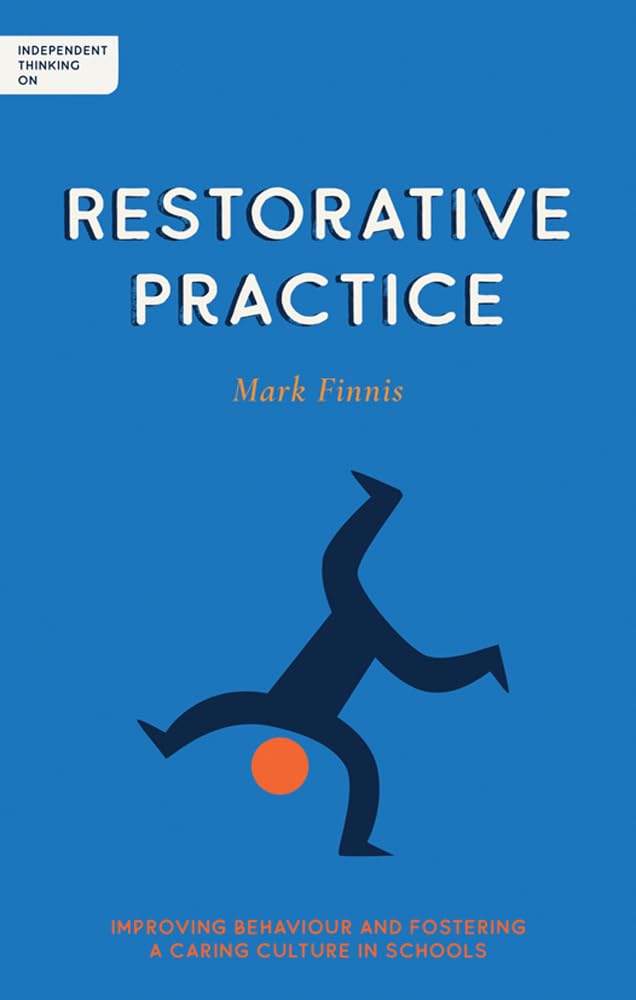
Independent Thinking on Restorative Practice: Building relationships, improving behaviour and creating stronger communities (Independent Thinking On ... series)
AED11255
Quantity:
Order today to get by 7-14 business days
Delivery fee of AED 20. Free for orders above AED 200.
'%3e%3crect%20x='0.599609'%20width='22.4'%20height='16'%20fill='%230A17A7'/%3e%3cpath%20fill-rule='evenodd'%20clip-rule='evenodd'%20d='M-0.426196%20-1.53223L9.1335%204.91587V-1.06506H14.4668V4.91648L24.0263%20-1.53147L25.2193%200.237148L17.6615%205.33494H23.0002V10.6683H17.6618L25.2187%2015.7655L24.0258%2017.5341L14.4668%2011.0865V17.0683H9.1335V11.0871L-0.425634%2017.5348L-1.61858%2015.7662L5.93947%2010.6683H0.600172V5.33494H5.93977L-1.61914%200.236387L-0.426196%20-1.53223Z'%20fill='white'/%3e%3cpath%20d='M15.5332%205.06615L25.6655%20-1.59961'%20stroke='%23DB1F35'%20stroke-width='0.533333'%20stroke-linecap='round'/%3e%3cpath%20d='M16.6094%2010.9578L25.6924%2017.0801'%20stroke='%23DB1F35'%20stroke-width='0.533333'%20stroke-linecap='round'/%3e%3cpath%20d='M7.00176%205.04727L-2.47266%20-1.33789'%20stroke='%23DB1F35'%20stroke-width='0.533333'%20stroke-linecap='round'/%3e%3cpath%20d='M8.02936%2010.8842L-2.47266%2017.8486'%20stroke='%23DB1F35'%20stroke-width='0.533333'%20stroke-linecap='round'/%3e%3cpath%20fill-rule='evenodd'%20clip-rule='evenodd'%20d='M0.599609%209.6H10.1996V16H13.3996V9.6H22.9996V6.4H13.3996V0H10.1996V6.4H0.599609V9.6Z'%20fill='%23E6273E'/%3e%3c/g%3e%3c/svg%3e) Imported From: United Kingdom
Imported From: United Kingdom
At BOLO, we work hard to ensure the products you receive are new, genuine, and sourced from reputable suppliers.
Every product in the BOLO catalogue is sourced through our Verified Global Supply Network of verified sellers, authorized distributors or directly from the manufacturer.
Each product undergoes thorough inspection and verification at our consolidation and fulfilment centers to ensure it meets our strict authenticity and quality standards before being shipped and delivered to you.
If you ever have concerns regarding the authenticity of a product purchased from us, please contact Bolo Support. We will review your inquiry promptly and, if necessary, provide documentation verifying authenticity or offer a suitable resolution.
Your trust is our top priority, and we are committed to maintaining transparency and integrity in every transaction.
While we strive to display accurate information, variations in packaging, labeling, instructions, or formulation may occasionally occur due to regional differences or supplier updates. For detailed or manufacturer-specific information, please contact the brand directly or reach out to BOLO Support for assistance.
Unless otherwise stated, all prices displayed on the product page include applicable taxes and import duties.
BOLO operates in accordance with the laws and regulations of United Arab Emirates. Any items found to be restricted or prohibited for sale within the United Arab Emirates will be cancelled prior to shipment. We take proactive measures to ensure that only products permitted for sale in United Arab Emirates are listed on our website.
All items are shipped by air, and any products classified as “Dangerous Goods (DG)” under IATA regulations will be removed from the order and cancelled.
All orders are processed manually, and we make every effort to process them promptly once confirmed. Products cancelled due to the above reasons will be permanently removed from listings across the website.
Similar suggestions by Bolo
More from this brand
Similar items from “Crisis Management”
Share with
Or share with link
https://www.bolo.ae/products/K1781353387
Visit the Independent Thinking Press Store
Independent Thinking on Restorative Practice: Building relationships, improving behaviour and creating stronger communities (Independent Thinking On ... series)
AED11255
Quantity:
Order today to get by 7-14 business days
Delivery fee of AED 20. Free for orders above AED 200.
Imported From: United Kingdom
At BOLO, we work hard to ensure the products you receive are new, genuine, and sourced from reputable suppliers.
Every product in the BOLO catalogue is sourced through our Verified Global Supply Network of verified sellers, authorized distributors or directly from the manufacturer.
Each product undergoes thorough inspection and verification at our consolidation and fulfilment centers to ensure it meets our strict authenticity and quality standards before being shipped and delivered to you.
If you ever have concerns regarding the authenticity of a product purchased from us, please contact Bolo Support. We will review your inquiry promptly and, if necessary, provide documentation verifying authenticity or offer a suitable resolution.
Your trust is our top priority, and we are committed to maintaining transparency and integrity in every transaction.
While we strive to display accurate information, variations in packaging, labeling, instructions, or formulation may occasionally occur due to regional differences or supplier updates. For detailed or manufacturer-specific information, please contact the brand directly or reach out to BOLO Support for assistance.
Unless otherwise stated, all prices displayed on the product page include applicable taxes and import duties.
BOLO operates in accordance with the laws and regulations of United Arab Emirates. Any items found to be restricted or prohibited for sale within the United Arab Emirates will be cancelled prior to shipment. We take proactive measures to ensure that only products permitted for sale in United Arab Emirates are listed on our website.
All items are shipped by air, and any products classified as “Dangerous Goods (DG)” under IATA regulations will be removed from the order and cancelled.
All orders are processed manually, and we make every effort to process them promptly once confirmed. Products cancelled due to the above reasons will be permanently removed from listings across the website.
Description:
Review
Independent Thinking on Restorative Practice is a tour de force in restorative working. Practical, authentic and intelligent, this book is crucial for anyone serious about a relational approach to teaching.
- Paul Dix, behaviour specialist, WhenTheAdultsChange.com
Restorative practice is not simply a way of doing; it’s a way of being, and it takes practice! In Independent Thinking on Restorative Practice Mark sets out key principles and their application, as well as the opportunities and challenges around their use, in this accessible, easy-to-read book. Furthermore, this book is not just for teachers – because restorative practice is not just for schools. It works for children, young people and families in a wide variety of contexts and settings, with young and old, with peers and colleagues, and in our work as leaders and managers.
In short, anyone interested in the power of human relationships to enable change to happen will find material in this book to help them.
- Andy Couldrick, Chief Executive, Birmingham Children’s Trust
I adore the fact that one of the first things Mark addresses in this book is the ‘L word’ – love – and that in our school communities we need to ‘spread it thick, like my mum spreads butter’.
He uses strong evidence to show that when schools use restorative practice effectively, both attendance and attainment improve. This is no woolly idea, and he provides a cohesive strategy for changing schools towards becoming relational. A happy, well respected child is a child who can learn and engage.
In these times of isolating pupils, he shows us that the way to reduce negative behaviours and communication is inclusion over exclusion and problem-solving over punishment. However, he doesn’t share a one-size-fits-all mentality here; instead he offers a plethora of fantastic ideas to build this change
His writing is quite simply a groundbreaking dive into the importance of social capital, relationships, humanity and compassion – in fact all the things that we know bring out the best in a whole community.
Independent Thinking on Restorative Practice is a compelling and articulate read, and by the end you are brimming with ideas and love.
- Chris Dyson, Head Teacher, Parklands Primary School
Independent Thinking on Restorative Practice is a book about hope.
For anyone working with children and young people, and who believe in the power of relationships, this is the book you have to read. Creating simplicity out of complexity, Mark beautifully captures the many different 1% changes that we can make on our ongoing journey to restorative practice. You will finish this book with the tools to proactively empower your ‘crew’ in school to know themselves, know one another, reflect on their actions, repair relationships responsibly and be better humans. This is a book about behaviour, belonging, connection, inclusion, listening and love.
I was hooked from the first thoughts to the final thoughts, and I will carry this book with me to remind me that there is always another way: a relational way.
- Emma Beveridge, Executive Principal, LaceyField – the home of Eastfield Academy and Lacey Gardens Academy
For far too long the education world has needed a thorough, authentic and expert guide to restorative practice, written by someone who really knows their stuff – and here it is!
In Independent Thinking on Restorative Practice Mark Finnis harnesses his years of experience to bring us the perfect balance of theory and practical advice. He is a true champion of relational practice and shows us how values and cultural development can lead to strong relationships and therefore positive behaviour, of both adults and children.
If you truly want to embrace relationships as the heartbeat of your school culture, then this book will show you how. This really is a book to change hearts and minds.
- Dave Whitaker, Director of Learning, Wellspring Academy Trust
In this book Mark Finnis guides the reader through restorative practice with clarity, insight, real-life examples and clear direction. It is full of practical ideas and advice on how to build relationships and create a restorative ethos at whole-school and classroom level.
Mark’s words inspire courage and a belief that small changes will have a huge impact. Restorative approaches are not just for resolving conflict, and this book suggests many ways in which it can be built into day-to-day interactions throughout a school. Restorative practice is not a ‘soft’ or easy option, and the structures suggested in this book guide the reader through its many functions and possibilities.
Mark describes the challenges and successes of restorative practice with honesty and gentle humour, sharing his rich experiences in these approaches. The value of strong relationships underpins every chapter, empowering educators to build trust and reciprocity across their school community.
For any teacher or school leader, this is the handbook you are looking for on restorative practice.
- Jennifer M. Knussen, Head Teacher, Pitteuchar East Primary School
Independent Thinking on Restorative Practice is an enjoyable, thought-provoking and, in some parts, laugh-out-loud easy read – and teachers and leaders at every stage of their careers need to read it. It explains restorative and relational practices with clarity, authenticity and warmth.
Mark’s vast experience and deep understanding of relationships and how they impact on children and adults has enabled him to make something that is easily misunderstood or misapplied refreshingly simplistic. The application of the principles Mark outlines will create a hugely positive impact on the lives of children in every classroom and school.
Leading and teaching with love isn’t a big thing; it’s lots of little things. And Mark captures this perfectly.
- Rachel Tomlinson, Head Teacher, Barrowford Primary School
This must-read book is the perfect balance of the principles and theory underpinning restorative practice and relational leadership – and it is peppered beautifully with practical examples of how to make it happen. Mark’s warmth, humour and non-judgemental manner is palpable throughout, and his writing serves up a ‘chicken soup for the soul’.
We will definitely be buying Independent Thinking on Restorative Practice for all our MAT’s leaders.
- Kate Davies, CEO, White Woods Primary Academy Trust
Mark’s common sense is remarkably uncommon. Detailing the ‘why?’, sharing the ‘how?’ and evidencing the impact, in Independent Thinking on Restorative Practice he takes you through working restoratively in a way that leaves you wondering why you didn’t do it sooner and why you didn’t read the book quicker! Mark’s personal style of high challenge and high support echoes in dulcet Liverpudlian tones from every page of the book, provoking you to consider your leadership style, your values and what you really want to achieve.
- Lucie Lakin, Principal, Carr Manor Community School, Executive Head Teacher, Wetherby High School
Part personal, part theory, part practical application, Independent Thinking on Restorative Practice is an eminently readable and always inspiring reminder of the power of working ‘with’. Writing with passion, humour and enthusiasm, Mark has successfully managed to capture the essence of restorative practice he so expertly and inspiringly talks about at his training events. While the content is primarily focused through an education/school lens, the theory and practice described in the book is equally applicable across all disciplines.
If you are new to restorative practice, this book is a great place to start as a welcome and timely introduction to restorative practice from one of the UK’s leading trainers. If you are someone who is more familiar with the subject, this is a really helpful ‘go to’ reminder that you can dip in and out of for inspiration.
- Nigel Richardson, CBE, former director of Children’s Services, Leeds City Council
About the Author
Mark Finnis is an Independent Thinking Associate and one of the UK’s leading exponents of restorative practice. With many years’ experience working with schools, local government agencies and social services, he is in great demand as a speaker and trainer – helping organisations adopt restorative practices in a way that is practical and achievable and that never loses sight of the children and young people they are all aiming to serve.
Details:
Similar suggestions by Bolo
More from this brand
Similar items from “Crisis Management”
Share with
Or share with link
https://www.bolo.ae/products/K1781353387