Deliver toUnited Arab Emirates
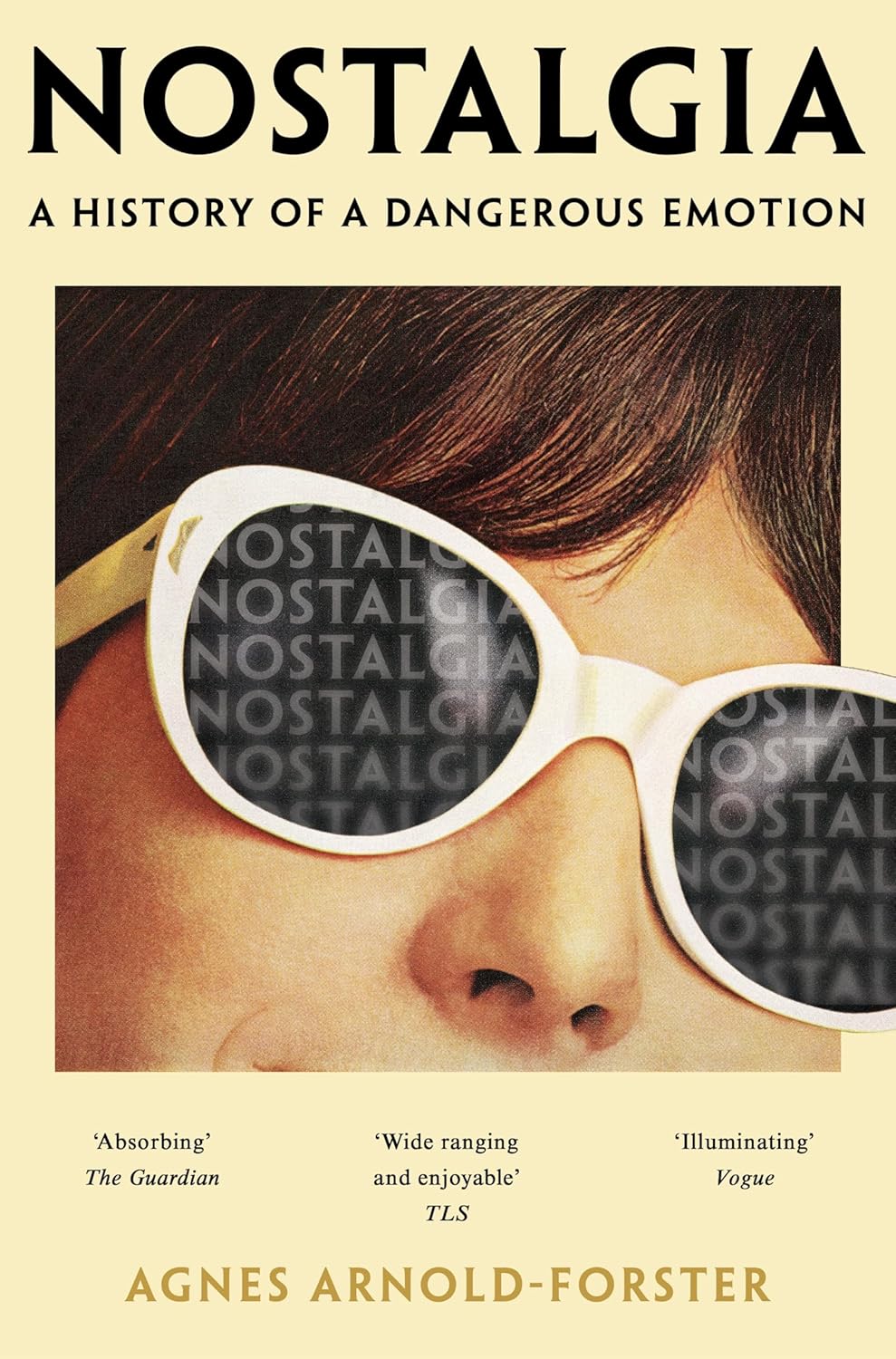
Nostalgia: A History of a Dangerous Emotion

Description:

A dazzling history of a dangerous emotion, by acclaimed historian Agnes Arnold-Forster.

'Absorbing' -
The Guardian
'Illuminating' -
Vogue
'
Fascinating' - Pandora Sykes
'Juicy' -
nb.

In
Nostalgia, historian Agnes Arnold-Forster blends neuroscience and psychology with the history of medicine and emotions to explore the evolution of nostalgia from seventeenth-century Switzerland (when it was held to be an illness that could, quite literally, kill you) to the present day (when it is co-opted by advertising agencies and politicians alike to sell us goods and policies).

It is a fascinating, compelling story of a social and political emotion, vulnerable to misuse, and one that reflects the anxieties of the age. It is also a clear-eyed analysis of what we are doing now, how we feel about it and what we might want to change about the world we live in.

‘Beautifully compact, wide-ranging and enjoyable’ - TLS


Review

This absorbing exploration of nostalgia raises questions about its slippery nature, and shows how it has been chillingly deployed in politics, from the cold war to TrumpismGuardian

Arnold-Forster is a shrewd critic and delightful guide. Her prose is fluent but not flashy . . . She carries weighty learning lightly – embracing everything relevant, from dubious neuroscience to cod sociology.' ― The Telegraph

Beautifully compact, wide-ranging and enjoyableTLS

IlluminatingVogue

With its juicy readability and historical wanderings, Nostalgia evidences the flaws of memory, and how it cherry picks the pleasant elements of the ‘good old days’nb.

From the Back Cover

A dazzling history of that most slippery of emotions: nostalgia, by an acclaimed young historian.

Reviews:

2.0 out of 5 stars A history rewritten to suit the worldview of its author

I.R. · 31 July 2025

This is a book of two halves, well two halves and a coda. The first half is the “history” of nostalgia from the book’s subtitle. Then a second half loosely examines some themes around nostalgia, whether personal, social, economic or political. Finally a chapter where the author expresses her opinions on how we should see nostalgia now.The first half is a straightforward chronological narrative of nostalgia as it slowly transforms, from initial identification to roughly the end of the war. It’s somewhat dry and academic, but effective in showing how perceptions have changed. It introduces the close proximity between homesickness and nostalgia, to the point where really the first half is a history of homesickness rather than nostalgia as it’s come to be understood now. As she says homesickness was more and more viewed in infantilised terms. This book may have been more successful if it tried to unpick homesickness instead of nostalgia.The second half drops the chronological approach, after temptingly continuing it with a chapter about the 70s, after skipping the 50s and 60s without giving a reason. The reason actually becomes pretty clear as the second half progresses, those decades don’t fit the author’s narrative at all. So we only get those decades covered later as a source of nostalgia. A bit of intellectual sleight of hand that doesn’t do the author much credit.The second half is where the quality of the book takes a nosedive. Here we get thematic chapters with little focus, themes ebb and flow incoherently in the narrative. Except the shorter chapter on nostalgia and the brain, which is well put together and very clear in its purpose. This chapter could have been longer to explore it in depth, it’s easily the best part of the second half.Then there’s the coda, the final chapter, which feels like her letting loose opinions that she’s not allowed herself to express until now. Who was stopping her? It’s a bit strange, but typical of books that lean more towards the academic. She appears to think her book has been building to these conclusions but they feel underdeveloped in comparison to many of the thinkers she’s drawn on elsewhere in the book. For a book about nostalgia hers is a suitably reactionary and conservative point of view that contradicts, manipulates, or just ignores the history she’s just told in favour of a rosy tinted view of her topic.Her reasoning against the people she disagrees with is that they are “snobs” and “self-indulgent” which doesn’t leave me feeling nostalgic for those long forgotten arguments from the playground. Because she might as well say they smell too. I like to read a book that I can be persuaded by or disagree with, but the final chapter makes me feel she hasn’t understood nostalgia despite having written a thoroughly researched book about it. She even indulges in a bit of woeful whataboutism toward the end, the traditional fallback of people who know they’re on shaky ground.The first half of the book is interesting, the second half needed an editor, and the final chapter feels like personal catharsis for the author.

4.0 out of 5 stars Interesting & Enlightening

H.P. · 10 June 2024

Nostalgia isn't an emotion I've ever particularly given much thought outside of the times I'm hit with it. So, reading this, I didn't have any particular expectations.This book is a fascinating dive into the history of nostalgia across centuries as it transformed from a disease to a benign emotion. I enjoyed learning the extent to which many aspects of history, culture and life - including imperialism, healthcare, politics and heritage - nostalgia is tied to. The discussion on heritage and historical re-enactors in relation to academic historians was particularly interesting to me - studying history and looking into heritage work.I also really appreciated how well the book was structured - which a sense of both chronology and theme separating the chapters making everything much easier to follow. The writing style was similarly accessible and I felt that it allowed me to better follow discussions that dipped into aspects of science or history that I'm otherwise unfamiliar with.All in all, a really interesting and enlightening read.

4.0 out of 5 stars Nostalgia is an easy way to manipulate us

C. · 25 April 2024

Agnes Arnold-Foster’s book, Nostalgia, has the sub-title “A History of a Dangerous Emotion.” The book takes us from the late seventeenth century up to the present day with Trump and “Make America Great Again.” At first, nostalgia referred to what we would call “acute homesickness”. Students, soldiers and others, uprooted from their home and transposed to another country, region or even town, would yearn for home so much that they would lose interest in food and drink, sometimes leading to their death. Remember, the world was different then: travel was much slower and far fewer people moved far from their birthplace. Being somewhere vastly different from home was profoundly disorienting and many just could not cope. Nostalgia then was about longing for a place, not a past time.The author shows us how, as the general pace of life increased with canals, railways and then motor vehicles, the trauma of travelling lessened and the disease mutated. She does a thorough job of tracking how the medical fraternity (physicians, psychologists, psychoanalysts, etc) changed their views over time too. I was surprised how much doctors’ personal views can colour how they perceive a disease. For example, Freud, Jung and others fled the Nazis and resettled in another country. They were scornful of people who looked back to a better past because, for those doctors, the past in Nazi Germany was not better. They felt that patients should look forward to a much brighter future and not backwards to the past. As that generation of immigrant doctors was succeeded by newer generations, the medical perception of nostalgia changed again.Nostalgia (as we know it today: the affectionate longing for a past time) and homesickness parted company in the early twentieth century but the nostalgia industry really took off after the 1960s, permeating everyone’s world. Do you have any Lilliput Lane models of olde-worlde buildings? Any artist’s Greatest Hits album? Do you prefer the music of your youth (whenever that was) to anything released after that? If so, you’re a victim of nostalgia marketing. The past was NOT all good: does anyone want to bring back typhoid and diphtheria? Workhouses and no unemployment benefit? Blatant, legal, gender inequality? No, me neither – so why do we unconsciously block out those aspects of past times? As Arnold-Foster shows us, nostalgic yearnings tell us much more about present-day anxieties than about a past that possible never existed.I cannot deny that parts of the book dragged for me and I suspect the author has sometimes mistaken correlation for causation, e.g. “Nationalism was a precondition for the rise of nostalgia”, but I learned a lot. Did you know that the last enslaved person forcibly taken from Africa to the US didn’t die until 1940? She was Matilda McCrear. This is a thoughtful analysis of what I thought was just an emotion but turns about to be a huge business - and an easy way for politicians, advertisers and the media to manipulate us. I recommend reading the book to understand how they do this.#Nostalgia #NetGalley

Nostalgia: A History of a Dangerous Emotion

Product ID: K152909139K
Condition: New

3.8

AED7550

Price includes VAT & Import Duties
Type: Paperback
Availability: In Stock

Quantity:

|

Order today to get by 7-14 business days

Delivery fee of AED 20. Free for orders above AED 200.

Returns & Warranty policies

Imported From: United Kingdom

At BOLO, we work hard to ensure the products you receive are new, genuine, and sourced from reputable suppliers.

BOLO is not an authorized or official retailer for most brands, nor are we affiliated with manufacturers unless specifically stated on a product page. Instead, we source verified sellers, authorized distributors or directly from the manufacturer.

Each product undergoes thorough inspection and verification at our consolidation and fulfilment centers to ensure it meets our strict authenticity and quality standards before being shipped and delivered to you.

If you ever have concerns regarding the authenticity of a product purchased from us, please contact Bolo Support. We will review your inquiry promptly and, if necessary, provide documentation verifying authenticity or offer a suitable resolution.

Your trust is our top priority, and we are committed to maintaining transparency and integrity in every transaction.

All product information, images, descriptions, and reviews originate from the manufacturer or from trusted sellers overseas. BOLO is not affiliated with, endorsed by, or an authorized retailer for most brands listed on our website unless stated otherwise.

While we strive to display accurate information, variations in packaging, labeling, instructions, or formulation may occasionally occur due to regional differences or supplier updates. For detailed or manufacturer-specific information, please contact the brand directly or reach out to BOLO Support for assistance.

Unless otherwise stated, all prices displayed on the product page include applicable taxes and import duties.

BOLO operates in accordance with the laws and regulations of United Arab Emirates. Any items found to be restricted or prohibited for sale within the UAE will be cancelled prior to shipment. We take proactive measures to ensure that only products permitted for sale in United Arab Emirates are listed on our website.

All items are shipped by air, and any products classified as “Dangerous Goods (DG)” under IATA regulations will be removed from the order and cancelled.

All orders are processed manually, and we make every effort to process them promptly once confirmed. Products cancelled due to the above reasons will be permanently removed from listings across the website.

Similar suggestions by Bolo

More from this brand

Similar items from “Political Science”

Nostalgia: A History of a Dangerous Emotion

Product ID: K152909139K
Condition: New

3.8

Nostalgia: A History of a Dangerous Emotion-0
Type: Paperback

AED7550

Price includes VAT & Import Duties
Availability: In Stock

Quantity:

|

Order today to get by 7-14 business days

Delivery fee of AED 20. Free for orders above AED 200.

Returns & Warranty policies

Imported From: United Kingdom

At BOLO, we work hard to ensure the products you receive are new, genuine, and sourced from reputable suppliers.

BOLO is not an authorized or official retailer for most brands, nor are we affiliated with manufacturers unless specifically stated on a product page. Instead, we source verified sellers, authorized distributors or directly from the manufacturer.

Each product undergoes thorough inspection and verification at our consolidation and fulfilment centers to ensure it meets our strict authenticity and quality standards before being shipped and delivered to you.

If you ever have concerns regarding the authenticity of a product purchased from us, please contact Bolo Support. We will review your inquiry promptly and, if necessary, provide documentation verifying authenticity or offer a suitable resolution.

Your trust is our top priority, and we are committed to maintaining transparency and integrity in every transaction.

All product information, images, descriptions, and reviews originate from the manufacturer or from trusted sellers overseas. BOLO is not affiliated with, endorsed by, or an authorized retailer for most brands listed on our website unless stated otherwise.

While we strive to display accurate information, variations in packaging, labeling, instructions, or formulation may occasionally occur due to regional differences or supplier updates. For detailed or manufacturer-specific information, please contact the brand directly or reach out to BOLO Support for assistance.

Unless otherwise stated, all prices displayed on the product page include applicable taxes and import duties.

BOLO operates in accordance with the laws and regulations of United Arab Emirates. Any items found to be restricted or prohibited for sale within the UAE will be cancelled prior to shipment. We take proactive measures to ensure that only products permitted for sale in United Arab Emirates are listed on our website.

All items are shipped by air, and any products classified as “Dangerous Goods (DG)” under IATA regulations will be removed from the order and cancelled.

All orders are processed manually, and we make every effort to process them promptly once confirmed. Products cancelled due to the above reasons will be permanently removed from listings across the website.

Description:

A dazzling history of a dangerous emotion, by acclaimed historian Agnes Arnold-Forster.

'Absorbing' -
The Guardian
'Illuminating' -
Vogue
'
Fascinating' - Pandora Sykes
'Juicy' -
nb.

In
Nostalgia, historian Agnes Arnold-Forster blends neuroscience and psychology with the history of medicine and emotions to explore the evolution of nostalgia from seventeenth-century Switzerland (when it was held to be an illness that could, quite literally, kill you) to the present day (when it is co-opted by advertising agencies and politicians alike to sell us goods and policies).

It is a fascinating, compelling story of a social and political emotion, vulnerable to misuse, and one that reflects the anxieties of the age. It is also a clear-eyed analysis of what we are doing now, how we feel about it and what we might want to change about the world we live in.

‘Beautifully compact, wide-ranging and enjoyable’ - TLS


Review

This absorbing exploration of nostalgia raises questions about its slippery nature, and shows how it has been chillingly deployed in politics, from the cold war to TrumpismGuardian

Arnold-Forster is a shrewd critic and delightful guide. Her prose is fluent but not flashy . . . She carries weighty learning lightly – embracing everything relevant, from dubious neuroscience to cod sociology.' ― The Telegraph

Beautifully compact, wide-ranging and enjoyableTLS

IlluminatingVogue

With its juicy readability and historical wanderings, Nostalgia evidences the flaws of memory, and how it cherry picks the pleasant elements of the ‘good old days’nb.

From the Back Cover

A dazzling history of that most slippery of emotions: nostalgia, by an acclaimed young historian.

Reviews:

2.0 out of 5 stars A history rewritten to suit the worldview of its author

I.R. · 31 July 2025

This is a book of two halves, well two halves and a coda. The first half is the “history” of nostalgia from the book’s subtitle. Then a second half loosely examines some themes around nostalgia, whether personal, social, economic or political. Finally a chapter where the author expresses her opinions on how we should see nostalgia now.The first half is a straightforward chronological narrative of nostalgia as it slowly transforms, from initial identification to roughly the end of the war. It’s somewhat dry and academic, but effective in showing how perceptions have changed. It introduces the close proximity between homesickness and nostalgia, to the point where really the first half is a history of homesickness rather than nostalgia as it’s come to be understood now. As she says homesickness was more and more viewed in infantilised terms. This book may have been more successful if it tried to unpick homesickness instead of nostalgia.The second half drops the chronological approach, after temptingly continuing it with a chapter about the 70s, after skipping the 50s and 60s without giving a reason. The reason actually becomes pretty clear as the second half progresses, those decades don’t fit the author’s narrative at all. So we only get those decades covered later as a source of nostalgia. A bit of intellectual sleight of hand that doesn’t do the author much credit.The second half is where the quality of the book takes a nosedive. Here we get thematic chapters with little focus, themes ebb and flow incoherently in the narrative. Except the shorter chapter on nostalgia and the brain, which is well put together and very clear in its purpose. This chapter could have been longer to explore it in depth, it’s easily the best part of the second half.Then there’s the coda, the final chapter, which feels like her letting loose opinions that she’s not allowed herself to express until now. Who was stopping her? It’s a bit strange, but typical of books that lean more towards the academic. She appears to think her book has been building to these conclusions but they feel underdeveloped in comparison to many of the thinkers she’s drawn on elsewhere in the book. For a book about nostalgia hers is a suitably reactionary and conservative point of view that contradicts, manipulates, or just ignores the history she’s just told in favour of a rosy tinted view of her topic.Her reasoning against the people she disagrees with is that they are “snobs” and “self-indulgent” which doesn’t leave me feeling nostalgic for those long forgotten arguments from the playground. Because she might as well say they smell too. I like to read a book that I can be persuaded by or disagree with, but the final chapter makes me feel she hasn’t understood nostalgia despite having written a thoroughly researched book about it. She even indulges in a bit of woeful whataboutism toward the end, the traditional fallback of people who know they’re on shaky ground.The first half of the book is interesting, the second half needed an editor, and the final chapter feels like personal catharsis for the author.

4.0 out of 5 stars Interesting & Enlightening

H.P. · 10 June 2024

Nostalgia isn't an emotion I've ever particularly given much thought outside of the times I'm hit with it. So, reading this, I didn't have any particular expectations.This book is a fascinating dive into the history of nostalgia across centuries as it transformed from a disease to a benign emotion. I enjoyed learning the extent to which many aspects of history, culture and life - including imperialism, healthcare, politics and heritage - nostalgia is tied to. The discussion on heritage and historical re-enactors in relation to academic historians was particularly interesting to me - studying history and looking into heritage work.I also really appreciated how well the book was structured - which a sense of both chronology and theme separating the chapters making everything much easier to follow. The writing style was similarly accessible and I felt that it allowed me to better follow discussions that dipped into aspects of science or history that I'm otherwise unfamiliar with.All in all, a really interesting and enlightening read.

4.0 out of 5 stars Nostalgia is an easy way to manipulate us

C. · 25 April 2024

Agnes Arnold-Foster’s book, Nostalgia, has the sub-title “A History of a Dangerous Emotion.” The book takes us from the late seventeenth century up to the present day with Trump and “Make America Great Again.” At first, nostalgia referred to what we would call “acute homesickness”. Students, soldiers and others, uprooted from their home and transposed to another country, region or even town, would yearn for home so much that they would lose interest in food and drink, sometimes leading to their death. Remember, the world was different then: travel was much slower and far fewer people moved far from their birthplace. Being somewhere vastly different from home was profoundly disorienting and many just could not cope. Nostalgia then was about longing for a place, not a past time.The author shows us how, as the general pace of life increased with canals, railways and then motor vehicles, the trauma of travelling lessened and the disease mutated. She does a thorough job of tracking how the medical fraternity (physicians, psychologists, psychoanalysts, etc) changed their views over time too. I was surprised how much doctors’ personal views can colour how they perceive a disease. For example, Freud, Jung and others fled the Nazis and resettled in another country. They were scornful of people who looked back to a better past because, for those doctors, the past in Nazi Germany was not better. They felt that patients should look forward to a much brighter future and not backwards to the past. As that generation of immigrant doctors was succeeded by newer generations, the medical perception of nostalgia changed again.Nostalgia (as we know it today: the affectionate longing for a past time) and homesickness parted company in the early twentieth century but the nostalgia industry really took off after the 1960s, permeating everyone’s world. Do you have any Lilliput Lane models of olde-worlde buildings? Any artist’s Greatest Hits album? Do you prefer the music of your youth (whenever that was) to anything released after that? If so, you’re a victim of nostalgia marketing. The past was NOT all good: does anyone want to bring back typhoid and diphtheria? Workhouses and no unemployment benefit? Blatant, legal, gender inequality? No, me neither – so why do we unconsciously block out those aspects of past times? As Arnold-Foster shows us, nostalgic yearnings tell us much more about present-day anxieties than about a past that possible never existed.I cannot deny that parts of the book dragged for me and I suspect the author has sometimes mistaken correlation for causation, e.g. “Nationalism was a precondition for the rise of nostalgia”, but I learned a lot. Did you know that the last enslaved person forcibly taken from Africa to the US didn’t die until 1940? She was Matilda McCrear. This is a thoughtful analysis of what I thought was just an emotion but turns about to be a huge business - and an easy way for politicians, advertisers and the media to manipulate us. I recommend reading the book to understand how they do this.#Nostalgia #NetGalley

Similar suggestions by Bolo

More from this brand

Similar items from “Political Science”