Description:
How human institutions—markets, states, communities, religions, guilds and families—have helped both to control and to exacerbate epidemics throughout history
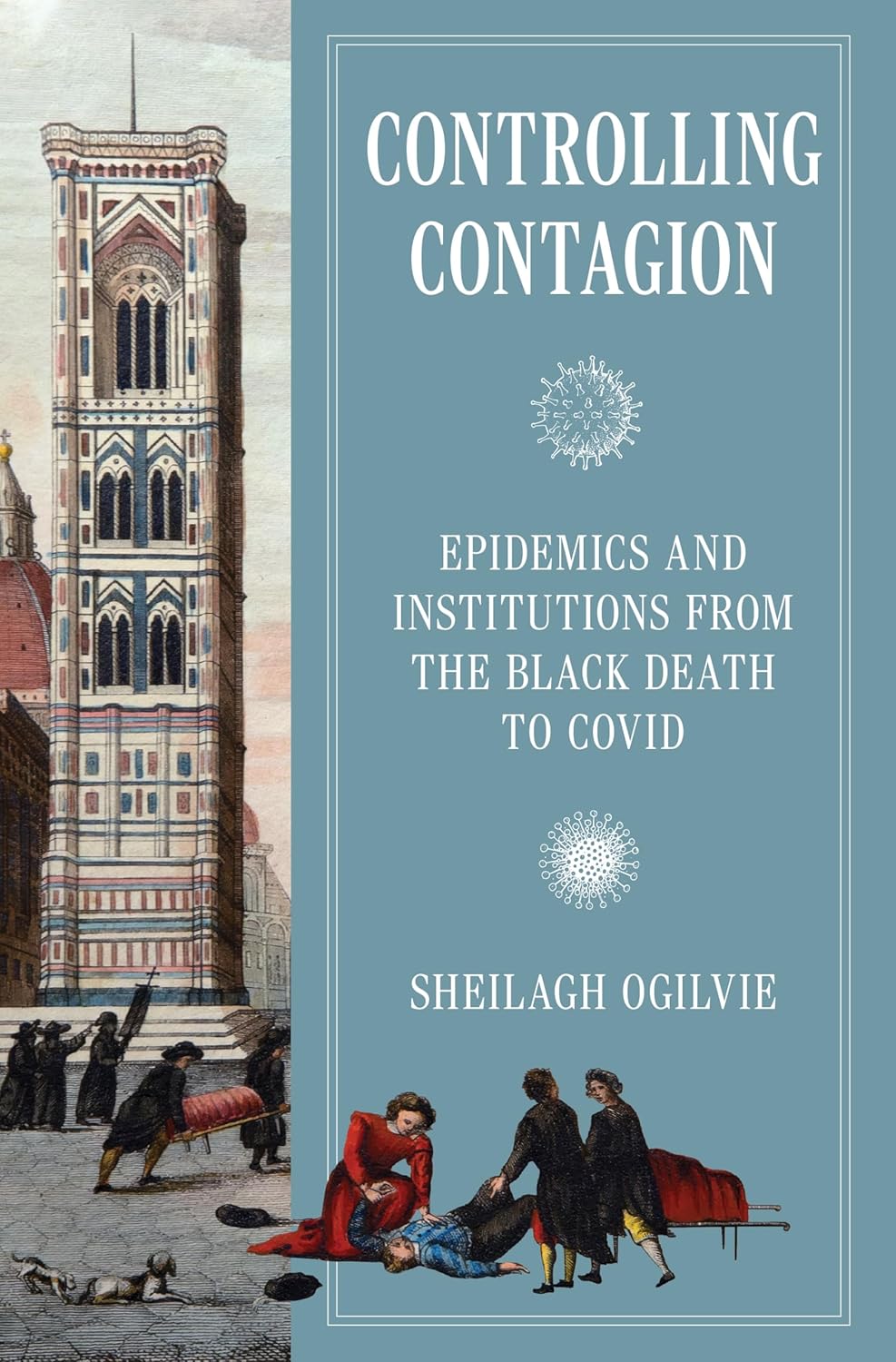
How do societies tackle epidemic disease? In Controlling Contagion, Sheilagh Ogilvie answers this question by exploring seven centuries of pandemics, from the Black Death to Covid-19. For most of history, infectious diseases have killed many more people than famine or war, and in 2019 they still caused one death in four. Today, we deal with epidemics more successfully than our ancestors managed plague, smallpox, cholera or influenza. But we use many of the same approaches. Long before scientific medicine, human societies coordinated and innovated in response to biological shocks—sometimes well, sometimes badly.
Ogilvie uses historical epidemics to analyse how human societies deal with “externalities”—situations where my action creates costs or benefits for others beyond those that I myself incur. Social institutions—markets, states, communities, religions, guilds, and families—help us manage the negative externalities of contagion and the positive externalities of social distancing, sanitation, and immunization. Ogilvie shows how each institution enables us to coordinate, innovate and inspire each other to limit contagion. But each institution also has weaknesses that can make things worse. Markets shut down voluntarily during every epidemic in history—but they also brought people together, spreading contagion. States mandated quarantines, sanitation, and immunization—but they also waged war and censored information, exacerbating epidemics. Religions admonished us to avoid infecting our neighbours—but they also preached against science and medical innovations. What decided the outcome, Ogilvie argues, was a temperate state, an adaptable market, and a strong civil society where a diversity of institutions played to their own strengths and checked each other’s flaws.
Review
"Ogilvie’s book ranges from the 14th century—the era of the Black Death—to the 21st. . . . [Her] wide-ranging survey throws up some telling points. . . . [And] exposes some cherished fallacies."---Virginia Berridge, BBC History Magazine
"An important book that opens analysis of epidemics across time and space within a new framework of institutional history."---Samuel Cohn, Political Quarterly
"An ambitious study. . . . It is impossible to offer more than a glimpse of Ogilvie’s compass and erudition."---Nicholas Brown, Australian Book Review
"This is the first scholarly work to connect [epidemics] to institutions, markets and how states perform over many centuries. . . . Ogilvie unpacks what history and cross-country comparisons tell us about the ability of societies to respond to epidemics. . . . If there is one lesson from this most impressive book, it is that preparation for and effective responses to epidemics are of critical importance."---R. Quentin Grafton, Economic Record
"This is the book I would have liked to read in March 2020. . . . Ogilvie’s essay is rich and brimming with ideas. . . . For its breadth, documentation, and depth, Sheilagh Ogilvie’s Controlling Contagion is a work you cannot open without learning something. The author deserves her readers’ full gratitude."---Alberto Mingardi, Curious Task
"An impressive study."---David Lorimer, Paradigm Explorer
"Sheilagh Ogilvie haswritten another big and important book. It explores a new theme for her: how do societies respond to and tackle epidemics. . . .Controlling Contagion is a heroic work of ingestion that has no obvious equivalent in the literature."---Patrick Wallis, Economic History Review
"Sheilagh Ogilvie has written a definitive book on how people use institutions to respond to infectious diseases. . . . Her argument, theoretical framework, even-handed writing, myriad examples, and organization all make for an incredible resource. Scholars, laymen, and policy makers alike who are interested in public health and epidemics and in the economics and institutions of epidemiology should read Controlling Contagion."---Byron B. Carson III, The Review of Austrian Economics
"A large-scale, timely assessment of human society’s responses to epidemics."---George Dehner, American Historical Review
"This book is groundbreaking in the sociological aspects of epidemics. . . . Essential." ― Choice
"Controlling Contagion provides a nuanced and detailed history of the role six institutions played in the dispersion of contagious disease and will be of interest to scholars studying the economic history of both institutions and epidemics."---Martin Saavedra, The Journal of Economic History
"Accessible and timely. . . . Controlling Contagion is an ambitious work, advancing knowledge by assembling a vast body of evidence"---Vellore Arthi, Journal of Economic Literature
Review
“Scholars will come to consider this book an essential reference, due to the specific angle from which it looks at epidemics and pandemics—there simply isn’t anything similar on the market. The author makes full use of her own expertise, which is truly impressive in many areas, including the general history of preindustrial Europe and the history of institutions.”—Guido Alfani, Bocconi University
“This superb book investigates some of the greatest crises that human societies have faced, in the form of major epidemics from the Black Death to Covid-19. What emerges vividly is the dismaying mixture of selfishness and ignorance repeatedly displayed by the elites, notably by rulers at every level, clerics, and doctors. This is history that could hardly be more relevant, a powerful cautionary tale explored with great analytical skill.”—Robin Briggs, University of Oxford
“Combining wide-ranging in-depth analysis with rigour and lucidity, this book transforms our understanding of how epidemics have been dealt with in history. Everyone interested in how societies deal with disease and in their resilience, in the past and in the present, will have to read this book.”—Chris Wickham, author of The Inheritance of Rome: A History of Europe from 400 to 1000
“In this impressive work, Ogilvie draws on a wealth of historical evidence and judicious reasoning to explore the ways institutions have interacted and continued to interact with pandemics. Some cherished institutions tend to make disease transmission easier, while others could control the spread of disease long before modern science attacked the microorganisms that caused pandemics. Controlling Contagion succeeds admirably as a compact history of pandemics as well as a thoughtful discussion of the implications of the way we respond to these events.”—Timothy Guinnane, Yale University
“Sheilagh Ogilvie deploys concepts derived from economic theory to enrich our understanding of historical epidemiology. Her analysis will be of great value to the specialist and general reader alike.”—John Landers, author of The Field and the Forge:Population, Production, and Power in the Pre-Industrial West
“This remarkable and wide-ranging book is essential reading for anybody interested in the history of epidemic disease from plague to COVID.”—John Henderson, author of Florence under Siege: Surviving Plague in an Early Modern City
“A stunning book in scope and method. To examine how human societies have dealt with epidemics over seven centuries, Ogilvie blends a rigorous social scientific approach with unusual sensitivity to local specificities and power structures. Her nondeterministic institutional analysis has broad implications for how we think about both the past and the present.”—Francesca Trivellato, Institute for Advanced Study, Princeton University
"With this exciting new study of epidemic disease, Sheilagh Ogilvie makes another persuasive case for institutions as significant determinants of economic, social and demographic outcomes. This wide-ranging research offers new perspectives on the past and valuable lessons for future epidemiological challenges."—Tracy Dennison, California Institute of Technology
About the Author
Details:
Visit the Princeton University Press Store
Controlling Contagion: Epidemics and Institutions from the Black Death to Covid: 125 (The Princeton Economic History of the Western World)
AED30309
Quantity:
Order today to get by 7-14 business days
This item qualifies for free delivery
 Imported From: United Kingdom
At BOLO, we work hard to ensure the products you receive are new, genuine, and sourced from reputable suppliers.
Every product in the BOLO catalogue is sourced through our Verified Global Supply Network of verified sellers, authorized distributors or directly from the manufacturer.
Each product undergoes thorough inspection and verification at our consolidation and fulfilment centers to ensure it meets our strict authenticity and quality standards before being shipped and delivered to you.
If you ever have concerns regarding the authenticity of a product purchased from us, please contact Bolo Support. We will review your inquiry promptly and, if necessary, provide documentation verifying authenticity or offer a suitable resolution.
Your trust is our top priority, and we are committed to maintaining transparency and integrity in every transaction.
While we strive to display accurate information, variations in packaging, labeling, instructions, or formulation may occasionally occur due to regional differences or supplier updates. For detailed or manufacturer-specific information, please contact the brand directly or reach out to BOLO Support for assistance.
Unless otherwise stated, all prices displayed on the product page include applicable taxes and import duties.
BOLO operates in accordance with the laws and regulations of United Arab Emirates. Any items found to be restricted or prohibited for sale within the United Arab Emirates will be cancelled prior to shipment. We take proactive measures to ensure that only products permitted for sale in United Arab Emirates are listed on our website.
All items are shipped by air, and any products classified as “Dangerous Goods (DG)” under IATA regulations will be removed from the order and cancelled.
All orders are processed manually, and we make every effort to process them promptly once confirmed. Products cancelled due to the above reasons will be permanently removed from listings across the website.
More from this brand
Similar items from “Development”
Share with
Or share with link
https://www.bolo.ae/products/K0691255563
Visit the Princeton University Press Store
Controlling Contagion: Epidemics and Institutions from the Black Death to Covid: 125 (The Princeton Economic History of the Western World)
AED30309
Quantity:
Order today to get by 7-14 business days
This item qualifies for free delivery
Imported From: United Kingdom
At BOLO, we work hard to ensure the products you receive are new, genuine, and sourced from reputable suppliers.
Every product in the BOLO catalogue is sourced through our Verified Global Supply Network of verified sellers, authorized distributors or directly from the manufacturer.
Each product undergoes thorough inspection and verification at our consolidation and fulfilment centers to ensure it meets our strict authenticity and quality standards before being shipped and delivered to you.
If you ever have concerns regarding the authenticity of a product purchased from us, please contact Bolo Support. We will review your inquiry promptly and, if necessary, provide documentation verifying authenticity or offer a suitable resolution.
Your trust is our top priority, and we are committed to maintaining transparency and integrity in every transaction.
While we strive to display accurate information, variations in packaging, labeling, instructions, or formulation may occasionally occur due to regional differences or supplier updates. For detailed or manufacturer-specific information, please contact the brand directly or reach out to BOLO Support for assistance.
Unless otherwise stated, all prices displayed on the product page include applicable taxes and import duties.
BOLO operates in accordance with the laws and regulations of United Arab Emirates. Any items found to be restricted or prohibited for sale within the United Arab Emirates will be cancelled prior to shipment. We take proactive measures to ensure that only products permitted for sale in United Arab Emirates are listed on our website.
All items are shipped by air, and any products classified as “Dangerous Goods (DG)” under IATA regulations will be removed from the order and cancelled.
All orders are processed manually, and we make every effort to process them promptly once confirmed. Products cancelled due to the above reasons will be permanently removed from listings across the website.
Description:
How human institutions—markets, states, communities, religions, guilds and families—have helped both to control and to exacerbate epidemics throughout history
How do societies tackle epidemic disease? In Controlling Contagion, Sheilagh Ogilvie answers this question by exploring seven centuries of pandemics, from the Black Death to Covid-19. For most of history, infectious diseases have killed many more people than famine or war, and in 2019 they still caused one death in four. Today, we deal with epidemics more successfully than our ancestors managed plague, smallpox, cholera or influenza. But we use many of the same approaches. Long before scientific medicine, human societies coordinated and innovated in response to biological shocks—sometimes well, sometimes badly.
Ogilvie uses historical epidemics to analyse how human societies deal with “externalities”—situations where my action creates costs or benefits for others beyond those that I myself incur. Social institutions—markets, states, communities, religions, guilds, and families—help us manage the negative externalities of contagion and the positive externalities of social distancing, sanitation, and immunization. Ogilvie shows how each institution enables us to coordinate, innovate and inspire each other to limit contagion. But each institution also has weaknesses that can make things worse. Markets shut down voluntarily during every epidemic in history—but they also brought people together, spreading contagion. States mandated quarantines, sanitation, and immunization—but they also waged war and censored information, exacerbating epidemics. Religions admonished us to avoid infecting our neighbours—but they also preached against science and medical innovations. What decided the outcome, Ogilvie argues, was a temperate state, an adaptable market, and a strong civil society where a diversity of institutions played to their own strengths and checked each other’s flaws.
Review
"Ogilvie’s book ranges from the 14th century—the era of the Black Death—to the 21st. . . . [Her] wide-ranging survey throws up some telling points. . . . [And] exposes some cherished fallacies."---Virginia Berridge, BBC History Magazine
"An important book that opens analysis of epidemics across time and space within a new framework of institutional history."---Samuel Cohn, Political Quarterly
"An ambitious study. . . . It is impossible to offer more than a glimpse of Ogilvie’s compass and erudition."---Nicholas Brown, Australian Book Review
"This is the first scholarly work to connect [epidemics] to institutions, markets and how states perform over many centuries. . . . Ogilvie unpacks what history and cross-country comparisons tell us about the ability of societies to respond to epidemics. . . . If there is one lesson from this most impressive book, it is that preparation for and effective responses to epidemics are of critical importance."---R. Quentin Grafton, Economic Record
"This is the book I would have liked to read in March 2020. . . . Ogilvie’s essay is rich and brimming with ideas. . . . For its breadth, documentation, and depth, Sheilagh Ogilvie’s Controlling Contagion is a work you cannot open without learning something. The author deserves her readers’ full gratitude."---Alberto Mingardi, Curious Task
"An impressive study."---David Lorimer, Paradigm Explorer
"Sheilagh Ogilvie haswritten another big and important book. It explores a new theme for her: how do societies respond to and tackle epidemics. . . .Controlling Contagion is a heroic work of ingestion that has no obvious equivalent in the literature."---Patrick Wallis, Economic History Review
"Sheilagh Ogilvie has written a definitive book on how people use institutions to respond to infectious diseases. . . . Her argument, theoretical framework, even-handed writing, myriad examples, and organization all make for an incredible resource. Scholars, laymen, and policy makers alike who are interested in public health and epidemics and in the economics and institutions of epidemiology should read Controlling Contagion."---Byron B. Carson III, The Review of Austrian Economics
"A large-scale, timely assessment of human society’s responses to epidemics."---George Dehner, American Historical Review
"This book is groundbreaking in the sociological aspects of epidemics. . . . Essential." ― Choice
"Controlling Contagion provides a nuanced and detailed history of the role six institutions played in the dispersion of contagious disease and will be of interest to scholars studying the economic history of both institutions and epidemics."---Martin Saavedra, The Journal of Economic History
"Accessible and timely. . . . Controlling Contagion is an ambitious work, advancing knowledge by assembling a vast body of evidence"---Vellore Arthi, Journal of Economic Literature
Review
“Scholars will come to consider this book an essential reference, due to the specific angle from which it looks at epidemics and pandemics—there simply isn’t anything similar on the market. The author makes full use of her own expertise, which is truly impressive in many areas, including the general history of preindustrial Europe and the history of institutions.”—Guido Alfani, Bocconi University
“This superb book investigates some of the greatest crises that human societies have faced, in the form of major epidemics from the Black Death to Covid-19. What emerges vividly is the dismaying mixture of selfishness and ignorance repeatedly displayed by the elites, notably by rulers at every level, clerics, and doctors. This is history that could hardly be more relevant, a powerful cautionary tale explored with great analytical skill.”—Robin Briggs, University of Oxford
“Combining wide-ranging in-depth analysis with rigour and lucidity, this book transforms our understanding of how epidemics have been dealt with in history. Everyone interested in how societies deal with disease and in their resilience, in the past and in the present, will have to read this book.”—Chris Wickham, author of The Inheritance of Rome: A History of Europe from 400 to 1000
“In this impressive work, Ogilvie draws on a wealth of historical evidence and judicious reasoning to explore the ways institutions have interacted and continued to interact with pandemics. Some cherished institutions tend to make disease transmission easier, while others could control the spread of disease long before modern science attacked the microorganisms that caused pandemics. Controlling Contagion succeeds admirably as a compact history of pandemics as well as a thoughtful discussion of the implications of the way we respond to these events.”—Timothy Guinnane, Yale University
“Sheilagh Ogilvie deploys concepts derived from economic theory to enrich our understanding of historical epidemiology. Her analysis will be of great value to the specialist and general reader alike.”—John Landers, author of The Field and the Forge:Population, Production, and Power in the Pre-Industrial West
“This remarkable and wide-ranging book is essential reading for anybody interested in the history of epidemic disease from plague to COVID.”—John Henderson, author of Florence under Siege: Surviving Plague in an Early Modern City
“A stunning book in scope and method. To examine how human societies have dealt with epidemics over seven centuries, Ogilvie blends a rigorous social scientific approach with unusual sensitivity to local specificities and power structures. Her nondeterministic institutional analysis has broad implications for how we think about both the past and the present.”—Francesca Trivellato, Institute for Advanced Study, Princeton University
"With this exciting new study of epidemic disease, Sheilagh Ogilvie makes another persuasive case for institutions as significant determinants of economic, social and demographic outcomes. This wide-ranging research offers new perspectives on the past and valuable lessons for future epidemiological challenges."—Tracy Dennison, California Institute of Technology
About the Author
Details:
More from this brand
Similar items from “Development”
Share with
Or share with link
https://www.bolo.ae/products/K0691255563