Description:
Review
From the Back Cover
Praise for the first edition: "[Clear and Simple as the Truth] has changed the way that I write and think about writing."--Paul Bloom, Yale University
Praise for the first edition: "Far and away the best how-to-write book I've ever read. It puts Strunk and White and everyone else in the shade."--John E. Talbott, University of California, Santa Barbara
Praise for the first edition: "Thanks to Thomas and Turner, the cognitive revolution has finally caught up with the analysis of style--brilliantly, learnedly, and, above all, readably."--David Lee Rubin, University of Virginia
Praise for the first edition: "Clear and Simple as the Truth holds the promise of raising the level of the nation's prose.... The book is full of cogency and insight."--Frederick Crews
Praise for the first edition: "A work of great intellectual elegance and power. I have read it with a lot of pleasure, admiring the wisdom and economy of its reflections and the extraordinary range of its citations."--Claude Rawson, Yale University
Praise for the first edition: "A treatment of the classic style that manifests the virtues of the writing it propounds, expounds, and exemplifies in a wealth of fascinating passages, brilliantly analyzed."--M. H. Abrams, Cornell University
Praise for the first edition: "Could well be the most important discussion of style since the great classical rhetoricians."--Wayne C. Booth, University of Chicago
Praise for the first edition: "One of the best discussions of style that I have recently read."--Richard Preston, author of The Hot Zone
Praise for the first edition: "The authors give one of the best discussions of style that I have ever read. Thomas and Turner juxtapose conventionally thought of as disparate, and thereby suggest possible new avenues of interpretation for critics of individual authors. Clear and Simple as the Truth occupies a niche of its own, as a kind of hybrid between books on writing such as The Elements of Style and The Reader over Your Shoulder, and more theoretical studies of representation, such as Mimesis."--Richard Preston, author of American Steel
About the Author
Excerpt. © Reprinted by permission. All rights reserved.
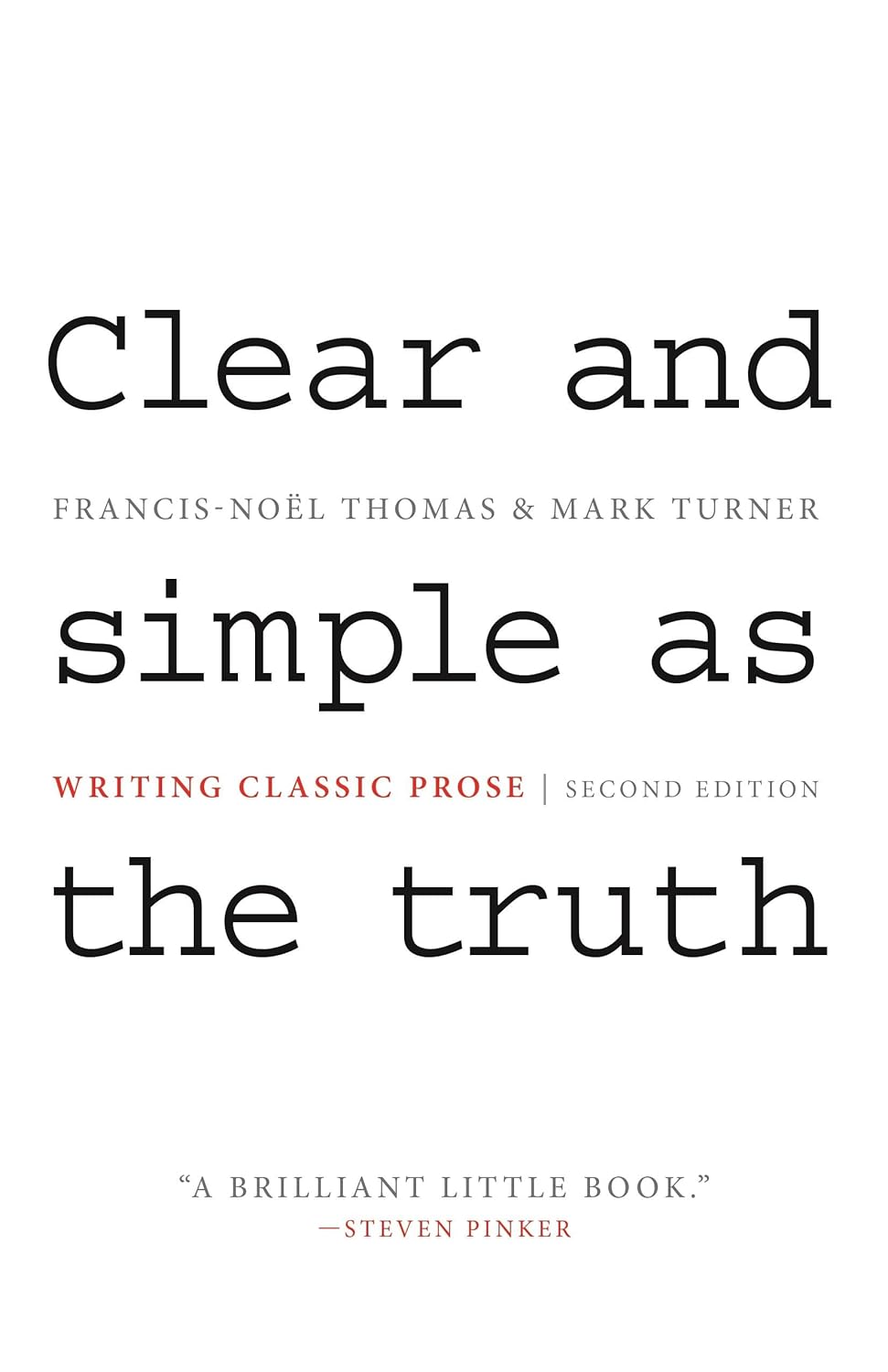
Clear and Simple as the Truth
Writing Classic ProseBy Francis-Noël Thomas Mark TurnerPRINCETON UNIVERSITY PRESS
Copyright © 2011 Princeton University PressAll right reserved.
ISBN: 978-0-691-14743-7
Contents
Acknowledgments.............................................viiClear and Simple as the Truth...............................1ONE Principles of Classic Style............................5TWO The Museum.............................................107THREE The Studio...........................................187FOUR Further Readings in Classic Prose.....................229Notes.......................................................239Index.......................................................253Chapter One
Principles of Classic Style* The Concept of Style
"Style" is a word everybody uses, but almost no one can explain what it means. It is often understood as the inessential or even disreputable member of a two-term set: style and substance. This set of terms is elastic but in all its many applications, style is the subordinate term and, in the traditional American idiom, there is a persistent suggestion that we would be better off without it. Style is, at best, a harmless if unnecessary bit of window dressing. At worst, it is a polite name for fraud. There used to be a cigar company whose motto was "All Quality. No Style."
When style is considered the opposite of substance, it seems optional and incidental, even when it is admired. In this way of framing things, substantive thought and meaning can be prior to style and completely separable from it. The identical thought or the identical meaning, it is suggested, can be expressed in many styles—or even in none at all, as when just plain integrity or the unvarnished truth is offered as an alternative to the adornments of style. Style, conceived this way, is something fancy that distracts us from what is essential; it is the varnish that makes the truth at least a little harder to see.
The notion that style is something completely separate from substance, so that substance can be offered "straight," lies behind both the motto of the cigar company and William Butler yeats's description of Bernard Shaw's writing, but in the second case the poet puts a high value on style and views writing in no style, while possible, to be something monstrously mechanical. Yeats apparently thought of his own characteristic poetic voice as "style." it was a voice so compelling that attempts to imitate it have ruined quite a number of aspiring poets. Shaw's voice was not poetic in yeats's sense, so yeats considered Shaw to be a writer "without style." Because he held the view that style is optional, yeats could simultaneously view Shaw as "the most formidable man in modern letters," able to write "with great effect," and yet view Shaw's writing as "without music, without style, either good or bad." He described Shaw as a nightmare sewing machine that clicked, shone, and smiled, "smiled perpetually."
Whether style is viewed as spiritual, fraudulent, or something in between, any concept of style that treats it as optional is inadequate not only to writing but to any human action. Nothing we do can be done "simply" and in no style, because style is something inherent in action, not something added to it. In this respect, style is like the typeface in which a text is printed. We may overlook it, and frequently do, but it is always there. The styles we acquire unconsciously remain invisible to us as a rule, and routine actions can seem to be done in no style at all, even though their styles are obvious to experienced observers. A printer, a proofreader, or a type designer cannot fail to notice the type in which a text is printed, but for most of us, that typeface will have to be laid down beside a contrasting face before we even notice it exists. We thought we were looking at words pure and simple and did not notice that they are printed in a specific typeface.
When we do something in a default style acquired unconsciously, we do not notice the style of our activity. In such cases, we have an abstract concept of action that leaves style out of account. We can have a concept of lying without being aware—as a good investigative reporter is—that, in practice, we must have a style of lying. We can have a concept of quarreling without being aware— as a good marriage counselor is—that, in practice, we must have a style of quarreling.
Despite a lifetime of speaking, we can remain unaware of having a style of speaking. Yankees in Maine or Good Ol' Boys in Louisiana think that people from Brooklyn talk funny. WASPS in the Chicago suburbs think that Poles or Lithuanians in Chicago speak English with an accent, as if the suburban WASPS, the Yankees, and the Good Ol' Boys speak just plain American English with no accent. coastal Californians think—just as the ancient Greeks did—that everybody else sounds barbarous. A moment's reflection will convince anyone that it is impossible to speak without an accent. But people who feel they set the local tone do not consider their own accents to be accents. It is hard to think of a child who is just learning to speak wanting to learn a style of speaking. The style is folded into the activity as it is learned: we think that we have learned to speak a language, not that we have learned a regional dialect. Children in Maine do not think they are learning to speak English with a Yankee accent; they think they are learning to speak English.
Although there are certainly a lot of English accents to be heard, even if we restrict the field to America, only a few people consciously choose theirs. Professional broadcasters, of course, do; sometimes people interested in acting careers do. Many politicians with degrees from prestigious universities have learned to speak with one accent in the capitals where they make laws and policy and quite a different one back home where they campaign for office. Senator Fulbright was a Rhodes scholar with an Oxford education. Before he went to the Senate, he had been the dean of a law school and the president of a university. His background was perfectly congruent with what he sounded like in action as chairman of the Senate Foreign relations committee conducting hearings on the Vietnam War, but when he campaigned in rural Arkansas, where he got his votes, there was no hint of oxford, or even Fayetteville. on the stump, he sounded completely down home. After the election, that sound dissipated with every mile he got closer to Washington until he was sworn in for a new term and reassumed both the seat of power and the music of policy.
Senator Fulbright could maintain two dramatically distinct styles of speech in his personal repertory because he was aware of both as styles and consequently did not mistake either of them for just plain English. His awareness of his own styles allowed him to switch back and forth between them and fit them to circumstances. Everyone does this to some extent, but not everyone is aware of doing so. Speakers who are not consciously aware of their styles run into problems when none of their habitual styles fits a particular circumstance very well. We are trapped by our unconscious styles if we cannot recognize them as styles. When all of our styles are effectively default styles, we choose without knowing we are choosing and so cannot recognize the practical possibility of alternative styles.
People who unconsciously have acquired a full complement of routine conversational styles can deliberately and consciously add a new style of conversation to their collection, a style invented for new purposes and situations, once they have an operating concept of style. A novice receptionist at the headquarters of a large corporation consciously acquires the standard impersonal business style of conversation. The receptionist already possesses an underlying competence in conversation; he consciously acquires a new style meant for a special and unusually well-defined purpose.
Because writing is an activity, it too must be done in a style. But the domain of writing, like the domain of conversation, is enormous, not limited by just a handful of occasions or purposes. consequently, there are many styles of writing. Common wisdom to the contrary, no one can master writing because writing is too large to be encompassed. It is not one skill; it is not even a small bundle of routine skills. A single style of writing invented for particular purposes, however, can be like a receptionist's conversation, something small enough to be walked around. It is possible to see where it begins and where it ends, what its purposes and occasions are, and how it selects its themes. These styles of writing can be acquired consciously as styles. Classic style is one of them.
Although nearly anybody who can read a newspaper can write, the styles we acquired unconsciously do not always serve our needs. Most of us have no unconscious writing style available to use when, after becoming engaged in a problem, we have thought it through, reached confident conclusions, and want to make our thought accessible to a permanent but unspecified audience. Even the best-educated members of our society commonly lack a routine style for presenting the result of their own engagement with a problem to people outside their own profession. Writers with a need to address such readers invented classic style. It is not a routine style in our culture, and unlike most of the writing styles we acquire, it is unlikely to be picked up without deliberate effort.
Classic style was not invented by one person or even by a small group working together. It was not invented just once, nor is it specific to one culture or one language. It was used with notable skill and effect by some of the outstanding French writers of the seventeenth century, and their achievements have left an echo in French culture that has no direct English or American equivalent. The seventeenth-century French masters of classic style, for one reason or another, conceived of themselves as addressing an intelligent but nonspecialist reader. They were all writers who had no doubt about the general importance of what they had to say. They shared the idea that truth about something is, in some sense, truth about everything, and they adopted the view that it is always possible to present a really significant conclusion to a general audience.
Classic style is focused and assured. Its virtues are clarity and simplicity; in a sense, so are its vices. It declines to acknowledge ambiguities, unessential qualifications, doubts, or other styles. It declines to acknowledge that it is a style. It makes its hard choices silently and out of the reader's sight. Once made, those hard choices are not acknowledged to be choices at all; they are presented as if they were inevitable because classic style is, above all, a style of presentation with claims to transparency.
To write without a chosen and consistent style is to write without a tacit concept of what writing can do, what its limits are, who its audience is, and what the writer's goals are. In the absence of settled decisions about these things, writing can be torture. While there is no single correct view of these matters, every well-defined style must take a stand on them. Classic style is neither shy nor ambiguous about fundamentals. The style rests on the assumptions that it is possible to think disinterestedly, to know the results of disinterested thought, and to present them without fundamental distortion. In this view, thought precedes writing. All of these assumptions may be wrong, but they help to define a style whose usefulness is manifest.
The attitudes that define classic style—the attitudes that define any style—are a set of enabling conventions. Some of the originators of classic style may have believed its enabling conventions— such as that truth can be known—but writing in this style requires no commitment to a set of beliefs, only a willingness to adopt a role for a limited time and a specific purpose.
The role is severely limited because classic prose is pure, fearless, cool, and relentless. It asks no quarter and gives no quarter to anyone, including the writer. While the role can be necessary, true, and useful, as well as wonderfully thrilling, it can hardly be permanent. For better or worse, human beings are not pure, fearless, cool, or relentless, even if we may find it convenient for certain purposes to pretend that we are. The human condition does not, in general, allow the degree of autonomy and certainty that the classic writer pretends to have. It does not sustain the classic writer's claim to disinterested expression of unconditional truth. It does not allow the writer indefinitely to maintain the posture required by classic style. But classic style simply does not acknowledge the human condition. The insouciance required to ignore what everyone knows and to carry the reader along in this style cannot be maintained very long, and the masters of the style always know its limits. The classic distance is a sprint.
* Recognizing Classic Style
Classic style never became the standard for English prose that it has been at various times for French. The most admired prose writers in English have never been as successful in creating any dominant style as the most admired French prose writers of the seventeenth century were in making classic style a cultural norm. The reasons are many and defy simple summary, but they probably include the existence of an exceptionally influential line of verse writers in English—a line with no French counterpart; the profound influence of the King James translation of the Bible on English prose style; the great diversity of styles among admired English prose writers; and the fact that English prose before the eighteenth century cannot serve as a direct model for later writing. Seventeenth-century English prose seems archaic to later English readers; seventeenth-century French prose is perfectly normal even to a contemporary French reader.
Certain classic French writers—Descartes, Pascal, the duc de La Rochefoucauld, Madame de Lafayette, the Cardinal de Retz, Madame de Sévigné, and La Bruyère—have been taken as models of French prose practically from their day to ours. Indeed, for many, their French is French. Those who admire it rarely fail to single out for praise its clarity, suppleness, and elegance.
Propagandists, in the course of promoting the use of French as an international diplomatic language, attributed these marks of style to something inherent in the French language. Antoine Rivarol is the author of the best-known version of this primitive excursion into salesmanship as essentialist linguistics. Language, Professor Rivarol observes, is clear when it follows the order of reason, and unclear when it follows the movements and order of our experience. But, behold, French has a unique privilege among languages: its natural order is the order of reason. It is, therefore, necessarily clear where Greek, Latin, Italian, and English are not. In the absence of the uniquely French syntax of reason, writing in other languages is heir to all the fog and filthy air that passion and sensation impart. Rivarol won a prize for a disquisition based on these observations in the eighteenth century; today both his argument and his conclusion sound like a parody of alchemy. In the age of Derrida and Lacan, French prose has triumphantly displayed its capacity to be as incomprehensible, elephantine, and turgid as double-Dutch.
The almost transparent silliness of attributing marks of style to the inherent qualities of particular languages has not discouraged the practice even among accomplished writers who ought to know better. T. S. Eliot, in observing that English writers at no time looked to a common standard, attributes this fact to what he takes to be an inherent characteristic of the language. "The English language," he pronounces, "is one which offers a wide scope for legitimate divergences of style; it seems to be such that no one age, and certainly no one writer, can establish a norm."
It seems superfluous to argue that classic style does not issue from French or from any other language as such. All we have to do is look at its history. French classic style was invented by drawing together and refining attitudes and practices found in antiquity among writers of Greek and Latin, and the invaluable instrument that resulted has long been employed by classic stylists in English, although no English philosopher with the cultural standing of Descartes consistently employs it, nor was there ever such a remarkable group of classic writers in English at any one time as there was in the French grand siècle.
Consider, as an example of classic style, the following passage from La Rochefoucauld:
Madame de Chevreuse had sparkling intelligence, ambition, and beauty in plenty; she was flirtatious, lively, bold, enterprising; she used all her charms to push her projects to success, and she almost always brought disaster to those she encountered on her way.
Mme de Chevreuse avait beaucoup d'esprit, d'ambition et de beauté; elle était galante, vive, hardie, entreprenante; elle se servait de tous ses charmes pour réussir dans ses desseins, et elle a presque toujours porté malheur aux personnes qu'elle y a engagées.
(Continues...)
Excerpted from Clear and Simple as the Truthby Francis-Noël Thomas Mark Turner Copyright © 2011 by Princeton University Press. Excerpted by permission of PRINCETON UNIVERSITY PRESS. All rights reserved. No part of this excerpt may be reproduced or reprinted without permission in writing from the publisher.
Excerpts are provided by Dial-A-Book Inc. solely for the personal use of visitors to this web site.
Details:
Visit the Princeton University Press Store
Clear and Simple as the Truth: Writing Classic Prose (Second Edition)
AED18211
Quantity:
Order today to get by 7-14 business days
Delivery fee of AED 20. Free for orders above AED 200.
'%3e%3crect%20x='0.599609'%20width='22.4'%20height='16'%20fill='%230A17A7'/%3e%3cpath%20fill-rule='evenodd'%20clip-rule='evenodd'%20d='M-0.426196%20-1.53223L9.1335%204.91587V-1.06506H14.4668V4.91648L24.0263%20-1.53147L25.2193%200.237148L17.6615%205.33494H23.0002V10.6683H17.6618L25.2187%2015.7655L24.0258%2017.5341L14.4668%2011.0865V17.0683H9.1335V11.0871L-0.425634%2017.5348L-1.61858%2015.7662L5.93947%2010.6683H0.600172V5.33494H5.93977L-1.61914%200.236387L-0.426196%20-1.53223Z'%20fill='white'/%3e%3cpath%20d='M15.5332%205.06615L25.6655%20-1.59961'%20stroke='%23DB1F35'%20stroke-width='0.533333'%20stroke-linecap='round'/%3e%3cpath%20d='M16.6094%2010.9578L25.6924%2017.0801'%20stroke='%23DB1F35'%20stroke-width='0.533333'%20stroke-linecap='round'/%3e%3cpath%20d='M7.00176%205.04727L-2.47266%20-1.33789'%20stroke='%23DB1F35'%20stroke-width='0.533333'%20stroke-linecap='round'/%3e%3cpath%20d='M8.02936%2010.8842L-2.47266%2017.8486'%20stroke='%23DB1F35'%20stroke-width='0.533333'%20stroke-linecap='round'/%3e%3cpath%20fill-rule='evenodd'%20clip-rule='evenodd'%20d='M0.599609%209.6H10.1996V16H13.3996V9.6H22.9996V6.4H13.3996V0H10.1996V6.4H0.599609V9.6Z'%20fill='%23E6273E'/%3e%3c/g%3e%3c/svg%3e) Imported From: United Kingdom
Imported From: United Kingdom
At BOLO, we work hard to ensure the products you receive are new, genuine, and sourced from reputable suppliers.
Every product in the BOLO catalogue is sourced through our Verified Global Supply Network of verified sellers, authorized distributors or directly from the manufacturer.
Each product undergoes thorough inspection and verification at our consolidation and fulfilment centers to ensure it meets our strict authenticity and quality standards before being shipped and delivered to you.
If you ever have concerns regarding the authenticity of a product purchased from us, please contact Bolo Support. We will review your inquiry promptly and, if necessary, provide documentation verifying authenticity or offer a suitable resolution.
Your trust is our top priority, and we are committed to maintaining transparency and integrity in every transaction.
While we strive to display accurate information, variations in packaging, labeling, instructions, or formulation may occasionally occur due to regional differences or supplier updates. For detailed or manufacturer-specific information, please contact the brand directly or reach out to BOLO Support for assistance.
Unless otherwise stated, all prices displayed on the product page include applicable taxes and import duties.
BOLO operates in accordance with the laws and regulations of United Arab Emirates. Any items found to be restricted or prohibited for sale within the United Arab Emirates will be cancelled prior to shipment. We take proactive measures to ensure that only products permitted for sale in United Arab Emirates are listed on our website.
All items are shipped by air, and any products classified as “Dangerous Goods (DG)” under IATA regulations will be removed from the order and cancelled.
All orders are processed manually, and we make every effort to process them promptly once confirmed. Products cancelled due to the above reasons will be permanently removed from listings across the website.
More from this brand
Similar items from “Test Prep”
Share with
Or share with link
https://www.bolo.ae/products/K0691147434
Visit the Princeton University Press Store
Clear and Simple as the Truth: Writing Classic Prose (Second Edition)
AED18211
Quantity:
Order today to get by 7-14 business days
Delivery fee of AED 20. Free for orders above AED 200.
Imported From: United Kingdom
At BOLO, we work hard to ensure the products you receive are new, genuine, and sourced from reputable suppliers.
Every product in the BOLO catalogue is sourced through our Verified Global Supply Network of verified sellers, authorized distributors or directly from the manufacturer.
Each product undergoes thorough inspection and verification at our consolidation and fulfilment centers to ensure it meets our strict authenticity and quality standards before being shipped and delivered to you.
If you ever have concerns regarding the authenticity of a product purchased from us, please contact Bolo Support. We will review your inquiry promptly and, if necessary, provide documentation verifying authenticity or offer a suitable resolution.
Your trust is our top priority, and we are committed to maintaining transparency and integrity in every transaction.
While we strive to display accurate information, variations in packaging, labeling, instructions, or formulation may occasionally occur due to regional differences or supplier updates. For detailed or manufacturer-specific information, please contact the brand directly or reach out to BOLO Support for assistance.
Unless otherwise stated, all prices displayed on the product page include applicable taxes and import duties.
BOLO operates in accordance with the laws and regulations of United Arab Emirates. Any items found to be restricted or prohibited for sale within the United Arab Emirates will be cancelled prior to shipment. We take proactive measures to ensure that only products permitted for sale in United Arab Emirates are listed on our website.
All items are shipped by air, and any products classified as “Dangerous Goods (DG)” under IATA regulations will be removed from the order and cancelled.
All orders are processed manually, and we make every effort to process them promptly once confirmed. Products cancelled due to the above reasons will be permanently removed from listings across the website.
Description:
Review
From the Back Cover
Praise for the first edition: "[Clear and Simple as the Truth] has changed the way that I write and think about writing."--Paul Bloom, Yale University
Praise for the first edition: "Far and away the best how-to-write book I've ever read. It puts Strunk and White and everyone else in the shade."--John E. Talbott, University of California, Santa Barbara
Praise for the first edition: "Thanks to Thomas and Turner, the cognitive revolution has finally caught up with the analysis of style--brilliantly, learnedly, and, above all, readably."--David Lee Rubin, University of Virginia
Praise for the first edition: "Clear and Simple as the Truth holds the promise of raising the level of the nation's prose.... The book is full of cogency and insight."--Frederick Crews
Praise for the first edition: "A work of great intellectual elegance and power. I have read it with a lot of pleasure, admiring the wisdom and economy of its reflections and the extraordinary range of its citations."--Claude Rawson, Yale University
Praise for the first edition: "A treatment of the classic style that manifests the virtues of the writing it propounds, expounds, and exemplifies in a wealth of fascinating passages, brilliantly analyzed."--M. H. Abrams, Cornell University
Praise for the first edition: "Could well be the most important discussion of style since the great classical rhetoricians."--Wayne C. Booth, University of Chicago
Praise for the first edition: "One of the best discussions of style that I have recently read."--Richard Preston, author of The Hot Zone
Praise for the first edition: "The authors give one of the best discussions of style that I have ever read. Thomas and Turner juxtapose conventionally thought of as disparate, and thereby suggest possible new avenues of interpretation for critics of individual authors. Clear and Simple as the Truth occupies a niche of its own, as a kind of hybrid between books on writing such as The Elements of Style and The Reader over Your Shoulder, and more theoretical studies of representation, such as Mimesis."--Richard Preston, author of American Steel
About the Author
Excerpt. © Reprinted by permission. All rights reserved.
Clear and Simple as the Truth
Writing Classic ProseBy Francis-Noël Thomas Mark TurnerPRINCETON UNIVERSITY PRESS
Copyright © 2011 Princeton University PressAll right reserved.
ISBN: 978-0-691-14743-7
Contents
Acknowledgments.............................................viiClear and Simple as the Truth...............................1ONE Principles of Classic Style............................5TWO The Museum.............................................107THREE The Studio...........................................187FOUR Further Readings in Classic Prose.....................229Notes.......................................................239Index.......................................................253Chapter One
Principles of Classic Style* The Concept of Style
"Style" is a word everybody uses, but almost no one can explain what it means. It is often understood as the inessential or even disreputable member of a two-term set: style and substance. This set of terms is elastic but in all its many applications, style is the subordinate term and, in the traditional American idiom, there is a persistent suggestion that we would be better off without it. Style is, at best, a harmless if unnecessary bit of window dressing. At worst, it is a polite name for fraud. There used to be a cigar company whose motto was "All Quality. No Style."
When style is considered the opposite of substance, it seems optional and incidental, even when it is admired. In this way of framing things, substantive thought and meaning can be prior to style and completely separable from it. The identical thought or the identical meaning, it is suggested, can be expressed in many styles—or even in none at all, as when just plain integrity or the unvarnished truth is offered as an alternative to the adornments of style. Style, conceived this way, is something fancy that distracts us from what is essential; it is the varnish that makes the truth at least a little harder to see.
The notion that style is something completely separate from substance, so that substance can be offered "straight," lies behind both the motto of the cigar company and William Butler yeats's description of Bernard Shaw's writing, but in the second case the poet puts a high value on style and views writing in no style, while possible, to be something monstrously mechanical. Yeats apparently thought of his own characteristic poetic voice as "style." it was a voice so compelling that attempts to imitate it have ruined quite a number of aspiring poets. Shaw's voice was not poetic in yeats's sense, so yeats considered Shaw to be a writer "without style." Because he held the view that style is optional, yeats could simultaneously view Shaw as "the most formidable man in modern letters," able to write "with great effect," and yet view Shaw's writing as "without music, without style, either good or bad." He described Shaw as a nightmare sewing machine that clicked, shone, and smiled, "smiled perpetually."
Whether style is viewed as spiritual, fraudulent, or something in between, any concept of style that treats it as optional is inadequate not only to writing but to any human action. Nothing we do can be done "simply" and in no style, because style is something inherent in action, not something added to it. In this respect, style is like the typeface in which a text is printed. We may overlook it, and frequently do, but it is always there. The styles we acquire unconsciously remain invisible to us as a rule, and routine actions can seem to be done in no style at all, even though their styles are obvious to experienced observers. A printer, a proofreader, or a type designer cannot fail to notice the type in which a text is printed, but for most of us, that typeface will have to be laid down beside a contrasting face before we even notice it exists. We thought we were looking at words pure and simple and did not notice that they are printed in a specific typeface.
When we do something in a default style acquired unconsciously, we do not notice the style of our activity. In such cases, we have an abstract concept of action that leaves style out of account. We can have a concept of lying without being aware—as a good investigative reporter is—that, in practice, we must have a style of lying. We can have a concept of quarreling without being aware— as a good marriage counselor is—that, in practice, we must have a style of quarreling.
Despite a lifetime of speaking, we can remain unaware of having a style of speaking. Yankees in Maine or Good Ol' Boys in Louisiana think that people from Brooklyn talk funny. WASPS in the Chicago suburbs think that Poles or Lithuanians in Chicago speak English with an accent, as if the suburban WASPS, the Yankees, and the Good Ol' Boys speak just plain American English with no accent. coastal Californians think—just as the ancient Greeks did—that everybody else sounds barbarous. A moment's reflection will convince anyone that it is impossible to speak without an accent. But people who feel they set the local tone do not consider their own accents to be accents. It is hard to think of a child who is just learning to speak wanting to learn a style of speaking. The style is folded into the activity as it is learned: we think that we have learned to speak a language, not that we have learned a regional dialect. Children in Maine do not think they are learning to speak English with a Yankee accent; they think they are learning to speak English.
Although there are certainly a lot of English accents to be heard, even if we restrict the field to America, only a few people consciously choose theirs. Professional broadcasters, of course, do; sometimes people interested in acting careers do. Many politicians with degrees from prestigious universities have learned to speak with one accent in the capitals where they make laws and policy and quite a different one back home where they campaign for office. Senator Fulbright was a Rhodes scholar with an Oxford education. Before he went to the Senate, he had been the dean of a law school and the president of a university. His background was perfectly congruent with what he sounded like in action as chairman of the Senate Foreign relations committee conducting hearings on the Vietnam War, but when he campaigned in rural Arkansas, where he got his votes, there was no hint of oxford, or even Fayetteville. on the stump, he sounded completely down home. After the election, that sound dissipated with every mile he got closer to Washington until he was sworn in for a new term and reassumed both the seat of power and the music of policy.
Senator Fulbright could maintain two dramatically distinct styles of speech in his personal repertory because he was aware of both as styles and consequently did not mistake either of them for just plain English. His awareness of his own styles allowed him to switch back and forth between them and fit them to circumstances. Everyone does this to some extent, but not everyone is aware of doing so. Speakers who are not consciously aware of their styles run into problems when none of their habitual styles fits a particular circumstance very well. We are trapped by our unconscious styles if we cannot recognize them as styles. When all of our styles are effectively default styles, we choose without knowing we are choosing and so cannot recognize the practical possibility of alternative styles.
People who unconsciously have acquired a full complement of routine conversational styles can deliberately and consciously add a new style of conversation to their collection, a style invented for new purposes and situations, once they have an operating concept of style. A novice receptionist at the headquarters of a large corporation consciously acquires the standard impersonal business style of conversation. The receptionist already possesses an underlying competence in conversation; he consciously acquires a new style meant for a special and unusually well-defined purpose.
Because writing is an activity, it too must be done in a style. But the domain of writing, like the domain of conversation, is enormous, not limited by just a handful of occasions or purposes. consequently, there are many styles of writing. Common wisdom to the contrary, no one can master writing because writing is too large to be encompassed. It is not one skill; it is not even a small bundle of routine skills. A single style of writing invented for particular purposes, however, can be like a receptionist's conversation, something small enough to be walked around. It is possible to see where it begins and where it ends, what its purposes and occasions are, and how it selects its themes. These styles of writing can be acquired consciously as styles. Classic style is one of them.
Although nearly anybody who can read a newspaper can write, the styles we acquired unconsciously do not always serve our needs. Most of us have no unconscious writing style available to use when, after becoming engaged in a problem, we have thought it through, reached confident conclusions, and want to make our thought accessible to a permanent but unspecified audience. Even the best-educated members of our society commonly lack a routine style for presenting the result of their own engagement with a problem to people outside their own profession. Writers with a need to address such readers invented classic style. It is not a routine style in our culture, and unlike most of the writing styles we acquire, it is unlikely to be picked up without deliberate effort.
Classic style was not invented by one person or even by a small group working together. It was not invented just once, nor is it specific to one culture or one language. It was used with notable skill and effect by some of the outstanding French writers of the seventeenth century, and their achievements have left an echo in French culture that has no direct English or American equivalent. The seventeenth-century French masters of classic style, for one reason or another, conceived of themselves as addressing an intelligent but nonspecialist reader. They were all writers who had no doubt about the general importance of what they had to say. They shared the idea that truth about something is, in some sense, truth about everything, and they adopted the view that it is always possible to present a really significant conclusion to a general audience.
Classic style is focused and assured. Its virtues are clarity and simplicity; in a sense, so are its vices. It declines to acknowledge ambiguities, unessential qualifications, doubts, or other styles. It declines to acknowledge that it is a style. It makes its hard choices silently and out of the reader's sight. Once made, those hard choices are not acknowledged to be choices at all; they are presented as if they were inevitable because classic style is, above all, a style of presentation with claims to transparency.
To write without a chosen and consistent style is to write without a tacit concept of what writing can do, what its limits are, who its audience is, and what the writer's goals are. In the absence of settled decisions about these things, writing can be torture. While there is no single correct view of these matters, every well-defined style must take a stand on them. Classic style is neither shy nor ambiguous about fundamentals. The style rests on the assumptions that it is possible to think disinterestedly, to know the results of disinterested thought, and to present them without fundamental distortion. In this view, thought precedes writing. All of these assumptions may be wrong, but they help to define a style whose usefulness is manifest.
The attitudes that define classic style—the attitudes that define any style—are a set of enabling conventions. Some of the originators of classic style may have believed its enabling conventions— such as that truth can be known—but writing in this style requires no commitment to a set of beliefs, only a willingness to adopt a role for a limited time and a specific purpose.
The role is severely limited because classic prose is pure, fearless, cool, and relentless. It asks no quarter and gives no quarter to anyone, including the writer. While the role can be necessary, true, and useful, as well as wonderfully thrilling, it can hardly be permanent. For better or worse, human beings are not pure, fearless, cool, or relentless, even if we may find it convenient for certain purposes to pretend that we are. The human condition does not, in general, allow the degree of autonomy and certainty that the classic writer pretends to have. It does not sustain the classic writer's claim to disinterested expression of unconditional truth. It does not allow the writer indefinitely to maintain the posture required by classic style. But classic style simply does not acknowledge the human condition. The insouciance required to ignore what everyone knows and to carry the reader along in this style cannot be maintained very long, and the masters of the style always know its limits. The classic distance is a sprint.
* Recognizing Classic Style
Classic style never became the standard for English prose that it has been at various times for French. The most admired prose writers in English have never been as successful in creating any dominant style as the most admired French prose writers of the seventeenth century were in making classic style a cultural norm. The reasons are many and defy simple summary, but they probably include the existence of an exceptionally influential line of verse writers in English—a line with no French counterpart; the profound influence of the King James translation of the Bible on English prose style; the great diversity of styles among admired English prose writers; and the fact that English prose before the eighteenth century cannot serve as a direct model for later writing. Seventeenth-century English prose seems archaic to later English readers; seventeenth-century French prose is perfectly normal even to a contemporary French reader.
Certain classic French writers—Descartes, Pascal, the duc de La Rochefoucauld, Madame de Lafayette, the Cardinal de Retz, Madame de Sévigné, and La Bruyère—have been taken as models of French prose practically from their day to ours. Indeed, for many, their French is French. Those who admire it rarely fail to single out for praise its clarity, suppleness, and elegance.
Propagandists, in the course of promoting the use of French as an international diplomatic language, attributed these marks of style to something inherent in the French language. Antoine Rivarol is the author of the best-known version of this primitive excursion into salesmanship as essentialist linguistics. Language, Professor Rivarol observes, is clear when it follows the order of reason, and unclear when it follows the movements and order of our experience. But, behold, French has a unique privilege among languages: its natural order is the order of reason. It is, therefore, necessarily clear where Greek, Latin, Italian, and English are not. In the absence of the uniquely French syntax of reason, writing in other languages is heir to all the fog and filthy air that passion and sensation impart. Rivarol won a prize for a disquisition based on these observations in the eighteenth century; today both his argument and his conclusion sound like a parody of alchemy. In the age of Derrida and Lacan, French prose has triumphantly displayed its capacity to be as incomprehensible, elephantine, and turgid as double-Dutch.
The almost transparent silliness of attributing marks of style to the inherent qualities of particular languages has not discouraged the practice even among accomplished writers who ought to know better. T. S. Eliot, in observing that English writers at no time looked to a common standard, attributes this fact to what he takes to be an inherent characteristic of the language. "The English language," he pronounces, "is one which offers a wide scope for legitimate divergences of style; it seems to be such that no one age, and certainly no one writer, can establish a norm."
It seems superfluous to argue that classic style does not issue from French or from any other language as such. All we have to do is look at its history. French classic style was invented by drawing together and refining attitudes and practices found in antiquity among writers of Greek and Latin, and the invaluable instrument that resulted has long been employed by classic stylists in English, although no English philosopher with the cultural standing of Descartes consistently employs it, nor was there ever such a remarkable group of classic writers in English at any one time as there was in the French grand siècle.
Consider, as an example of classic style, the following passage from La Rochefoucauld:
Madame de Chevreuse had sparkling intelligence, ambition, and beauty in plenty; she was flirtatious, lively, bold, enterprising; she used all her charms to push her projects to success, and she almost always brought disaster to those she encountered on her way.
Mme de Chevreuse avait beaucoup d'esprit, d'ambition et de beauté; elle était galante, vive, hardie, entreprenante; elle se servait de tous ses charmes pour réussir dans ses desseins, et elle a presque toujours porté malheur aux personnes qu'elle y a engagées.
(Continues...)
Excerpted from Clear and Simple as the Truthby Francis-Noël Thomas Mark Turner Copyright © 2011 by Princeton University Press. Excerpted by permission of PRINCETON UNIVERSITY PRESS. All rights reserved. No part of this excerpt may be reproduced or reprinted without permission in writing from the publisher.
Excerpts are provided by Dial-A-Book Inc. solely for the personal use of visitors to this web site.
Details:
More from this brand
Similar items from “Test Prep”
Share with
Or share with link
https://www.bolo.ae/products/K0691147434