Description:
Review
This book changed the field of design. As the pace of technological change accelerates, the principles in this book are increasingly important. The new examples and ideas about design and product development make it essential reading. --Patrick Whitney, Dean, Institute of Design, Illinois Institute of Technology
About the Author
Reviews:
5.0 out of 5 stars A classic
A must read for aspiring and practicing designers.
5.0 out of 5 stars Accessible, informative primer on design principles
Talks about design principles, relationships between the user and the product and what can grow wrong. Touches on types of errors (referencing the airline industry and the importance of checklists, effective signifiers, appropriate affordances and warning alarms/feedback mechanisms). Design is contextual and users, stakeholders, the business side of things all have to be considered and can make or break a product. Design underpins most fields (e.g Medicine, Gaming, Aviation, Software, Cuisine, Writing).An important topic everyone should delve into.
4.0 out of 5 stars Great read for those looking to get into Product design
Great little gift for my colleague at work :-) Worth a read for those looking to get into Product design
5.0 out of 5 stars Good gift
good gift
5.0 out of 5 stars Just good design sense
Most of this book is pure gold for designers and product managers, elegantly expressed and faultlessly argued. The third act is a bit woolly and observational but so what. I've never copied so many quotes.
5.0 out of 5 stars Fascinating!
I bought this because I'm moving my teaching towards a design focus (I'm sick of seeing my workshop filled with dozens of identical projects!), and this book is fascinating. It's definitely going to take two reads to get the full message from it.But, generally, if you find yourself getting frustrated by the made world around you - doors you can't find, taps that turn the wrong way - this is the book for you.
5.0 out of 5 stars Insightful and fascinating
I read the original version of this book in the 1980’s and was fascinated by its content and scope. Since then I have had an interest in design and interfacing. I finally thought it was time to re-read TDOET and thought I would buy the updated version. It didn’t disappoint.
4.0 out of 5 stars Good but let down by technical language and poor photos
This book is a classic in its field but ... The picture quality throughout his printing is terrible, the photos are small, low resolution and in black and white so you really have to peer at them to understand what is being shown / discussed. Not great for a book about design. Whilst this updated version has lots of new content it uses fairly technical language and isn’t a book that you just flow through it feels more like an effort to read it. It’s a good book but one you must want to read
Geweldig boek maar deze uitgave is zwak
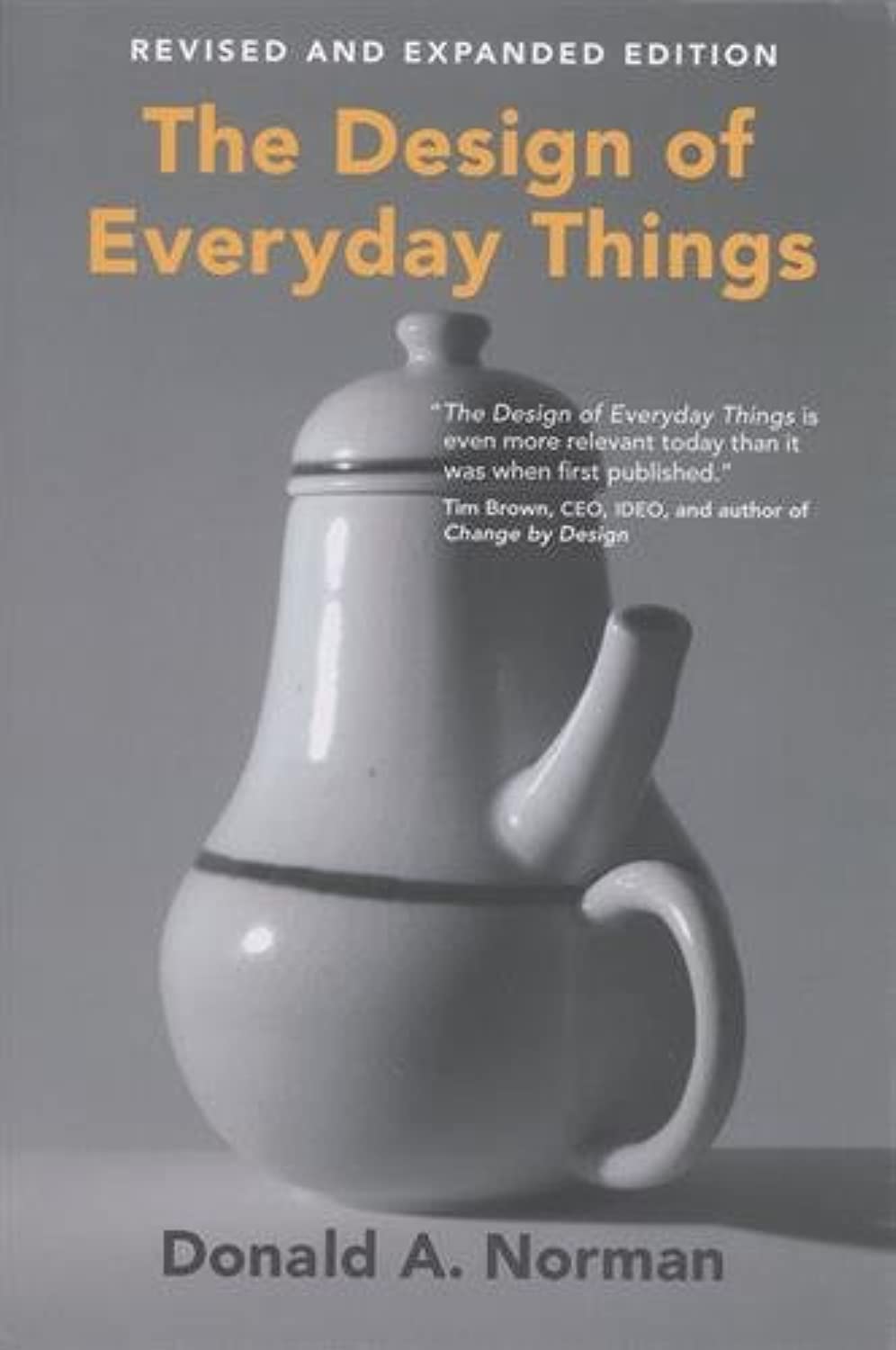
Kocht deze versie als geschenk. De uitgave is enorm teleurstellend... Cover foto helemaal uitgewassen en lage resolutie.
It's a cool book that gets you thinking
I read the book and sometimes got a little confused but I read most of it drunk. He gives a lot of cool examples that make you go "Oh that's why fire escape doors have that bar in front of them and open outwards".I wish more people in the design/manufacturing field would have read this book. It would make for far less waste and frustration in the world
It's great, just stop calling it 'the UX Bible'
A lot of people voice their disappointment with this book, because they expect it to be an in-depth, authoritative guide written for professional designers, and it turns out to be something else. Let me tell you a little secret, design people: it's not "the design bible", it's not "the UX bible", it's not anything bible. It's more of a religious pamphlet aimed at laymen who don't normally think about design in their everyday work, to bring them the gospel of good design practices in an extremely condensed form.Developers love this book, because it's good (duh!) and also because it comes with recommendations from several luminaries in the field, most notably Jeff Atwood, the co-founder of StackOverflow. I'm no exception. It helped shift my focus from making software that does its job well, to making software that helps its users do their jobs well. It explains in very simple terms why you should care about how users experience and interact with the things you make and how to start thinking about making their interactions more satisfying and rewarding. It also walks you through the typical interaction cycle, from the idea of action that user wants to perform, to the interpretation of feedback they receive; it is a tremendous help when you are trying to 'debug' the interactions and figure out the exact reason why users find your design distracting, irritating or counter-intuitive.There are sections clarifying the terms you might have heard elsewhere but don't know exactly what they mean (A/B testing, root cause analysis, iterative vs. waterfall approach) or how they might help you improve your design. There is a particularly illuminating chapter explaining why fridge controls and stove controls (among many other things) come in so many different and incompatible designs, how companies are trying to solve this problem with standardization and why standards sometimes create more problems than they solve.What else? It's also short, well-written and entertaining. The jokes are rare, poignant, and usually delivered with a deadpan snark. To give you an example,"The typewriter was a radical innovation that had a dramatic impact upon office and home writing. It helped provide a role for women in offices as typists and secretaries, which led to the redefinition of the job of secretary to be a dead end rather than the first step toward an executive position".Nice, huh?To summarize: buy this book if you want to know more about design in general and/or become a better designer to complement your other skills. Don't buy this book if you expect a huge how-to manual or a cookbook aimed at experienced designers.
Für jeden geeignet
Das Buch war an der Uni für die Einführungsvorlesung zu Human-Computer-Interaction (HCI) Pflichtlektüre. In der Vorlesung wurde es als ein Muss für alle vorgestellt, die UI/UX-Design machen. Nach zweimaligem Lesen kann ich dies bestätigen. Aber auch für Leute, die mit HCI oder Design nichts am Hut haben, kann ich das Buch empfehlen. Es liefert einem eine ganz andere Sichtweise auf Dinge, die man täglich im Leben benutzt. Und da ist meine größte Erkenntnis: Fehler durch "menschliches Versagen" - egal ob das große oder nur kleine Auswirkungen hat - sind meist nicht durch den Menschen verursacht, sondern durch schlechtes Design. Das ist eine Denkweise, mit der man sich selbst weniger herunterzieht.Norman macht aus etlichen Beispielen aus dem Leben deutlich, wie einfach oder kompliziert Gegenstände entworfen werden. Dabei gibt er einfache Modelle, die helfen das menschliche Handeln und die Psychologie hinter ihrem Handeln zu verstehen. Er beantwortet Fragen wie:-Wie funktionieren mentale Modelle?-Wie denkt der Mensch und führt Aktionen aus? Was können dabei für Probleme auftreten? Was ist wenn Fehler auftreten?-Wie funktioniert (vereinfacht) das Gedächtnis und was können wir daraus für Design lernen?-Wie kann Design Menschen dazu beeinflussen das "Richtige" zu tun und Fehler zu vermeiden?-Wie kann ein Team im Idealfall ein Designprojekt funktionieren?Die Beispiele aus dem Alltag, die er in dieser überarbeiteten Version anführt, sind so gewählt, dass sie modern sind und wahrscheinlich auch noch in einigen Jahren aktuell sind. Auch wenn es nun bereits einige Zeit her ist, dass ich das Buch gelesen habe, denke ich immer noch häufig an Beispiele aus dem Buch; zum Beispiel wenn ich wieder einer "Norman-Tür" begegne und drücke statt zu ziehen, oder wenn ich zum hundertsten Mal versuche die Temperatur in meinem Kühlschrank anzupassen, den Drehregler aber immer noch nicht verstanden habe.Das Buch ist sehr gut lesbar, sprachlich einfach gehalten, interessant und unterhaltsam. Es gibt einige Abbildungen, die zum Verständnis beitragen.Fazit: Klare Leseempfehlung.
انصح بشراءه
الكتاب جميل جدا وجودته ممتازة
Visit the MIT Press Store
The Design of Everyday Things, revised and expanded edition (The MIT Press)
AED29276
Quantity:
Order today to get by 7-14 business days
This item qualifies for free delivery
Imported From: United Kingdom
At BOLO, we work hard to ensure the products you receive are new, genuine, and sourced from reputable suppliers.
BOLO is not an authorized or official retailer for most brands, nor are we affiliated with manufacturers unless specifically stated on a product page. Instead, we source verified sellers, authorized distributors or directly from the manufacturer.
Each product undergoes thorough inspection and verification at our consolidation and fulfilment centers to ensure it meets our strict authenticity and quality standards before being shipped and delivered to you.
If you ever have concerns regarding the authenticity of a product purchased from us, please contact Bolo Support. We will review your inquiry promptly and, if necessary, provide documentation verifying authenticity or offer a suitable resolution.
Your trust is our top priority, and we are committed to maintaining transparency and integrity in every transaction.
All product information, images, descriptions, and reviews originate from the manufacturer or from trusted sellers overseas. BOLO is not affiliated with, endorsed by, or an authorized retailer for most brands listed on our website unless stated otherwise.
While we strive to display accurate information, variations in packaging, labeling, instructions, or formulation may occasionally occur due to regional differences or supplier updates. For detailed or manufacturer-specific information, please contact the brand directly or reach out to BOLO Support for assistance.
Unless otherwise stated, all prices displayed on the product page include applicable taxes and import duties.
BOLO operates in accordance with the laws and regulations of United Arab Emirates. Any items found to be restricted or prohibited for sale within the UAE will be cancelled prior to shipment. We take proactive measures to ensure that only products permitted for sale in United Arab Emirates are listed on our website.
All items are shipped by air, and any products classified as “Dangerous Goods (DG)” under IATA regulations will be removed from the order and cancelled.
All orders are processed manually, and we make every effort to process them promptly once confirmed. Products cancelled due to the above reasons will be permanently removed from listings across the website.
Similar suggestions by Bolo
More from this brand
Similar items from “Industrial Design”
Share with
Or share with link
https://www.bolo.ae/products/K0262525674
Visit the MIT Press Store
The Design of Everyday Things, revised and expanded edition (The MIT Press)

AED29276
Quantity:
Order today to get by 7-14 business days
This item qualifies for free delivery
Imported From: United Kingdom
At BOLO, we work hard to ensure the products you receive are new, genuine, and sourced from reputable suppliers.
BOLO is not an authorized or official retailer for most brands, nor are we affiliated with manufacturers unless specifically stated on a product page. Instead, we source verified sellers, authorized distributors or directly from the manufacturer.
Each product undergoes thorough inspection and verification at our consolidation and fulfilment centers to ensure it meets our strict authenticity and quality standards before being shipped and delivered to you.
If you ever have concerns regarding the authenticity of a product purchased from us, please contact Bolo Support. We will review your inquiry promptly and, if necessary, provide documentation verifying authenticity or offer a suitable resolution.
Your trust is our top priority, and we are committed to maintaining transparency and integrity in every transaction.
All product information, images, descriptions, and reviews originate from the manufacturer or from trusted sellers overseas. BOLO is not affiliated with, endorsed by, or an authorized retailer for most brands listed on our website unless stated otherwise.
While we strive to display accurate information, variations in packaging, labeling, instructions, or formulation may occasionally occur due to regional differences or supplier updates. For detailed or manufacturer-specific information, please contact the brand directly or reach out to BOLO Support for assistance.
Unless otherwise stated, all prices displayed on the product page include applicable taxes and import duties.
BOLO operates in accordance with the laws and regulations of United Arab Emirates. Any items found to be restricted or prohibited for sale within the UAE will be cancelled prior to shipment. We take proactive measures to ensure that only products permitted for sale in United Arab Emirates are listed on our website.
All items are shipped by air, and any products classified as “Dangerous Goods (DG)” under IATA regulations will be removed from the order and cancelled.
All orders are processed manually, and we make every effort to process them promptly once confirmed. Products cancelled due to the above reasons will be permanently removed from listings across the website.
Description:
Review
This book changed the field of design. As the pace of technological change accelerates, the principles in this book are increasingly important. The new examples and ideas about design and product development make it essential reading. --Patrick Whitney, Dean, Institute of Design, Illinois Institute of Technology
About the Author
Reviews:
5.0 out of 5 stars A classic
A must read for aspiring and practicing designers.
5.0 out of 5 stars Accessible, informative primer on design principles
Talks about design principles, relationships between the user and the product and what can grow wrong. Touches on types of errors (referencing the airline industry and the importance of checklists, effective signifiers, appropriate affordances and warning alarms/feedback mechanisms). Design is contextual and users, stakeholders, the business side of things all have to be considered and can make or break a product. Design underpins most fields (e.g Medicine, Gaming, Aviation, Software, Cuisine, Writing).An important topic everyone should delve into.
4.0 out of 5 stars Great read for those looking to get into Product design
Great little gift for my colleague at work :-) Worth a read for those looking to get into Product design
5.0 out of 5 stars Good gift
good gift
5.0 out of 5 stars Just good design sense
Most of this book is pure gold for designers and product managers, elegantly expressed and faultlessly argued. The third act is a bit woolly and observational but so what. I've never copied so many quotes.
5.0 out of 5 stars Fascinating!
I bought this because I'm moving my teaching towards a design focus (I'm sick of seeing my workshop filled with dozens of identical projects!), and this book is fascinating. It's definitely going to take two reads to get the full message from it.But, generally, if you find yourself getting frustrated by the made world around you - doors you can't find, taps that turn the wrong way - this is the book for you.
5.0 out of 5 stars Insightful and fascinating
I read the original version of this book in the 1980’s and was fascinated by its content and scope. Since then I have had an interest in design and interfacing. I finally thought it was time to re-read TDOET and thought I would buy the updated version. It didn’t disappoint.
4.0 out of 5 stars Good but let down by technical language and poor photos
This book is a classic in its field but ... The picture quality throughout his printing is terrible, the photos are small, low resolution and in black and white so you really have to peer at them to understand what is being shown / discussed. Not great for a book about design. Whilst this updated version has lots of new content it uses fairly technical language and isn’t a book that you just flow through it feels more like an effort to read it. It’s a good book but one you must want to read
Geweldig boek maar deze uitgave is zwak
Kocht deze versie als geschenk. De uitgave is enorm teleurstellend... Cover foto helemaal uitgewassen en lage resolutie.
It's a cool book that gets you thinking
I read the book and sometimes got a little confused but I read most of it drunk. He gives a lot of cool examples that make you go "Oh that's why fire escape doors have that bar in front of them and open outwards".I wish more people in the design/manufacturing field would have read this book. It would make for far less waste and frustration in the world
It's great, just stop calling it 'the UX Bible'
A lot of people voice their disappointment with this book, because they expect it to be an in-depth, authoritative guide written for professional designers, and it turns out to be something else. Let me tell you a little secret, design people: it's not "the design bible", it's not "the UX bible", it's not anything bible. It's more of a religious pamphlet aimed at laymen who don't normally think about design in their everyday work, to bring them the gospel of good design practices in an extremely condensed form.Developers love this book, because it's good (duh!) and also because it comes with recommendations from several luminaries in the field, most notably Jeff Atwood, the co-founder of StackOverflow. I'm no exception. It helped shift my focus from making software that does its job well, to making software that helps its users do their jobs well. It explains in very simple terms why you should care about how users experience and interact with the things you make and how to start thinking about making their interactions more satisfying and rewarding. It also walks you through the typical interaction cycle, from the idea of action that user wants to perform, to the interpretation of feedback they receive; it is a tremendous help when you are trying to 'debug' the interactions and figure out the exact reason why users find your design distracting, irritating or counter-intuitive.There are sections clarifying the terms you might have heard elsewhere but don't know exactly what they mean (A/B testing, root cause analysis, iterative vs. waterfall approach) or how they might help you improve your design. There is a particularly illuminating chapter explaining why fridge controls and stove controls (among many other things) come in so many different and incompatible designs, how companies are trying to solve this problem with standardization and why standards sometimes create more problems than they solve.What else? It's also short, well-written and entertaining. The jokes are rare, poignant, and usually delivered with a deadpan snark. To give you an example,"The typewriter was a radical innovation that had a dramatic impact upon office and home writing. It helped provide a role for women in offices as typists and secretaries, which led to the redefinition of the job of secretary to be a dead end rather than the first step toward an executive position".Nice, huh?To summarize: buy this book if you want to know more about design in general and/or become a better designer to complement your other skills. Don't buy this book if you expect a huge how-to manual or a cookbook aimed at experienced designers.
Für jeden geeignet
Das Buch war an der Uni für die Einführungsvorlesung zu Human-Computer-Interaction (HCI) Pflichtlektüre. In der Vorlesung wurde es als ein Muss für alle vorgestellt, die UI/UX-Design machen. Nach zweimaligem Lesen kann ich dies bestätigen. Aber auch für Leute, die mit HCI oder Design nichts am Hut haben, kann ich das Buch empfehlen. Es liefert einem eine ganz andere Sichtweise auf Dinge, die man täglich im Leben benutzt. Und da ist meine größte Erkenntnis: Fehler durch "menschliches Versagen" - egal ob das große oder nur kleine Auswirkungen hat - sind meist nicht durch den Menschen verursacht, sondern durch schlechtes Design. Das ist eine Denkweise, mit der man sich selbst weniger herunterzieht.Norman macht aus etlichen Beispielen aus dem Leben deutlich, wie einfach oder kompliziert Gegenstände entworfen werden. Dabei gibt er einfache Modelle, die helfen das menschliche Handeln und die Psychologie hinter ihrem Handeln zu verstehen. Er beantwortet Fragen wie:-Wie funktionieren mentale Modelle?-Wie denkt der Mensch und führt Aktionen aus? Was können dabei für Probleme auftreten? Was ist wenn Fehler auftreten?-Wie funktioniert (vereinfacht) das Gedächtnis und was können wir daraus für Design lernen?-Wie kann Design Menschen dazu beeinflussen das "Richtige" zu tun und Fehler zu vermeiden?-Wie kann ein Team im Idealfall ein Designprojekt funktionieren?Die Beispiele aus dem Alltag, die er in dieser überarbeiteten Version anführt, sind so gewählt, dass sie modern sind und wahrscheinlich auch noch in einigen Jahren aktuell sind. Auch wenn es nun bereits einige Zeit her ist, dass ich das Buch gelesen habe, denke ich immer noch häufig an Beispiele aus dem Buch; zum Beispiel wenn ich wieder einer "Norman-Tür" begegne und drücke statt zu ziehen, oder wenn ich zum hundertsten Mal versuche die Temperatur in meinem Kühlschrank anzupassen, den Drehregler aber immer noch nicht verstanden habe.Das Buch ist sehr gut lesbar, sprachlich einfach gehalten, interessant und unterhaltsam. Es gibt einige Abbildungen, die zum Verständnis beitragen.Fazit: Klare Leseempfehlung.
انصح بشراءه
الكتاب جميل جدا وجودته ممتازة
Similar suggestions by Bolo
More from this brand
Similar items from “Industrial Design”
Share with
Or share with link
https://www.bolo.ae/products/K0262525674