Deliver toUnited Arab Emirates
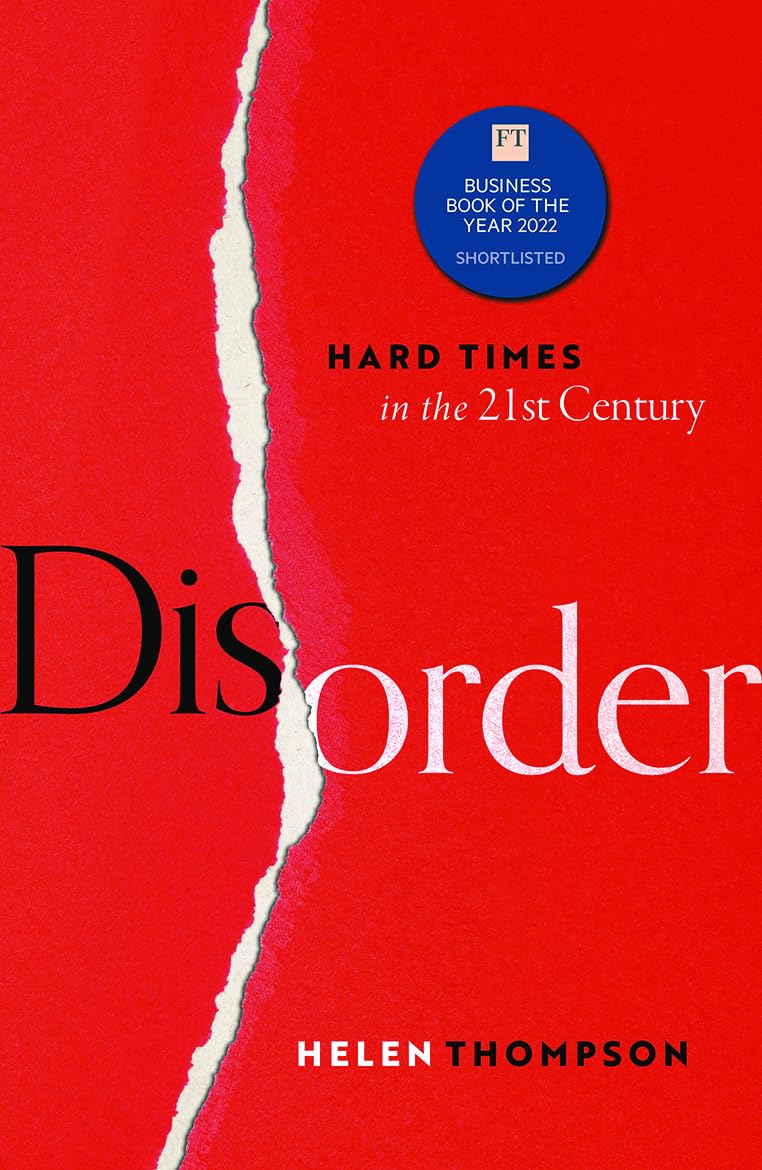
Disorder: Hard Times in the 21st Century

Description:

Getting to grips with the overlapping geopolitical, economic, and political crises faced by Western democratic societies in the 2020s.

The 21st century has brought a powerful tide of geopolitical, economic, and democratic shocks. Their fallout has led central banks to create over $25 trillion of new money, brought about a new age of geopolitical competition, destabilised the Middle East, ruptured the European Union, and exposed old political fault lines in the United States.

Disorder: Hard Times in the 21st Century is a long history of this present political moment. It recounts three histories - one about geopolitics, one about the world economy, and one about western democracies - and explains how in the years of political disorder prior to the pandemic the disruption in each became one big story. It shows how much of this turbulence originated in problems generated by fossil-fuel energies, and it explains why as the green transition takes place the long-standing predicaments energy invariably shapes will remain in place.

The Afterword brings these geopolitical, economic, and political crises up to date by reflecting on the development and impact of the war in Ukraine.


Review

Helen Thompson's book stands tallest among the recent titles that attempt to make sense of our age of crises. Disorder is a singular work owing to the skill with which Thompson maps the intersecting relationships between energy, global monetary policy, and the state of liberal democracy. ― New Statesman

Fascinating ―
Simon Nixon, The Times

A stimulating read. ―
Howard Davies, Literary Review

Exceptional ―
Gavin Jacobson, New Statesman

Excellent. ―
Peter Franklin, Unherd

Bold and brilliant, studded with insights...one of the year's most essential books. ―
Christopher Bray, The Tablet

A powerful guide to modern Hard Times...any reader will finish it with a deeper understanding of our contemporary challenges. ―
Paschal Donohoe, Irish Times

Most of us struggle to keep up [with the news], but not Helen Thompson - she doesn't merely grip each strand, but ties them together. ―
Tom Clark, Prospect

Bursting with ideas. ―
James Barr, The Critic

[
Disorder is] as disturbing as it is thought-provoking. ― Martin Wolf, Financial Times, Summer Books 2022: Economics

If you are looking for a well-developed and convincing theory of our time, I advise you to start here. ―
Gilles Gressani, Le Grand Continent, 'What to read this summer'

We are on the verge of a fascinating epoch that Thompson might write about in a second volume, but that doesnt invalidate her first. Instead, it underscores her larger point that energy and finance are often at the heart of geopolitics. ―
Tony Yates, Chatham House

Disorder is a brilliant extended essay on the troubles of the era in terms of energy, global finance, governance and democracy...So much of this tortuously fascinating book gives the background to the global crisis now upon us, specifically in energy and governance. ― Robert Fox, Reaction

If you want to understand why Russia invaded Ukraine then this book will help ―
Richard Lofthouse, QUAD

Deftly weaving together the history of energy, economics, and politics,
Disorder restores depth to contemporary history. Refusing familiar stereotypes, Thompson offers a truly eye-opening account of our current predicament and points the way to a deeper understanding of the energy transition that lies ahead. Challenging and essential reading. ― Adam Tooze, Kathryn and Shelby Cullom Davis Professor of History, Director of the European Institute, Columbia University

A remarkable history of the complex ways in which the global energy economy has shaped the wealth and politics of nations. Helen Thompson's command of her subject is second to none.
Disorder is revelatory, sobering, and indispensable. ― Gary Gerstle, author of The Rise and Fall of the Neoliberal Order: America and the World during the Free Market Era

To read Thompson on the history of the past century is to see it in a sudden sharp definition. It is akin to looking through glass after the window-cleaner has been. ―
Tom Holland, bestselling author and co-host of The Rest is History podcast

There could be no better guide than Helen Thompson to the turbulence of the 21st century, with its successive disruptions, from financial crisis to energy transition, from Brexit to emerging geopolitical conflicts. When history seems to have come for us with a vengeance since the turn of the millennium, this magisterial book brings into focus the key structural forces driving, not only recent events, but also the inevitable changes still to come. ―
Diane Coyle, Bennett Professor of Public Policy, University of Cambridge

In this absorbing and wide-ranging study Helen Thompson unravels the complex intersections of oil, money, and democracy for understanding the politics of the last century. She provides an indispensable and illuminating guide to our current predicaments. ―
Andrew Gamble, Professor of Politics, University of Sheffield

Thompson's conceptual work is...elaborate...full of revelations. ―
Thomas König, Austrian Journal of Political Science

The best economics book for contextualising the present. ―
James Grimshaw, Evening Standard

Book Description

Shortlisted for the 2022 FT Business Book of the Year Award

Reviews:

5.0 out of 5 stars Outstanding and insightful

N. · 30 April 2024

Very interesting account of recent and 20th century history through the lens of a deep understanding of politics and economics. Quite densely written but not loaded with jargon. Probably best if you have an existing knowledge base of the chronology. Gave me a better understanding of events I'd lived through. Not cheerful but if you want a compelling explanation of where we are today and why then you should read this book. It's been updated to include the Ukraine war.

3.0 out of 5 stars A genuine tour de force, but perhaps too ambitious and ultimately a bit disappointing.

G.O.A. · 25 April 2022

I was really looking forward to reading this book, in part because I always enjoyed listening to Helen Thompson on the Talking Politics podcast, and in part because of the reviews I’d seen. Maybe my expectations were too high. Unfortunately though, I was a bit disappointed.Before explaining why, a word about the narration. Having thought carefully about to express my view here, I concluded the best approach was to be direct. It was simply awful and I fear this may have contributed materially to my enjoyment of the book. I’ve just started ‘There’s nothing for you here’, written and narrated by Fiona Hill. If I was in any doubt about Kitty Kelly’s reading of Disorder (and inclined to be generous) those doubts disappeared after just five minutes listening to Fiona Hill use intonation, pause and emphasis to bring her text to life. Kitty Kelly simply didn’t do that. Moreover, I doubt she was even close to understanding what she was reading and it showed.As for the book, it’s a genuine tour de force; an impressive and well researched catalogue and chronology of events, often recorded at quite a granular level. Having studied economics in the early 70’s, which included a postgraduate degree in international economics, and having worked in the investment management industry ever since, I enjoyed listening to the narrative and reflecting on how I experienced the events described at the time.However, from my perspective, there wasn’t much analysis of events and rarely were opinions expressed. Not only did this make the story being told a bit bland, but more importantly it made it hard to deduce what lessons might be learnt. Are we discussing policy mistakes, for example, or well intended polices that just happened not to work for some reason or, more prosaically, the randomness that inevitably follows from decision making under conditions of complexity and, at times, radical uncertainty? It wasn’t ever made clear.That said, I felt that at times Thompson was trying too hard to convince the reader that the persistent fault lines in the global order she describes have, to a large extent, been the result of the shifting geopolitics of energy, on the one hand, and of the unregulated Eurodollar market on the other. For me, this emphasis oversimplified events and, once again, made it harder to understand what lessons might be learned from history and what might be done next.There is much interesting content in the book. It’s just not that well marshalled. It’s not clear how it might all fit together. For example, I enjoyed the frequent references to ‘democratic excess’, on the one hand, and ‘aristocratic excess’ on the other, but having read the book I’m non the wiser how a middle ground might be struck, let alone how we might get there.The conclusion of the book seems to be that the liberal democracies face a major crisis a long time in the making. They are divided and have complex challenges to navigate, including climate change, but it’s not at all clear how democratic mandates can be secured to enable a way forward. The world is complex and it’s becoming more so.It‘s hard to disagree with this, but it might have been helpful if Thompson had shared less granular detail, but been clearer about the diagnosis of the underlying problems being faced by liberal democracies (not just the symptoms) and been able to suggest some possible solutions.The book is interesting, but might be hard going for anyone not familiar with economics in particular, especially if consuming the audio book. And don’t expect any clear judgements about historic policies or events or any proposed solutions.Just my perspective, for what it’s worth.

5.0 out of 5 stars Essential for understanding the interaction amongst energy, economics and politics

A.C. · 27 January 2023

This is a detailed and thoughtful account of key structural factors in explaining the world we live in now, emphasising the role of energy. It does not suggest that other factors are not in play but these powerful forces unquestionably set the context for geo, supra national and national politics since WW2. The sheer mass of evidence can be challenging to absorb for the non specialist but is worth the effort.That so many tensions today can be traced back to interacting historical disjunctures shows that a complex rather than a simple account is essential. Consequently, simple models of the future and political solutions are doomed to failure. For anyone who is genuinely interested in grasping some of the complexity this is the book to read.

5.0 out of 5 stars Unsentimental history

A.C. · 13 June 2022

History is always difficult and writing new history especially so. Helen Thompson deals with this by analysing the fault lines, especially in democratic societies, that underly the present geopolitical turmoil. It concerns facts and causes without any sentiment applied on her part. In the age of gush, the age of hyperbole, this is very sobering - and illuminating. I thought of Thucydides, and there could be no greater compliment in a way. The ideas are pretty clearly expressed, without achieving crystal clarity - a bit like Thucydides too.

5.0 out of 5 stars Excellent.

B. · 6 August 2024

Buy it

5.0 out of 5 stars Somewhere between holistic and totalising

P.M. · 9 March 2022

Many writers can write about oil and gas, many can write about economics and many can write about democracy. Helen Thompson has one of the best understandings of the intermeshing equilibria between all three. A view from 10,000 feet and all the more compelling for it, she describes how resource dependency drives economic decision making, expertly sketches the effect on monetary policy (this part I had to read very slowly!) and contextualises the Brexit/Trump/decline of social democratic parties very well. A wonderful read

Bueno

j.c. · 22 March 2025

Bien

Lange Sätze, keine Frage...

R. · 4 September 2022

... und wenn das Buch nicht so gut wäre 3,5 Sterne.Aber dieses Buch ist richtig gut.Man kann vieles über das Buch sagen, z.B. es geht teils hinaus überThe Quest: Energy, Security, and the Remaking of the Modern World by Daniel Yergin, welches exzellent ist.Man kann vieles sagen. Aber ich sage wenig. Anders als Mrs. Thompson ;-)

interacting and full of critical perspectives

R. · 5 March 2023

Particolarly appreciated in the sections that relates oil with monetary and political consequences. Holistic view over dynamics let understanding historical facts with different angle. I strongly recommend reading to better understand actual status of things …

Brilliant content but a slog to read

j.b. · 17 February 2023

The material covered is brilliant and insightful, but the writing itself is hard work to read through - best tackled by non-academics like me in short bursts rather than extended study - I tried the audiobook version but frankly that was too hard to follow and turned into a bit of a drone - at least with the book versions I can dip and delve into it and read in my own head voice.

A thought provoking book…

J.A.F. · 21 August 2023

… that does an admirable job of connecting the dots between energy and financial markets, and the political and geopolitical challenges the world has been facing.The work is ambitious in scope and the author spared no effort digging into details to support her arguments. The result is a set of novel insights on a number of historical events over the past few decades.My only (small) criticism is that, in her attempt to explain a number of policy decisions, she perhaps attributes an excess of rationality to the processes. It is easy to rationalise after the fact but in reality practitioners are subject to biases and often have to act with only a small fraction of the available information. And, sadly, far too few of them will have read books like this…

Disorder: Hard Times in the 21st Century

Product ID: K0198865015
Condition: New

4.4

AED8470

Price includes VAT & Import Duties
Type: Paperback
Availability: In Stock

Quantity:

|

Order today to get by 7-14 business days

Delivery fee of AED 20. Free for orders above AED 200.

Returns & Warranty policies

Imported From: United Kingdom

At BOLO, we work hard to ensure the products you receive are new, genuine, and sourced from reputable suppliers.

BOLO is not an authorized or official retailer for most brands, nor are we affiliated with manufacturers unless specifically stated on a product page. Instead, we source verified sellers, authorized distributors or directly from the manufacturer.

Each product undergoes thorough inspection and verification at our consolidation and fulfilment centers to ensure it meets our strict authenticity and quality standards before being shipped and delivered to you.

If you ever have concerns regarding the authenticity of a product purchased from us, please contact Bolo Support. We will review your inquiry promptly and, if necessary, provide documentation verifying authenticity or offer a suitable resolution.

Your trust is our top priority, and we are committed to maintaining transparency and integrity in every transaction.

All product information, images, descriptions, and reviews originate from the manufacturer or from trusted sellers overseas. BOLO is not affiliated with, endorsed by, or an authorized retailer for most brands listed on our website unless stated otherwise.

While we strive to display accurate information, variations in packaging, labeling, instructions, or formulation may occasionally occur due to regional differences or supplier updates. For detailed or manufacturer-specific information, please contact the brand directly or reach out to BOLO Support for assistance.

Unless otherwise stated, all prices displayed on the product page include applicable taxes and import duties.

BOLO operates in accordance with the laws and regulations of United Arab Emirates. Any items found to be restricted or prohibited for sale within the UAE will be cancelled prior to shipment. We take proactive measures to ensure that only products permitted for sale in United Arab Emirates are listed on our website.

All items are shipped by air, and any products classified as “Dangerous Goods (DG)” under IATA regulations will be removed from the order and cancelled.

All orders are processed manually, and we make every effort to process them promptly once confirmed. Products cancelled due to the above reasons will be permanently removed from listings across the website.

Similar suggestions by Bolo

More from this brand

Similar items from “Diplomacy”

Disorder: Hard Times in the 21st Century

Product ID: K0198865015
Condition: New

4.4

Disorder: Hard Times in the 21st Century-0
Type: Paperback

AED8470

Price includes VAT & Import Duties
Availability: In Stock

Quantity:

|

Order today to get by 7-14 business days

Delivery fee of AED 20. Free for orders above AED 200.

Returns & Warranty policies

Imported From: United Kingdom

At BOLO, we work hard to ensure the products you receive are new, genuine, and sourced from reputable suppliers.

BOLO is not an authorized or official retailer for most brands, nor are we affiliated with manufacturers unless specifically stated on a product page. Instead, we source verified sellers, authorized distributors or directly from the manufacturer.

Each product undergoes thorough inspection and verification at our consolidation and fulfilment centers to ensure it meets our strict authenticity and quality standards before being shipped and delivered to you.

If you ever have concerns regarding the authenticity of a product purchased from us, please contact Bolo Support. We will review your inquiry promptly and, if necessary, provide documentation verifying authenticity or offer a suitable resolution.

Your trust is our top priority, and we are committed to maintaining transparency and integrity in every transaction.

All product information, images, descriptions, and reviews originate from the manufacturer or from trusted sellers overseas. BOLO is not affiliated with, endorsed by, or an authorized retailer for most brands listed on our website unless stated otherwise.

While we strive to display accurate information, variations in packaging, labeling, instructions, or formulation may occasionally occur due to regional differences or supplier updates. For detailed or manufacturer-specific information, please contact the brand directly or reach out to BOLO Support for assistance.

Unless otherwise stated, all prices displayed on the product page include applicable taxes and import duties.

BOLO operates in accordance with the laws and regulations of United Arab Emirates. Any items found to be restricted or prohibited for sale within the UAE will be cancelled prior to shipment. We take proactive measures to ensure that only products permitted for sale in United Arab Emirates are listed on our website.

All items are shipped by air, and any products classified as “Dangerous Goods (DG)” under IATA regulations will be removed from the order and cancelled.

All orders are processed manually, and we make every effort to process them promptly once confirmed. Products cancelled due to the above reasons will be permanently removed from listings across the website.

Description:

Getting to grips with the overlapping geopolitical, economic, and political crises faced by Western democratic societies in the 2020s.

The 21st century has brought a powerful tide of geopolitical, economic, and democratic shocks. Their fallout has led central banks to create over $25 trillion of new money, brought about a new age of geopolitical competition, destabilised the Middle East, ruptured the European Union, and exposed old political fault lines in the United States.

Disorder: Hard Times in the 21st Century is a long history of this present political moment. It recounts three histories - one about geopolitics, one about the world economy, and one about western democracies - and explains how in the years of political disorder prior to the pandemic the disruption in each became one big story. It shows how much of this turbulence originated in problems generated by fossil-fuel energies, and it explains why as the green transition takes place the long-standing predicaments energy invariably shapes will remain in place.

The Afterword brings these geopolitical, economic, and political crises up to date by reflecting on the development and impact of the war in Ukraine.


Review

Helen Thompson's book stands tallest among the recent titles that attempt to make sense of our age of crises. Disorder is a singular work owing to the skill with which Thompson maps the intersecting relationships between energy, global monetary policy, and the state of liberal democracy. ― New Statesman

Fascinating ―
Simon Nixon, The Times

A stimulating read. ―
Howard Davies, Literary Review

Exceptional ―
Gavin Jacobson, New Statesman

Excellent. ―
Peter Franklin, Unherd

Bold and brilliant, studded with insights...one of the year's most essential books. ―
Christopher Bray, The Tablet

A powerful guide to modern Hard Times...any reader will finish it with a deeper understanding of our contemporary challenges. ―
Paschal Donohoe, Irish Times

Most of us struggle to keep up [with the news], but not Helen Thompson - she doesn't merely grip each strand, but ties them together. ―
Tom Clark, Prospect

Bursting with ideas. ―
James Barr, The Critic

[
Disorder is] as disturbing as it is thought-provoking. ― Martin Wolf, Financial Times, Summer Books 2022: Economics

If you are looking for a well-developed and convincing theory of our time, I advise you to start here. ―
Gilles Gressani, Le Grand Continent, 'What to read this summer'

We are on the verge of a fascinating epoch that Thompson might write about in a second volume, but that doesnt invalidate her first. Instead, it underscores her larger point that energy and finance are often at the heart of geopolitics. ―
Tony Yates, Chatham House

Disorder is a brilliant extended essay on the troubles of the era in terms of energy, global finance, governance and democracy...So much of this tortuously fascinating book gives the background to the global crisis now upon us, specifically in energy and governance. ― Robert Fox, Reaction

If you want to understand why Russia invaded Ukraine then this book will help ―
Richard Lofthouse, QUAD

Deftly weaving together the history of energy, economics, and politics,
Disorder restores depth to contemporary history. Refusing familiar stereotypes, Thompson offers a truly eye-opening account of our current predicament and points the way to a deeper understanding of the energy transition that lies ahead. Challenging and essential reading. ― Adam Tooze, Kathryn and Shelby Cullom Davis Professor of History, Director of the European Institute, Columbia University

A remarkable history of the complex ways in which the global energy economy has shaped the wealth and politics of nations. Helen Thompson's command of her subject is second to none.
Disorder is revelatory, sobering, and indispensable. ― Gary Gerstle, author of The Rise and Fall of the Neoliberal Order: America and the World during the Free Market Era

To read Thompson on the history of the past century is to see it in a sudden sharp definition. It is akin to looking through glass after the window-cleaner has been. ―
Tom Holland, bestselling author and co-host of The Rest is History podcast

There could be no better guide than Helen Thompson to the turbulence of the 21st century, with its successive disruptions, from financial crisis to energy transition, from Brexit to emerging geopolitical conflicts. When history seems to have come for us with a vengeance since the turn of the millennium, this magisterial book brings into focus the key structural forces driving, not only recent events, but also the inevitable changes still to come. ―
Diane Coyle, Bennett Professor of Public Policy, University of Cambridge

In this absorbing and wide-ranging study Helen Thompson unravels the complex intersections of oil, money, and democracy for understanding the politics of the last century. She provides an indispensable and illuminating guide to our current predicaments. ―
Andrew Gamble, Professor of Politics, University of Sheffield

Thompson's conceptual work is...elaborate...full of revelations. ―
Thomas König, Austrian Journal of Political Science

The best economics book for contextualising the present. ―
James Grimshaw, Evening Standard

Book Description

Shortlisted for the 2022 FT Business Book of the Year Award

Reviews:

5.0 out of 5 stars Outstanding and insightful

N. · 30 April 2024

Very interesting account of recent and 20th century history through the lens of a deep understanding of politics and economics. Quite densely written but not loaded with jargon. Probably best if you have an existing knowledge base of the chronology. Gave me a better understanding of events I'd lived through. Not cheerful but if you want a compelling explanation of where we are today and why then you should read this book. It's been updated to include the Ukraine war.

3.0 out of 5 stars A genuine tour de force, but perhaps too ambitious and ultimately a bit disappointing.

G.O.A. · 25 April 2022

I was really looking forward to reading this book, in part because I always enjoyed listening to Helen Thompson on the Talking Politics podcast, and in part because of the reviews I’d seen. Maybe my expectations were too high. Unfortunately though, I was a bit disappointed.Before explaining why, a word about the narration. Having thought carefully about to express my view here, I concluded the best approach was to be direct. It was simply awful and I fear this may have contributed materially to my enjoyment of the book. I’ve just started ‘There’s nothing for you here’, written and narrated by Fiona Hill. If I was in any doubt about Kitty Kelly’s reading of Disorder (and inclined to be generous) those doubts disappeared after just five minutes listening to Fiona Hill use intonation, pause and emphasis to bring her text to life. Kitty Kelly simply didn’t do that. Moreover, I doubt she was even close to understanding what she was reading and it showed.As for the book, it’s a genuine tour de force; an impressive and well researched catalogue and chronology of events, often recorded at quite a granular level. Having studied economics in the early 70’s, which included a postgraduate degree in international economics, and having worked in the investment management industry ever since, I enjoyed listening to the narrative and reflecting on how I experienced the events described at the time.However, from my perspective, there wasn’t much analysis of events and rarely were opinions expressed. Not only did this make the story being told a bit bland, but more importantly it made it hard to deduce what lessons might be learnt. Are we discussing policy mistakes, for example, or well intended polices that just happened not to work for some reason or, more prosaically, the randomness that inevitably follows from decision making under conditions of complexity and, at times, radical uncertainty? It wasn’t ever made clear.That said, I felt that at times Thompson was trying too hard to convince the reader that the persistent fault lines in the global order she describes have, to a large extent, been the result of the shifting geopolitics of energy, on the one hand, and of the unregulated Eurodollar market on the other. For me, this emphasis oversimplified events and, once again, made it harder to understand what lessons might be learned from history and what might be done next.There is much interesting content in the book. It’s just not that well marshalled. It’s not clear how it might all fit together. For example, I enjoyed the frequent references to ‘democratic excess’, on the one hand, and ‘aristocratic excess’ on the other, but having read the book I’m non the wiser how a middle ground might be struck, let alone how we might get there.The conclusion of the book seems to be that the liberal democracies face a major crisis a long time in the making. They are divided and have complex challenges to navigate, including climate change, but it’s not at all clear how democratic mandates can be secured to enable a way forward. The world is complex and it’s becoming more so.It‘s hard to disagree with this, but it might have been helpful if Thompson had shared less granular detail, but been clearer about the diagnosis of the underlying problems being faced by liberal democracies (not just the symptoms) and been able to suggest some possible solutions.The book is interesting, but might be hard going for anyone not familiar with economics in particular, especially if consuming the audio book. And don’t expect any clear judgements about historic policies or events or any proposed solutions.Just my perspective, for what it’s worth.

5.0 out of 5 stars Essential for understanding the interaction amongst energy, economics and politics

A.C. · 27 January 2023

This is a detailed and thoughtful account of key structural factors in explaining the world we live in now, emphasising the role of energy. It does not suggest that other factors are not in play but these powerful forces unquestionably set the context for geo, supra national and national politics since WW2. The sheer mass of evidence can be challenging to absorb for the non specialist but is worth the effort.That so many tensions today can be traced back to interacting historical disjunctures shows that a complex rather than a simple account is essential. Consequently, simple models of the future and political solutions are doomed to failure. For anyone who is genuinely interested in grasping some of the complexity this is the book to read.

5.0 out of 5 stars Unsentimental history

A.C. · 13 June 2022

History is always difficult and writing new history especially so. Helen Thompson deals with this by analysing the fault lines, especially in democratic societies, that underly the present geopolitical turmoil. It concerns facts and causes without any sentiment applied on her part. In the age of gush, the age of hyperbole, this is very sobering - and illuminating. I thought of Thucydides, and there could be no greater compliment in a way. The ideas are pretty clearly expressed, without achieving crystal clarity - a bit like Thucydides too.

5.0 out of 5 stars Excellent.

B. · 6 August 2024

Buy it

5.0 out of 5 stars Somewhere between holistic and totalising

P.M. · 9 March 2022

Many writers can write about oil and gas, many can write about economics and many can write about democracy. Helen Thompson has one of the best understandings of the intermeshing equilibria between all three. A view from 10,000 feet and all the more compelling for it, she describes how resource dependency drives economic decision making, expertly sketches the effect on monetary policy (this part I had to read very slowly!) and contextualises the Brexit/Trump/decline of social democratic parties very well. A wonderful read

Bueno

j.c. · 22 March 2025

Bien

Lange Sätze, keine Frage...

R. · 4 September 2022

... und wenn das Buch nicht so gut wäre 3,5 Sterne.Aber dieses Buch ist richtig gut.Man kann vieles über das Buch sagen, z.B. es geht teils hinaus überThe Quest: Energy, Security, and the Remaking of the Modern World by Daniel Yergin, welches exzellent ist.Man kann vieles sagen. Aber ich sage wenig. Anders als Mrs. Thompson ;-)

interacting and full of critical perspectives

R. · 5 March 2023

Particolarly appreciated in the sections that relates oil with monetary and political consequences. Holistic view over dynamics let understanding historical facts with different angle. I strongly recommend reading to better understand actual status of things …

Brilliant content but a slog to read

j.b. · 17 February 2023

The material covered is brilliant and insightful, but the writing itself is hard work to read through - best tackled by non-academics like me in short bursts rather than extended study - I tried the audiobook version but frankly that was too hard to follow and turned into a bit of a drone - at least with the book versions I can dip and delve into it and read in my own head voice.

A thought provoking book…

J.A.F. · 21 August 2023

… that does an admirable job of connecting the dots between energy and financial markets, and the political and geopolitical challenges the world has been facing.The work is ambitious in scope and the author spared no effort digging into details to support her arguments. The result is a set of novel insights on a number of historical events over the past few decades.My only (small) criticism is that, in her attempt to explain a number of policy decisions, she perhaps attributes an excess of rationality to the processes. It is easy to rationalise after the fact but in reality practitioners are subject to biases and often have to act with only a small fraction of the available information. And, sadly, far too few of them will have read books like this…

Similar suggestions by Bolo

More from this brand

Similar items from “Diplomacy”