Deliver toUnited Arab Emirates
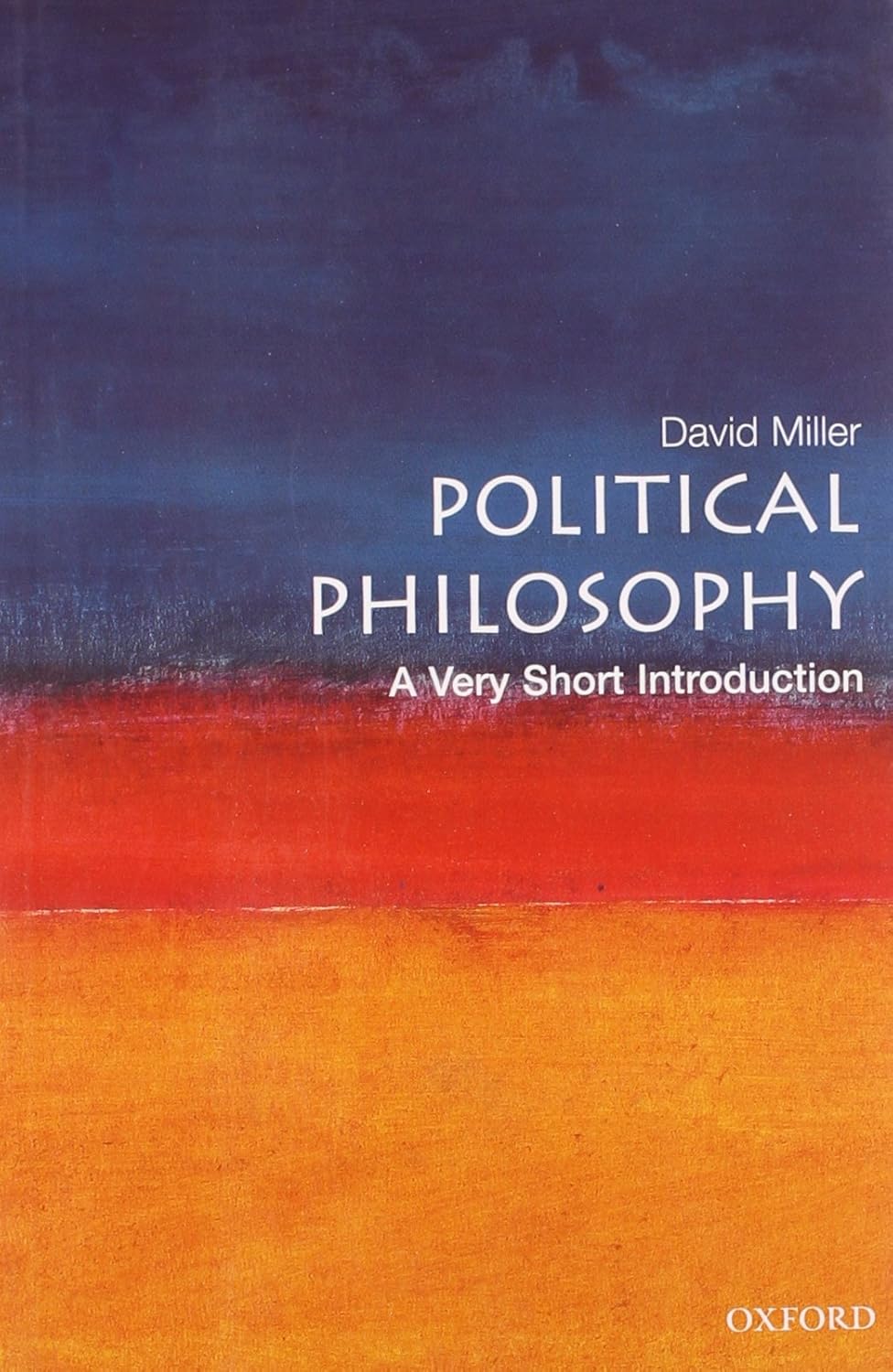
Political Philosophy: A Very Short Introduction: 97 (Very Short Introductions)

Description:

This book introduces readers to the concepts of political philosophy. It starts by explaining why the subject is important and how it tackles basic ethical questions such as 'how should we live together in society?' It looks at political authority, the reasons why we need politics at all, the limitations of politics, and whether there are areas of life that shouldn't be governed by politics. It explores the connections between political authority and justice, a constant theme in political philosophy, and the ways in which social justice can be used to regulate rather than destroy a market economy. David Miller discusses why nations are the natural units of government and whether the rise of multiculturalism and transnational co-operation will change this: will we ever see the formation of a world government?

ABOUT THE SERIES: The Very Short Introductions series from Oxford University Press contains hundreds of titles in almost every subject area. These pocket-sized books are the perfect way to get ahead in a new subject quickly. Our expert authors combine facts, analysis, perspective, new ideas, and enthusiasm to make interesting and challenging topics highly readable.


Review

Select Guide Rating

Book Description

An illuminating, compact introduction to political philosophy

Reviews:

5.0 out of 5 stars An Easy Enjoyable Read!

T. · 17 February 2025

Excellent introduction to political philosophy, easy to understand and full of great facts and terms. A great read indeed !

4.0 out of 5 stars Great introduction, but an update to include recent political events would be appreciated

A.K. · 11 August 2018

I read this book as somebody without formal education in the subject. Needless the say, though, I covers a topic that many people will find easy to relate to.Altogether, this was a very pleasant read. Often I found myself longing for more, but this is outside what can be expected from a ‘very short introduction’. Miller does a great job explaining key concepts in the field. I do agree however, that even though he tries to highlight multiple opinions, he does advocate a liberal view. I personally found this not an issue at all, but other readers might find it annoying.The only serious criticism I have is the age of the book (published 2003). While one could easily argue that this subject does not change particularly quickly, I do believe there have been many noteworthy (political) events in the past 15 years (in particular US politics, recent events in the UK, the refugee crisis and the Syria war) that potentially would lead one the review some his points, but certainly would have been very interesting to be included as examples.

5.0 out of 5 stars An honest and thoughtful overview

J.E. · 7 September 2012

Not being exactly new to the ideas of political philosophy I found certain aspects of this book somewhat basic particularly regarding the ethical considerations of good governance and justice. However I have now had a lot of gaps filled and my ignorance enlightened in other areas.Arguments for and against different points of view from across the whole political spectrum were presented and discussed without presuming infallible wisdom on the part of the author but yet still with a candid attitude and no attempt to mask his own views. Indeed the book ends with a rough outline of the author's ideas of how we might improve society as it currently stands.I would thoroughly recommend this book to all those new to the subject but also to anyone with a healthy critical outlook even if they feel they have a good idea of how society should be run already as you might find some ideas you had not given fair consideration to before.

5.0 out of 5 stars Great introductions.

A. · 26 January 2017

I find every A Very Short Introduction I read really opens my up my mind to new thoughts and allows me to make connections to things I've previously read and maybe not understood. This one is no different, very concise and very interesting.

3.0 out of 5 stars Worth reading

C.R.H. · 29 August 2017

I purchased this book as I have a roundabout knowledge of political philosophy, having read many of the authors, yet having basic gaps in my knowledge. The book is well written and informative. It should be noted however that, the author explicitly states he wishes to convince the reader of his own views, which are in the vein of British liberalism. This is fine, although I do think that at times, the author does not give a fair defence of views he disagrees with, though I would not necessarily say he constructs a straw man. For example, in the chapter on feminism and multiculturalism, the only philosopher referred to (bizarrely) is John Stuart Mill, everything else is sort of broad. ('they', 'them', 'feminists claim') Poor arguments are dismissed in a fairly unsatisfactory way. I do not consider myself strongly tied to either of these intellectual traditions but feel that I have heard better arguments the author chooses not to include. This occurs throughout, but I felt it was most pronounced in this chapter. Of course, this may be a problem of a book of this length that aims to give a whistle stop tour.Overall, this is a good introduction to Political Philosophy, that engages the reader in a creative and non-technical way.

4.0 out of 5 stars Good summary

L. · 24 August 2012

Pocket sized summary of lots of political theories. I bought it for a philosophy evening class to get me up to speed and I found it very helpful. Nicely written, zips along, not heavy going at all, but sufficient detail for a beginner.

5.0 out of 5 stars pocket size

M.G. · 2 March 2020

handy size, easy to read

5.0 out of 5 stars Good

N.C. · 19 October 2020

good

Excellent!

B.R. · 9 September 2020

The way the author approaches the subject sets up the right train of thoughts in the mind of the reader. The author also discusses each issue or topic with adequate depth so that a novice reader will not be able to get away with half baked knowledge.Above all, the book is a sheer joy to read.If, at some point if time in your life, you have thought about improving or changing the political system you are living under, then this book should on top of your wish list.

OUTSTANDING, UPDATED EDITION RECOMMENDED

Y.D. · 3 May 2015

Avant-Garde Politician: Leaders for a New EpochThis book is a very good short introduction to political philosophy. It fully meets the requirement that "political philosophers...are bound to challenge many of the conventional beliefs held both by politicians and by the public at large...when political philosophers put forward their own ideas and proposals, these nearly always look strange and disturbing to those who are used to the conventional debate" (pp. 9-10). This is all the more essential "at moments when we face new political challenges that we cannot deal with using the conventional wisdom of the day" (p. 11). I wish more political philosophers would heed this imperative, moving towards new paradigms as required by the metamorphosis into which humanity is cascading, instead of marginally improving ideas which are important but in need revaluation, often radically so.All chapters are enlightening. Thus, chapter 4 on "Freedom and the limits of government" succinctly discusses central issues of "liberty" and "human rights." Departing from common views, the author distinguishes between "human rights" and "citizen rights", recommending quite counter-conventionally that "rights that belong on the longer list (of) rights of citizenship...ought to be recognized as basic protections for the individual within our political community - while in other communities a different set of rights, overlapping with but not identical with ours, should prevail (p. 72, emphasis in original). The author is careful "not to succumb to debilitating political correctness." Thus, he offers a balanced view of feminism and multiculturalism (p. 102). And he becomes quite "daring" in supporting a form of market socialism (p. 90), as position with which I fully agree.On page 5 the book includes a crucial statement: in contrast to earlier periods "we think much more about the institutions of good government, and less about the personal qualities of the people who make them work. Arguably we have gone too far in this direction. But I will follow modern fashion and talk...primarily about good government as a system, not about how to make our rulers virtuous." The author has good reasons for doing so in a short introduction. But, still, this leaves a black hole at the center of political philosophy, which can easily swallow the best designed institutions and make them work miserably. I recommend that a new edition takes up this issue, however concisely.Some of the presented views may well be over-optimistic. Thus, compromises and taking into account minority views may work in some Western countries, but not when intense, multiple and contradictory ideological commitments push ideas of "fairness" into a corner and make trust in "public discussion, where both sides listen to the other's point of view and try to find a solution that as far as possible is acceptable to both" (pp. 52, 104) into a chimera. The economic failures of the Israeli Kibbutz movement further undermine the hopes that in small communities economic incentives are not essential (p. 87). The experience of Singapore demonstrates the advantages in some situations of authoritarian rule headed by outstanding leaders. And the book does not discuss the tendency of democracies, as well as most other regimes (but not Singapore), to neglect the responsibility to take care of future generation - a trait the consequences of which are likely to become more serious and perhaps fatal to the future of the human species, far above and beyond the risks of environmental degradation.Here I reach the main point which requires in my view quite some rewriting in a new edition, all the more so as it was less obvious ten years ago, when this book was published, while receiving much attention in more recent books by the author.The book correctly states that "as societies change, as new needs and new problems arise, so too will the shape of freedom itself. Who could have imagined, even 20 years ago, that internet access, electronic surveillance, or gene ownership would very soon assume center state in debates about individual liberty?" (p. 73). But the consequences of this crucial understanding may well be more radical than suggested in the text.The author raises justified concerns over strong global governance (pp. 120-121). Indeed, "Cosmopolitianism in its most literal sense is both implausible and unattractive" (p. 123) and the danger pointed out by Kant of a single world government being a "universal despotism which saps all man's energies and ends in the graveyard of freedom" (123) is real. But the book does not face the emerging radical and in part fateful challenges sure to confront politics which require radical innovations, including a strong global authority and much improved political leaders (as discussed in my recent book).Examples include human enhancement, virus synthesis, robotization, artificial intelligence and more - all of which add up to a phase jump in human history. Present and all the more so emerging science and technology is quite sure to enabling humanity for the first time in its evolutionary history to deliberately transform itself and also to eliminate itself, on purpose by some fanatics or by accident. This shift in the situation of humanity required radical philosophizing with a Nietzschean hammer, especially in political philosophy. The emerging problems are much broader and even more fateful than environmental ones, mentioned by the author (120). They can only be coped with globally, requiring a supervisory and regulatory worldwide regime enforced on all states, never mind "sovereignty." At stake is not "global justice," however important and well discussed by the author, but the very future of humanity as a species.The "strong need people have to feel in control of their own destiny" (p.130) is not met at present and is sure to be even less satisfied in the future. But there is no other choice: A neo-Hobbesian situation can only be prevented by unprecedented global measures, which are far beyond public awareness and surpass by far the capacities of nearly all contemporary political leaders.The author seems to sense this problematic. He states wisely that "the choice between good and bad government is always one we have to make, even if the form that good government takes changes as technology advanced and societies become larger and more complex" (p. 131). He is right in postulating that "it is precisely those moments when we feel that humanity's future is slipping out of our control that we need to think about them long and hard, and then decide together what to do" (p. 132). The time is now!This book paves the way for moving on to a new phase of political philosophy. As it is, it is strongly recommended for all concerned with public affairs, including political leaders who often lack basic knowledge in political philosophy as well provided by this book. But more is need than was visible ten years ago, when this book was published - waiting for an updated edition, hopefully coming soon.Professor Yehezkel DrorThe Hebrew University of Jerusalem

Short Introductions

v. · 29 July 2024

Lo he comprado para un curso próximo en Filosofía política.Aún no lo he leído, pero espero, como con otros de esta colección, que será una buena introducción y resumen.

Great Book

J.S. · 23 October 2021

This book was a required reading in one of my university courses. It is easy to read compared to other academic texts at the university level. The author lays out details easily and provides thought-provoking ideas. He gives many examples, including simple ones, to explain the concepts. I recommend it for anyone interested in political science, especially at a beginning level.

Interessantes Format, stimulierende Lektüre

D.S.J. · 8 October 2013

Die "A Very Short Introduction" Reihe der Oxford University Press wird sehr kontrovers diskutiert. In der Tat ist es eine ziemliche Herausforderung, große Themen (wie etwa politische Philosophie) in nur knapp über 100 kleinen Seiten zu erklären. Wer dabei einen Vollständigkeitsanspruch an die Autoren hat, wird sicherlich enttäuscht werden.Ich persönlich finde, dass es David Miller gut gelungen ist, der Herausforderung dieses Formats gerecht zu werden. Er schreibt sehr persönlich und versteckt dabei seine eigene Meinung nicht. Dennoch bemüht er sich, Meinungen anderer Denker gebührend darzustellen. Er beginnt mit der Frage, warum wir überhaupt politische Philosophie benötigen. Danach geht er über zu der Frage nach der Legitimität politischer Autorität. Dies ist gefolgt von einem Kapitel über Demokratie. Im weiteren geht es dann um Freiheiten und die Grenzen von Regierungen, die Diskussion des Begriffes 'Gerechtigkeit', Feminismus und "Multiculturalism". Das Buch endet mit einem Kapitel über Nationen, Staaten und globale Gerechtigkeit. Zum Schluss gibt es noch Empfehlungen zu weiterer Literatur. Die Ausführungen werden geschmückt mit greifbaren Vergleichen aus der Kunst und Beispielen aus dem Alltag.Wer sich gar nicht mit dem Thema auskennt wird in diesem Buch sicher stimulierende Anreize finden, sich tiefer mit dem Thema zu beschäftigen zu wollen. Wer in politischer Philosophie versiert ist, wird eventuell zu schätzen wissen, wie der Autor versucht, ein sehr komplexes und ausschweifendes Thema kondensiert, alltagsnah und leicht verständlich zu präsentieren. Eine beeindruckende Leistung, wie ich finde.

Political Philosophy: A Very Short Introduction: 97 (Very Short Introductions)

Product ID: K0192803956
Condition: New

4.3

AED8663

Price includes VAT & Import Duties
Type: Paperback
Availability: In Stock

Quantity:

|

Order today to get by 7-14 business days

Delivery fee of AED 20. Free for orders above AED 200.

Returns & Warranty policies

Imported From: United Kingdom

At BOLO, we work hard to ensure the products you receive are new, genuine, and sourced from reputable suppliers.

BOLO is not an authorized or official retailer for most brands, nor are we affiliated with manufacturers unless specifically stated on a product page. Instead, we source verified sellers, authorized distributors or directly from the manufacturer.

Each product undergoes thorough inspection and verification at our consolidation and fulfilment centers to ensure it meets our strict authenticity and quality standards before being shipped and delivered to you.

If you ever have concerns regarding the authenticity of a product purchased from us, please contact Bolo Support. We will review your inquiry promptly and, if necessary, provide documentation verifying authenticity or offer a suitable resolution.

Your trust is our top priority, and we are committed to maintaining transparency and integrity in every transaction.

All product information, images, descriptions, and reviews originate from the manufacturer or from trusted sellers overseas. BOLO is not affiliated with, endorsed by, or an authorized retailer for most brands listed on our website unless stated otherwise.

While we strive to display accurate information, variations in packaging, labeling, instructions, or formulation may occasionally occur due to regional differences or supplier updates. For detailed or manufacturer-specific information, please contact the brand directly or reach out to BOLO Support for assistance.

Unless otherwise stated, all prices displayed on the product page include applicable taxes and import duties.

BOLO operates in accordance with the laws and regulations of United Arab Emirates. Any items found to be restricted or prohibited for sale within the UAE will be cancelled prior to shipment. We take proactive measures to ensure that only products permitted for sale in United Arab Emirates are listed on our website.

All items are shipped by air, and any products classified as “Dangerous Goods (DG)” under IATA regulations will be removed from the order and cancelled.

All orders are processed manually, and we make every effort to process them promptly once confirmed. Products cancelled due to the above reasons will be permanently removed from listings across the website.

Similar suggestions by Bolo

More from this brand

Similar items from “History”

Political Philosophy: A Very Short Introduction: 97 (Very Short Introductions)

Product ID: K0192803956
Condition: New

4.3

Political Philosophy: A Very Short Introduction: 97 (Very Short Introductions)-0
Type: Paperback

AED8663

Price includes VAT & Import Duties
Availability: In Stock

Quantity:

|

Order today to get by 7-14 business days

Delivery fee of AED 20. Free for orders above AED 200.

Returns & Warranty policies

Imported From: United Kingdom

At BOLO, we work hard to ensure the products you receive are new, genuine, and sourced from reputable suppliers.

BOLO is not an authorized or official retailer for most brands, nor are we affiliated with manufacturers unless specifically stated on a product page. Instead, we source verified sellers, authorized distributors or directly from the manufacturer.

Each product undergoes thorough inspection and verification at our consolidation and fulfilment centers to ensure it meets our strict authenticity and quality standards before being shipped and delivered to you.

If you ever have concerns regarding the authenticity of a product purchased from us, please contact Bolo Support. We will review your inquiry promptly and, if necessary, provide documentation verifying authenticity or offer a suitable resolution.

Your trust is our top priority, and we are committed to maintaining transparency and integrity in every transaction.

All product information, images, descriptions, and reviews originate from the manufacturer or from trusted sellers overseas. BOLO is not affiliated with, endorsed by, or an authorized retailer for most brands listed on our website unless stated otherwise.

While we strive to display accurate information, variations in packaging, labeling, instructions, or formulation may occasionally occur due to regional differences or supplier updates. For detailed or manufacturer-specific information, please contact the brand directly or reach out to BOLO Support for assistance.

Unless otherwise stated, all prices displayed on the product page include applicable taxes and import duties.

BOLO operates in accordance with the laws and regulations of United Arab Emirates. Any items found to be restricted or prohibited for sale within the UAE will be cancelled prior to shipment. We take proactive measures to ensure that only products permitted for sale in United Arab Emirates are listed on our website.

All items are shipped by air, and any products classified as “Dangerous Goods (DG)” under IATA regulations will be removed from the order and cancelled.

All orders are processed manually, and we make every effort to process them promptly once confirmed. Products cancelled due to the above reasons will be permanently removed from listings across the website.

Description:

This book introduces readers to the concepts of political philosophy. It starts by explaining why the subject is important and how it tackles basic ethical questions such as 'how should we live together in society?' It looks at political authority, the reasons why we need politics at all, the limitations of politics, and whether there are areas of life that shouldn't be governed by politics. It explores the connections between political authority and justice, a constant theme in political philosophy, and the ways in which social justice can be used to regulate rather than destroy a market economy. David Miller discusses why nations are the natural units of government and whether the rise of multiculturalism and transnational co-operation will change this: will we ever see the formation of a world government?

ABOUT THE SERIES: The Very Short Introductions series from Oxford University Press contains hundreds of titles in almost every subject area. These pocket-sized books are the perfect way to get ahead in a new subject quickly. Our expert authors combine facts, analysis, perspective, new ideas, and enthusiasm to make interesting and challenging topics highly readable.


Review

Select Guide Rating

Book Description

An illuminating, compact introduction to political philosophy

Reviews:

5.0 out of 5 stars An Easy Enjoyable Read!

T. · 17 February 2025

Excellent introduction to political philosophy, easy to understand and full of great facts and terms. A great read indeed !

4.0 out of 5 stars Great introduction, but an update to include recent political events would be appreciated

A.K. · 11 August 2018

I read this book as somebody without formal education in the subject. Needless the say, though, I covers a topic that many people will find easy to relate to.Altogether, this was a very pleasant read. Often I found myself longing for more, but this is outside what can be expected from a ‘very short introduction’. Miller does a great job explaining key concepts in the field. I do agree however, that even though he tries to highlight multiple opinions, he does advocate a liberal view. I personally found this not an issue at all, but other readers might find it annoying.The only serious criticism I have is the age of the book (published 2003). While one could easily argue that this subject does not change particularly quickly, I do believe there have been many noteworthy (political) events in the past 15 years (in particular US politics, recent events in the UK, the refugee crisis and the Syria war) that potentially would lead one the review some his points, but certainly would have been very interesting to be included as examples.

5.0 out of 5 stars An honest and thoughtful overview

J.E. · 7 September 2012

Not being exactly new to the ideas of political philosophy I found certain aspects of this book somewhat basic particularly regarding the ethical considerations of good governance and justice. However I have now had a lot of gaps filled and my ignorance enlightened in other areas.Arguments for and against different points of view from across the whole political spectrum were presented and discussed without presuming infallible wisdom on the part of the author but yet still with a candid attitude and no attempt to mask his own views. Indeed the book ends with a rough outline of the author's ideas of how we might improve society as it currently stands.I would thoroughly recommend this book to all those new to the subject but also to anyone with a healthy critical outlook even if they feel they have a good idea of how society should be run already as you might find some ideas you had not given fair consideration to before.

5.0 out of 5 stars Great introductions.

A. · 26 January 2017

I find every A Very Short Introduction I read really opens my up my mind to new thoughts and allows me to make connections to things I've previously read and maybe not understood. This one is no different, very concise and very interesting.

3.0 out of 5 stars Worth reading

C.R.H. · 29 August 2017

I purchased this book as I have a roundabout knowledge of political philosophy, having read many of the authors, yet having basic gaps in my knowledge. The book is well written and informative. It should be noted however that, the author explicitly states he wishes to convince the reader of his own views, which are in the vein of British liberalism. This is fine, although I do think that at times, the author does not give a fair defence of views he disagrees with, though I would not necessarily say he constructs a straw man. For example, in the chapter on feminism and multiculturalism, the only philosopher referred to (bizarrely) is John Stuart Mill, everything else is sort of broad. ('they', 'them', 'feminists claim') Poor arguments are dismissed in a fairly unsatisfactory way. I do not consider myself strongly tied to either of these intellectual traditions but feel that I have heard better arguments the author chooses not to include. This occurs throughout, but I felt it was most pronounced in this chapter. Of course, this may be a problem of a book of this length that aims to give a whistle stop tour.Overall, this is a good introduction to Political Philosophy, that engages the reader in a creative and non-technical way.

4.0 out of 5 stars Good summary

L. · 24 August 2012

Pocket sized summary of lots of political theories. I bought it for a philosophy evening class to get me up to speed and I found it very helpful. Nicely written, zips along, not heavy going at all, but sufficient detail for a beginner.

5.0 out of 5 stars pocket size

M.G. · 2 March 2020

handy size, easy to read

5.0 out of 5 stars Good

N.C. · 19 October 2020

good

Excellent!

B.R. · 9 September 2020

The way the author approaches the subject sets up the right train of thoughts in the mind of the reader. The author also discusses each issue or topic with adequate depth so that a novice reader will not be able to get away with half baked knowledge.Above all, the book is a sheer joy to read.If, at some point if time in your life, you have thought about improving or changing the political system you are living under, then this book should on top of your wish list.

OUTSTANDING, UPDATED EDITION RECOMMENDED

Y.D. · 3 May 2015

Avant-Garde Politician: Leaders for a New EpochThis book is a very good short introduction to political philosophy. It fully meets the requirement that "political philosophers...are bound to challenge many of the conventional beliefs held both by politicians and by the public at large...when political philosophers put forward their own ideas and proposals, these nearly always look strange and disturbing to those who are used to the conventional debate" (pp. 9-10). This is all the more essential "at moments when we face new political challenges that we cannot deal with using the conventional wisdom of the day" (p. 11). I wish more political philosophers would heed this imperative, moving towards new paradigms as required by the metamorphosis into which humanity is cascading, instead of marginally improving ideas which are important but in need revaluation, often radically so.All chapters are enlightening. Thus, chapter 4 on "Freedom and the limits of government" succinctly discusses central issues of "liberty" and "human rights." Departing from common views, the author distinguishes between "human rights" and "citizen rights", recommending quite counter-conventionally that "rights that belong on the longer list (of) rights of citizenship...ought to be recognized as basic protections for the individual within our political community - while in other communities a different set of rights, overlapping with but not identical with ours, should prevail (p. 72, emphasis in original). The author is careful "not to succumb to debilitating political correctness." Thus, he offers a balanced view of feminism and multiculturalism (p. 102). And he becomes quite "daring" in supporting a form of market socialism (p. 90), as position with which I fully agree.On page 5 the book includes a crucial statement: in contrast to earlier periods "we think much more about the institutions of good government, and less about the personal qualities of the people who make them work. Arguably we have gone too far in this direction. But I will follow modern fashion and talk...primarily about good government as a system, not about how to make our rulers virtuous." The author has good reasons for doing so in a short introduction. But, still, this leaves a black hole at the center of political philosophy, which can easily swallow the best designed institutions and make them work miserably. I recommend that a new edition takes up this issue, however concisely.Some of the presented views may well be over-optimistic. Thus, compromises and taking into account minority views may work in some Western countries, but not when intense, multiple and contradictory ideological commitments push ideas of "fairness" into a corner and make trust in "public discussion, where both sides listen to the other's point of view and try to find a solution that as far as possible is acceptable to both" (pp. 52, 104) into a chimera. The economic failures of the Israeli Kibbutz movement further undermine the hopes that in small communities economic incentives are not essential (p. 87). The experience of Singapore demonstrates the advantages in some situations of authoritarian rule headed by outstanding leaders. And the book does not discuss the tendency of democracies, as well as most other regimes (but not Singapore), to neglect the responsibility to take care of future generation - a trait the consequences of which are likely to become more serious and perhaps fatal to the future of the human species, far above and beyond the risks of environmental degradation.Here I reach the main point which requires in my view quite some rewriting in a new edition, all the more so as it was less obvious ten years ago, when this book was published, while receiving much attention in more recent books by the author.The book correctly states that "as societies change, as new needs and new problems arise, so too will the shape of freedom itself. Who could have imagined, even 20 years ago, that internet access, electronic surveillance, or gene ownership would very soon assume center state in debates about individual liberty?" (p. 73). But the consequences of this crucial understanding may well be more radical than suggested in the text.The author raises justified concerns over strong global governance (pp. 120-121). Indeed, "Cosmopolitianism in its most literal sense is both implausible and unattractive" (p. 123) and the danger pointed out by Kant of a single world government being a "universal despotism which saps all man's energies and ends in the graveyard of freedom" (123) is real. But the book does not face the emerging radical and in part fateful challenges sure to confront politics which require radical innovations, including a strong global authority and much improved political leaders (as discussed in my recent book).Examples include human enhancement, virus synthesis, robotization, artificial intelligence and more - all of which add up to a phase jump in human history. Present and all the more so emerging science and technology is quite sure to enabling humanity for the first time in its evolutionary history to deliberately transform itself and also to eliminate itself, on purpose by some fanatics or by accident. This shift in the situation of humanity required radical philosophizing with a Nietzschean hammer, especially in political philosophy. The emerging problems are much broader and even more fateful than environmental ones, mentioned by the author (120). They can only be coped with globally, requiring a supervisory and regulatory worldwide regime enforced on all states, never mind "sovereignty." At stake is not "global justice," however important and well discussed by the author, but the very future of humanity as a species.The "strong need people have to feel in control of their own destiny" (p.130) is not met at present and is sure to be even less satisfied in the future. But there is no other choice: A neo-Hobbesian situation can only be prevented by unprecedented global measures, which are far beyond public awareness and surpass by far the capacities of nearly all contemporary political leaders.The author seems to sense this problematic. He states wisely that "the choice between good and bad government is always one we have to make, even if the form that good government takes changes as technology advanced and societies become larger and more complex" (p. 131). He is right in postulating that "it is precisely those moments when we feel that humanity's future is slipping out of our control that we need to think about them long and hard, and then decide together what to do" (p. 132). The time is now!This book paves the way for moving on to a new phase of political philosophy. As it is, it is strongly recommended for all concerned with public affairs, including political leaders who often lack basic knowledge in political philosophy as well provided by this book. But more is need than was visible ten years ago, when this book was published - waiting for an updated edition, hopefully coming soon.Professor Yehezkel DrorThe Hebrew University of Jerusalem

Short Introductions

v. · 29 July 2024

Lo he comprado para un curso próximo en Filosofía política.Aún no lo he leído, pero espero, como con otros de esta colección, que será una buena introducción y resumen.

Great Book

J.S. · 23 October 2021

This book was a required reading in one of my university courses. It is easy to read compared to other academic texts at the university level. The author lays out details easily and provides thought-provoking ideas. He gives many examples, including simple ones, to explain the concepts. I recommend it for anyone interested in political science, especially at a beginning level.

Interessantes Format, stimulierende Lektüre

D.S.J. · 8 October 2013

Die "A Very Short Introduction" Reihe der Oxford University Press wird sehr kontrovers diskutiert. In der Tat ist es eine ziemliche Herausforderung, große Themen (wie etwa politische Philosophie) in nur knapp über 100 kleinen Seiten zu erklären. Wer dabei einen Vollständigkeitsanspruch an die Autoren hat, wird sicherlich enttäuscht werden.Ich persönlich finde, dass es David Miller gut gelungen ist, der Herausforderung dieses Formats gerecht zu werden. Er schreibt sehr persönlich und versteckt dabei seine eigene Meinung nicht. Dennoch bemüht er sich, Meinungen anderer Denker gebührend darzustellen. Er beginnt mit der Frage, warum wir überhaupt politische Philosophie benötigen. Danach geht er über zu der Frage nach der Legitimität politischer Autorität. Dies ist gefolgt von einem Kapitel über Demokratie. Im weiteren geht es dann um Freiheiten und die Grenzen von Regierungen, die Diskussion des Begriffes 'Gerechtigkeit', Feminismus und "Multiculturalism". Das Buch endet mit einem Kapitel über Nationen, Staaten und globale Gerechtigkeit. Zum Schluss gibt es noch Empfehlungen zu weiterer Literatur. Die Ausführungen werden geschmückt mit greifbaren Vergleichen aus der Kunst und Beispielen aus dem Alltag.Wer sich gar nicht mit dem Thema auskennt wird in diesem Buch sicher stimulierende Anreize finden, sich tiefer mit dem Thema zu beschäftigen zu wollen. Wer in politischer Philosophie versiert ist, wird eventuell zu schätzen wissen, wie der Autor versucht, ein sehr komplexes und ausschweifendes Thema kondensiert, alltagsnah und leicht verständlich zu präsentieren. Eine beeindruckende Leistung, wie ich finde.

Similar suggestions by Bolo

More from this brand

Similar items from “History”