Deliver toUnited Arab Emirates
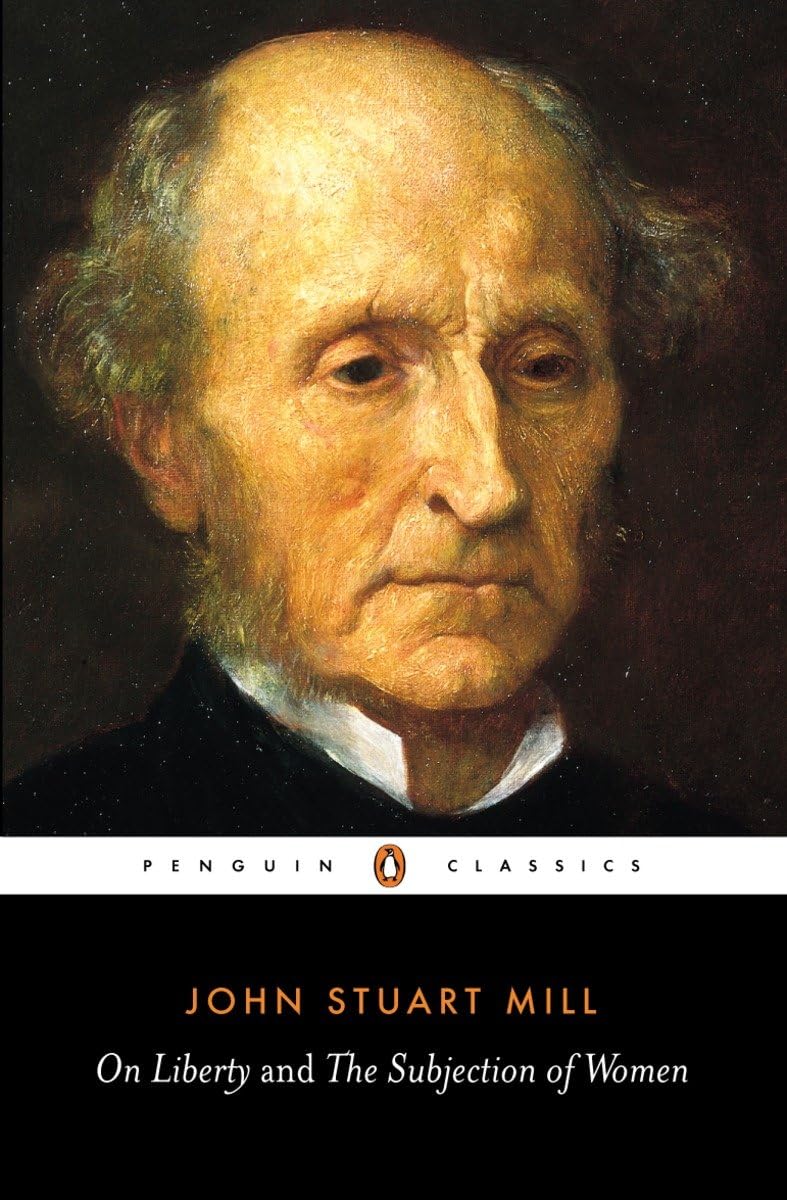
On Liberty and the Subjection of Women (Penguin Classics)

Description:

A prodigiously brilliant thinker who sharply challenged the beliefs of his age, the political and social radical John Stuart Mill was the most influential English-speaking philosopher of the nineteenth century. Regarded as one of the sacred texts of liberalism, his great work On Liberty argues lucidly that any democracy risks becoming a 'tyranny of opinion' in which minority views are suppressed if they do not conform with those of the majority. Written in the same period as On Liberty, shortly after the death of Mill's beloved wife and fellow-thinker Harriet, The Subjection of Women stresses the importance of equality for the sexes. Together, the works provide a fascinating testimony to the hopes and anxieties of mid-Victorian England, and offer a compelling consideration of what it truly means to be free.


Review

Select Guide Rating

About the Author

John Stuart Mill (1806-73). Utilitarianism was published in 1861 but before that Mill published his System of Logic (1843), Principles of Political Economy (1848) and On Liberty (1839). His other works include his classic Autobiography (1873). Mill retired in 1858 and became the independent MP for Westminster from 1865 to 1868. He spent the rest of his life in France and died in Avignon.


Alan Ryan is the Warden of the New College, Oxford, and before that was Professor of Politics at Princeton University. He is the author of The Philosophy of John Stuart Mill, and J.S. Mill, and the editor of the Penguin Classics edition of Utilitarianism and Other Essays.

Reviews:

5.0 out of 5 stars The Father of Feminism

R.A.s. · 5 January 2025

JSM is my hero. The first man I'm aware of to fight for women's rights. He did it so passionately. I also love the chapter in On Liberty that celebrates individualism.

5.0 out of 5 stars The definitive works of the man who campaigned for gender equality before the Suffragettes existed

j. · 9 November 2019

So far I have only read the second book: The Subjection of Women. Everyone must read it. I am a 100% dedicated fan of Harari's "Sapiens" but even he did not provide a convincing argument as to why patriarchal societies are so universal. Mill brings the question down to the macro level and presents a more convincing explanation. Many of us would describe ourselves as "egalitarian" but in the 1860's "progressive" Britain was still misogynistic. There were rules as to when, what time of day and with whom Women could be seen. Women by law (excepting Royalty), were not allowed to contribute to the running of the state. Mill stands up against the "universal" opinion of his day and tackles the arguments against gender equality one by one. As an example, when tackling the received opinion that women are not fit for public service because of "their nature" Mill argues (in paraphrase) "we do not know the true nature of women. How can we know the true nature of a person that has lived in domestic slavery their whole life?". This book is still so relevant today. The debate on gender equality rages. This book will help you understand why the debate even exists; contribute, hopefully, to what your definition of "equality" is and help you move the debate forward in your own mind at least. Mill's equality was not one where everyone gets a leg up to do the same jobs and "contribute" the same to society: it is one where where everyone competes with their natural abilities and the "best" will be chosen, everyone eventually falling into what they are personally "best at" rather than what the law/society says they can/should/must do.Signed,An Egalitarian

5.0 out of 5 stars Prompt delivery

m. · 23 June 2023

Rereading S. Mill was an unexpected pleasure

5.0 out of 5 stars Great book

R. · 3 April 2022

Bought for Son who was pleased. Nothing not to like to be honest

5.0 out of 5 stars great

M.A.J.B. · 6 March 2013

a course book it arrived in good time well packed and i will use this site again and recommend it

5.0 out of 5 stars An unusual but worthwhile combination of essays

D.J. · 7 February 2011

This Penguin edition has a relatively unusual combination. "On Liberty" is more often paired with "Utilitarianism" and "Representative Government" but the pairing with "The Subjection of Women" is worthwhile even though the latter is primarily of historical interest now."On Liberty" is one of the most important books on political thought of the nineteenth century. Fortunately for the 21st century reader it is also one of the most accessible. Mill was a libertarian who chose not to base his defence of liberty on natural rights but on his own revised version of utilitarianism:"I regard utility as the ultimate appeal on all ethical questions...grounded on the permanent interests of man as a progressive being."This enables Mill to argue that freedom is needed if man is to be able to explore all the avenues of human development that allow the human race to progress. Total freedom is impossible so what determines the legitimate boundaries of freedom? Mill distinguishes between self-regarding and other-regarding actions. The former should never be interfered with and the latter subject to limitation only if they harm the legitimate rights of others.For Mill free thought is a self-regarding action which should not be curtailed, and free thought is virtually useless without free speech. He was thinking not only of the legislative curtailemnt of free speech but also the pressure for social conformity, fearing as he did a "tyranny of the majority". Mill then proceeds to add a utilitarian argument in favour of free speech: if an opinion is silenced then mankind is necessarily the loser whether the opinion is true or false. He advances a number of arguments to support this, concluding with the claim that a climate of freedom is essential for "great thinkers" (his attachment to intellectual elitism) and "it is as much, and even more indispensable to enable average human beings to attain the mental stature they are capable of" (his revised utilitarianism). He has no truck with paternalists seeking to guide people's thoughts in the "right" direction. He was equally hostile to the idea that people had the right not to be offended; hence he opposed the blasphemy law. The single case Mill gives of an acceptable limitation of free speech is the case of corn-dealers and an excited mob. An opinion expressed in a newspaper that corn-dealers are "starvers of the poor" is legitimate, but the same view stated to an angry mob outside the corn-dealer's home may be limited if it "is a positive instigation to a mischievous act."Mill concedes that actions cannot be as free as speech and seeks to establish the proper limits of freedom of action. Mill proposes that "the sole end for which mankind are warranted...in interfering with the liberty of action of any of their number is self-protection." Because he rejects paternalism he opposes all interference with self-regarding actions. Mill would not have prevented people from taking drugs and he would have led the opposition to seat belt legislation. Mill spends a great deal of time attacking the "Social Rights" school that argued people had a right to be protected from seeing evils such as prostitution and drunkenness around them. Mill disagrees, observing that drunkenness is unacceptable only if the person physically harms others or is, say, a soldier or policeman on duty.Mill even rejects state interference with liberty for the sake of crime prevention, e.g. poisons can be used for criminal purposes. Mill was willing to accept a register of their sale but not the banning of them. Mill believes we must not interfere with the "rights" of others but these are narrowly circumscribed, and Mill makes it clear that "rights" are not the same as "interests". Hence unrestricted laissez-faire is legitimate. As for moral decency arguments Mill does say that sexual intercourse in public is unacceptable, but would not have condemned sado-masochistic practices between consenting adults in private. For Mill it is important not to limit behaviour for any reason at all because any such action is likely to be the thin end of the wedge, leading to the justification for some further restriction.Though Mill is a very determined anti-paternalist he makes three exceptions: children, primitive societies and the disabled. Children must be guided until they reach maturity and they must be given compulsory education - something not given legislative force until 1871. As for primitive societies we must resist the notion that Mill was a typical Victorian believing in the "white man's burden" or inherent differences between races. He simply observed the reality of the world in the mid-nineteenth century but made it very clear any intervention in backward societies must be temporary with the aim to bring about self-government as soon as possible.Hence Mill was more libertarian than most modern writers on the subject. There is just one example where, at first sight, Mill may seem reactionary to modern readers. He wished to restrict the right to have children to those who could prove that they could support them. However, those who today wish others to be allowed to procreate at will do so on the grounds of human rights. Mill based his theories on utilitarianism, and not on rights. There was no welfare state when Mill wrote "On Liberty" and he was concerned with the well-being of children born to people without the means to support them.In view of the growing restrictions on freedom in Britain "On Liberty" is well worth reading again. In particular I like Mill's argument that every restriction on freedom is the thin end of the wedge, providing a justification for further restrictions.Turning to "The Subjection of Women" we find arguments that women were in no way naturally unequal to men. Such views provoked mirth and hostility in equal measure in Victorian England but are, of course, now the norm. However, there is a link between "On Liberty" and "The Subjection of Women" (plus of course "Utilitarianism") and that is his frequent recourse to his revised version of utilitarianism. This book too is imbued with Mill's version of utilitarianism that wished to open up "all the avenues of human development that allow the human race to progress". Not only did Mill deny that women were in any way intrinsically inferior to men but declared that withholding the vote and restricting them to an inferior status legally and socially held back their development. Not only did women themselves lose out as individuals but so too did society as a whole.

Ein Klassiker im besten Sinne

L. · 20 November 2013

Die Tatsache, dass dies (zumindest für die Penguin-Ausgabe) die erste Rezension zu Mills „On Liberty“ auf Bolo.de ist, weist auf mindestens einen Sachverhalt hin: John Stuart Mill wird in Deutschland nur wenig zur Kenntnis genommen – und wenn, dann am ehesten als einer der Vertreter des klassischen Utilitarismus, nicht jedoch als einer der wichtigsten Theoretiker einer liberalen Gesellschaftsordnung. Vielleicht liegt dies daran, dass genuiner Liberalismus in Deutschland nicht besonders hoch im Kurs steht, nicht einmal bei den Parteien, die ihn angeblich vertreten.Mill vertritt die Freiheit entschieden, aber mit Augenmaß. Er gehört nicht zu jenen, die in dem Staat nur Teufelszeug sehen und ihn abschaffen wollen. Freiheit kann insbesondere nicht heißen, die legitimen Interessen anderer mit Füßen zu treten, schon gar nicht im Namen von Freiheit. Der Schutz solcher Interessen ist für ihn allerdings auch der einzige legitime Grund, in die Entscheidungen von Erwachsenen einzugreifen. Alles andere – z.B. das Wohlergehen einer Person selbst – ist dagegen kein ausreichender Anlass, ihre freie Selbstbestimmung einzuschränken. Wenn man ein wenig nachdenkt, sieht man schnell, dass Deutschland nach diesem Kriterium oftmals kein liberaler Staat ist. Z.B. ist es nicht erlaubt, Drogen zu konsumieren, Eltern dürfen in die körperliche Unversehrtheit ihrer Söhne eingreifen oder gesellschaftliche Gruppen wollen die freie Meinungsäußerung einschränken, damit sie selbst oder andere sich nicht kritisiert oder angegriffen fühlen müssen, etwas, wofür Mill nur völliges Unverständnis übrig hat. In diesen Fragen ist er durchaus radikal, und zwar mit Argumenten, die eine sorgfältige, ergebnisoffene Auseinandersetzung verdienen, wie ich finde.Das ist erfrischend. Und nicht nur das, es stellt eine wichtige Perspektive in der Diskussion politischer Fragen zur Verfügung. Mill ist einer derjenigen politischen Denker der Tradition, auf die das etwas abgegriffene Attribut der Aktualität mal wirklich voll zutrifft. Es lohnt sich, ihn aufmerksam zu lesen.

Engaging and Accessible

M.H. · 7 June 2025

Mill's writing is very accessible, which is not at all what I expected. If you're intimidated by his reputation, you needn't be. You needn't be a scholar to feel engaged by these landmark documents.

🏆

G.D. · 8 April 2021

👍🏼

One of the Greatest work on Liberalism !

M.S. · 14 December 2017

Excellent , one of the greatest arguments in favor of liberalism in a utilitarian way . A must read for everyone even minutely interested or conscious about liberalism or politics in general . Best thing is that Mr. Mill doesn't involve in broodingly baseless theoretical arguments , instead he shows how it's not just about morality(which is sometimes the sole and inadequate argument provided by some scholars in defense of their philosophies )but utility .

Must-read book for anyone who wishes to understand the concept of liberalism

S.P. · 22 December 2022

Yeah.. I know I know, J.S. Mill is much known for utilitarianism. In my opinion, this book also must be read in order to fully grasp his philosophy.It's true that today's liberalism is only liberal with other people's money. Thus it might be a good idea to go back to the classical preaching.

On Liberty and the Subjection of Women (Penguin Classics)

Product ID: K014144147K
Condition: New

4.6

AED7027

Price includes VAT & Import Duties
Type: Paperback
Availability: In Stock

Quantity:

|

Order today to get by 7-14 business days

Delivery fee of AED 20. Free for orders above AED 200.

Returns & Warranty policies

Imported From: United Kingdom

At BOLO, we work hard to ensure the products you receive are new, genuine, and sourced from reputable suppliers.

BOLO is not an authorized or official retailer for most brands, nor are we affiliated with manufacturers unless specifically stated on a product page. Instead, we source verified sellers, authorized distributors or directly from the manufacturer.

Each product undergoes thorough inspection and verification at our consolidation and fulfilment centers to ensure it meets our strict authenticity and quality standards before being shipped and delivered to you.

If you ever have concerns regarding the authenticity of a product purchased from us, please contact Bolo Support. We will review your inquiry promptly and, if necessary, provide documentation verifying authenticity or offer a suitable resolution.

Your trust is our top priority, and we are committed to maintaining transparency and integrity in every transaction.

All product information, images, descriptions, and reviews originate from the manufacturer or from trusted sellers overseas. BOLO is not affiliated with, endorsed by, or an authorized retailer for most brands listed on our website unless stated otherwise.

While we strive to display accurate information, variations in packaging, labeling, instructions, or formulation may occasionally occur due to regional differences or supplier updates. For detailed or manufacturer-specific information, please contact the brand directly or reach out to BOLO Support for assistance.

Unless otherwise stated, all prices displayed on the product page include applicable taxes and import duties.

BOLO operates in accordance with the laws and regulations of United Arab Emirates. Any items found to be restricted or prohibited for sale within the UAE will be cancelled prior to shipment. We take proactive measures to ensure that only products permitted for sale in United Arab Emirates are listed on our website.

All items are shipped by air, and any products classified as “Dangerous Goods (DG)” under IATA regulations will be removed from the order and cancelled.

All orders are processed manually, and we make every effort to process them promptly once confirmed. Products cancelled due to the above reasons will be permanently removed from listings across the website.

Similar suggestions by Bolo

More from this brand

Similar items from “Reference”

On Liberty and the Subjection of Women (Penguin Classics)

Product ID: K014144147K
Condition: New

4.6

On Liberty and the Subjection of Women (Penguin Classics)-0
Type: Paperback

AED7027

Price includes VAT & Import Duties
Availability: In Stock

Quantity:

|

Order today to get by 7-14 business days

Delivery fee of AED 20. Free for orders above AED 200.

Returns & Warranty policies

Imported From: United Kingdom

At BOLO, we work hard to ensure the products you receive are new, genuine, and sourced from reputable suppliers.

BOLO is not an authorized or official retailer for most brands, nor are we affiliated with manufacturers unless specifically stated on a product page. Instead, we source verified sellers, authorized distributors or directly from the manufacturer.

Each product undergoes thorough inspection and verification at our consolidation and fulfilment centers to ensure it meets our strict authenticity and quality standards before being shipped and delivered to you.

If you ever have concerns regarding the authenticity of a product purchased from us, please contact Bolo Support. We will review your inquiry promptly and, if necessary, provide documentation verifying authenticity or offer a suitable resolution.

Your trust is our top priority, and we are committed to maintaining transparency and integrity in every transaction.

All product information, images, descriptions, and reviews originate from the manufacturer or from trusted sellers overseas. BOLO is not affiliated with, endorsed by, or an authorized retailer for most brands listed on our website unless stated otherwise.

While we strive to display accurate information, variations in packaging, labeling, instructions, or formulation may occasionally occur due to regional differences or supplier updates. For detailed or manufacturer-specific information, please contact the brand directly or reach out to BOLO Support for assistance.

Unless otherwise stated, all prices displayed on the product page include applicable taxes and import duties.

BOLO operates in accordance with the laws and regulations of United Arab Emirates. Any items found to be restricted or prohibited for sale within the UAE will be cancelled prior to shipment. We take proactive measures to ensure that only products permitted for sale in United Arab Emirates are listed on our website.

All items are shipped by air, and any products classified as “Dangerous Goods (DG)” under IATA regulations will be removed from the order and cancelled.

All orders are processed manually, and we make every effort to process them promptly once confirmed. Products cancelled due to the above reasons will be permanently removed from listings across the website.

Description:

A prodigiously brilliant thinker who sharply challenged the beliefs of his age, the political and social radical John Stuart Mill was the most influential English-speaking philosopher of the nineteenth century. Regarded as one of the sacred texts of liberalism, his great work On Liberty argues lucidly that any democracy risks becoming a 'tyranny of opinion' in which minority views are suppressed if they do not conform with those of the majority. Written in the same period as On Liberty, shortly after the death of Mill's beloved wife and fellow-thinker Harriet, The Subjection of Women stresses the importance of equality for the sexes. Together, the works provide a fascinating testimony to the hopes and anxieties of mid-Victorian England, and offer a compelling consideration of what it truly means to be free.


Review

Select Guide Rating

About the Author

John Stuart Mill (1806-73). Utilitarianism was published in 1861 but before that Mill published his System of Logic (1843), Principles of Political Economy (1848) and On Liberty (1839). His other works include his classic Autobiography (1873). Mill retired in 1858 and became the independent MP for Westminster from 1865 to 1868. He spent the rest of his life in France and died in Avignon.


Alan Ryan is the Warden of the New College, Oxford, and before that was Professor of Politics at Princeton University. He is the author of The Philosophy of John Stuart Mill, and J.S. Mill, and the editor of the Penguin Classics edition of Utilitarianism and Other Essays.

Reviews:

5.0 out of 5 stars The Father of Feminism

R.A.s. · 5 January 2025

JSM is my hero. The first man I'm aware of to fight for women's rights. He did it so passionately. I also love the chapter in On Liberty that celebrates individualism.

5.0 out of 5 stars The definitive works of the man who campaigned for gender equality before the Suffragettes existed

j. · 9 November 2019

So far I have only read the second book: The Subjection of Women. Everyone must read it. I am a 100% dedicated fan of Harari's "Sapiens" but even he did not provide a convincing argument as to why patriarchal societies are so universal. Mill brings the question down to the macro level and presents a more convincing explanation. Many of us would describe ourselves as "egalitarian" but in the 1860's "progressive" Britain was still misogynistic. There were rules as to when, what time of day and with whom Women could be seen. Women by law (excepting Royalty), were not allowed to contribute to the running of the state. Mill stands up against the "universal" opinion of his day and tackles the arguments against gender equality one by one. As an example, when tackling the received opinion that women are not fit for public service because of "their nature" Mill argues (in paraphrase) "we do not know the true nature of women. How can we know the true nature of a person that has lived in domestic slavery their whole life?". This book is still so relevant today. The debate on gender equality rages. This book will help you understand why the debate even exists; contribute, hopefully, to what your definition of "equality" is and help you move the debate forward in your own mind at least. Mill's equality was not one where everyone gets a leg up to do the same jobs and "contribute" the same to society: it is one where where everyone competes with their natural abilities and the "best" will be chosen, everyone eventually falling into what they are personally "best at" rather than what the law/society says they can/should/must do.Signed,An Egalitarian

5.0 out of 5 stars Prompt delivery

m. · 23 June 2023

Rereading S. Mill was an unexpected pleasure

5.0 out of 5 stars Great book

R. · 3 April 2022

Bought for Son who was pleased. Nothing not to like to be honest

5.0 out of 5 stars great

M.A.J.B. · 6 March 2013

a course book it arrived in good time well packed and i will use this site again and recommend it

5.0 out of 5 stars An unusual but worthwhile combination of essays

D.J. · 7 February 2011

This Penguin edition has a relatively unusual combination. "On Liberty" is more often paired with "Utilitarianism" and "Representative Government" but the pairing with "The Subjection of Women" is worthwhile even though the latter is primarily of historical interest now."On Liberty" is one of the most important books on political thought of the nineteenth century. Fortunately for the 21st century reader it is also one of the most accessible. Mill was a libertarian who chose not to base his defence of liberty on natural rights but on his own revised version of utilitarianism:"I regard utility as the ultimate appeal on all ethical questions...grounded on the permanent interests of man as a progressive being."This enables Mill to argue that freedom is needed if man is to be able to explore all the avenues of human development that allow the human race to progress. Total freedom is impossible so what determines the legitimate boundaries of freedom? Mill distinguishes between self-regarding and other-regarding actions. The former should never be interfered with and the latter subject to limitation only if they harm the legitimate rights of others.For Mill free thought is a self-regarding action which should not be curtailed, and free thought is virtually useless without free speech. He was thinking not only of the legislative curtailemnt of free speech but also the pressure for social conformity, fearing as he did a "tyranny of the majority". Mill then proceeds to add a utilitarian argument in favour of free speech: if an opinion is silenced then mankind is necessarily the loser whether the opinion is true or false. He advances a number of arguments to support this, concluding with the claim that a climate of freedom is essential for "great thinkers" (his attachment to intellectual elitism) and "it is as much, and even more indispensable to enable average human beings to attain the mental stature they are capable of" (his revised utilitarianism). He has no truck with paternalists seeking to guide people's thoughts in the "right" direction. He was equally hostile to the idea that people had the right not to be offended; hence he opposed the blasphemy law. The single case Mill gives of an acceptable limitation of free speech is the case of corn-dealers and an excited mob. An opinion expressed in a newspaper that corn-dealers are "starvers of the poor" is legitimate, but the same view stated to an angry mob outside the corn-dealer's home may be limited if it "is a positive instigation to a mischievous act."Mill concedes that actions cannot be as free as speech and seeks to establish the proper limits of freedom of action. Mill proposes that "the sole end for which mankind are warranted...in interfering with the liberty of action of any of their number is self-protection." Because he rejects paternalism he opposes all interference with self-regarding actions. Mill would not have prevented people from taking drugs and he would have led the opposition to seat belt legislation. Mill spends a great deal of time attacking the "Social Rights" school that argued people had a right to be protected from seeing evils such as prostitution and drunkenness around them. Mill disagrees, observing that drunkenness is unacceptable only if the person physically harms others or is, say, a soldier or policeman on duty.Mill even rejects state interference with liberty for the sake of crime prevention, e.g. poisons can be used for criminal purposes. Mill was willing to accept a register of their sale but not the banning of them. Mill believes we must not interfere with the "rights" of others but these are narrowly circumscribed, and Mill makes it clear that "rights" are not the same as "interests". Hence unrestricted laissez-faire is legitimate. As for moral decency arguments Mill does say that sexual intercourse in public is unacceptable, but would not have condemned sado-masochistic practices between consenting adults in private. For Mill it is important not to limit behaviour for any reason at all because any such action is likely to be the thin end of the wedge, leading to the justification for some further restriction.Though Mill is a very determined anti-paternalist he makes three exceptions: children, primitive societies and the disabled. Children must be guided until they reach maturity and they must be given compulsory education - something not given legislative force until 1871. As for primitive societies we must resist the notion that Mill was a typical Victorian believing in the "white man's burden" or inherent differences between races. He simply observed the reality of the world in the mid-nineteenth century but made it very clear any intervention in backward societies must be temporary with the aim to bring about self-government as soon as possible.Hence Mill was more libertarian than most modern writers on the subject. There is just one example where, at first sight, Mill may seem reactionary to modern readers. He wished to restrict the right to have children to those who could prove that they could support them. However, those who today wish others to be allowed to procreate at will do so on the grounds of human rights. Mill based his theories on utilitarianism, and not on rights. There was no welfare state when Mill wrote "On Liberty" and he was concerned with the well-being of children born to people without the means to support them.In view of the growing restrictions on freedom in Britain "On Liberty" is well worth reading again. In particular I like Mill's argument that every restriction on freedom is the thin end of the wedge, providing a justification for further restrictions.Turning to "The Subjection of Women" we find arguments that women were in no way naturally unequal to men. Such views provoked mirth and hostility in equal measure in Victorian England but are, of course, now the norm. However, there is a link between "On Liberty" and "The Subjection of Women" (plus of course "Utilitarianism") and that is his frequent recourse to his revised version of utilitarianism. This book too is imbued with Mill's version of utilitarianism that wished to open up "all the avenues of human development that allow the human race to progress". Not only did Mill deny that women were in any way intrinsically inferior to men but declared that withholding the vote and restricting them to an inferior status legally and socially held back their development. Not only did women themselves lose out as individuals but so too did society as a whole.

Ein Klassiker im besten Sinne

L. · 20 November 2013

Die Tatsache, dass dies (zumindest für die Penguin-Ausgabe) die erste Rezension zu Mills „On Liberty“ auf Bolo.de ist, weist auf mindestens einen Sachverhalt hin: John Stuart Mill wird in Deutschland nur wenig zur Kenntnis genommen – und wenn, dann am ehesten als einer der Vertreter des klassischen Utilitarismus, nicht jedoch als einer der wichtigsten Theoretiker einer liberalen Gesellschaftsordnung. Vielleicht liegt dies daran, dass genuiner Liberalismus in Deutschland nicht besonders hoch im Kurs steht, nicht einmal bei den Parteien, die ihn angeblich vertreten.Mill vertritt die Freiheit entschieden, aber mit Augenmaß. Er gehört nicht zu jenen, die in dem Staat nur Teufelszeug sehen und ihn abschaffen wollen. Freiheit kann insbesondere nicht heißen, die legitimen Interessen anderer mit Füßen zu treten, schon gar nicht im Namen von Freiheit. Der Schutz solcher Interessen ist für ihn allerdings auch der einzige legitime Grund, in die Entscheidungen von Erwachsenen einzugreifen. Alles andere – z.B. das Wohlergehen einer Person selbst – ist dagegen kein ausreichender Anlass, ihre freie Selbstbestimmung einzuschränken. Wenn man ein wenig nachdenkt, sieht man schnell, dass Deutschland nach diesem Kriterium oftmals kein liberaler Staat ist. Z.B. ist es nicht erlaubt, Drogen zu konsumieren, Eltern dürfen in die körperliche Unversehrtheit ihrer Söhne eingreifen oder gesellschaftliche Gruppen wollen die freie Meinungsäußerung einschränken, damit sie selbst oder andere sich nicht kritisiert oder angegriffen fühlen müssen, etwas, wofür Mill nur völliges Unverständnis übrig hat. In diesen Fragen ist er durchaus radikal, und zwar mit Argumenten, die eine sorgfältige, ergebnisoffene Auseinandersetzung verdienen, wie ich finde.Das ist erfrischend. Und nicht nur das, es stellt eine wichtige Perspektive in der Diskussion politischer Fragen zur Verfügung. Mill ist einer derjenigen politischen Denker der Tradition, auf die das etwas abgegriffene Attribut der Aktualität mal wirklich voll zutrifft. Es lohnt sich, ihn aufmerksam zu lesen.

Engaging and Accessible

M.H. · 7 June 2025

Mill's writing is very accessible, which is not at all what I expected. If you're intimidated by his reputation, you needn't be. You needn't be a scholar to feel engaged by these landmark documents.

🏆

G.D. · 8 April 2021

👍🏼

One of the Greatest work on Liberalism !

M.S. · 14 December 2017

Excellent , one of the greatest arguments in favor of liberalism in a utilitarian way . A must read for everyone even minutely interested or conscious about liberalism or politics in general . Best thing is that Mr. Mill doesn't involve in broodingly baseless theoretical arguments , instead he shows how it's not just about morality(which is sometimes the sole and inadequate argument provided by some scholars in defense of their philosophies )but utility .

Must-read book for anyone who wishes to understand the concept of liberalism

S.P. · 22 December 2022

Yeah.. I know I know, J.S. Mill is much known for utilitarianism. In my opinion, this book also must be read in order to fully grasp his philosophy.It's true that today's liberalism is only liberal with other people's money. Thus it might be a good idea to go back to the classical preaching.

Similar suggestions by Bolo

More from this brand

Similar items from “Reference”