Deliver toUnited Arab Emirates
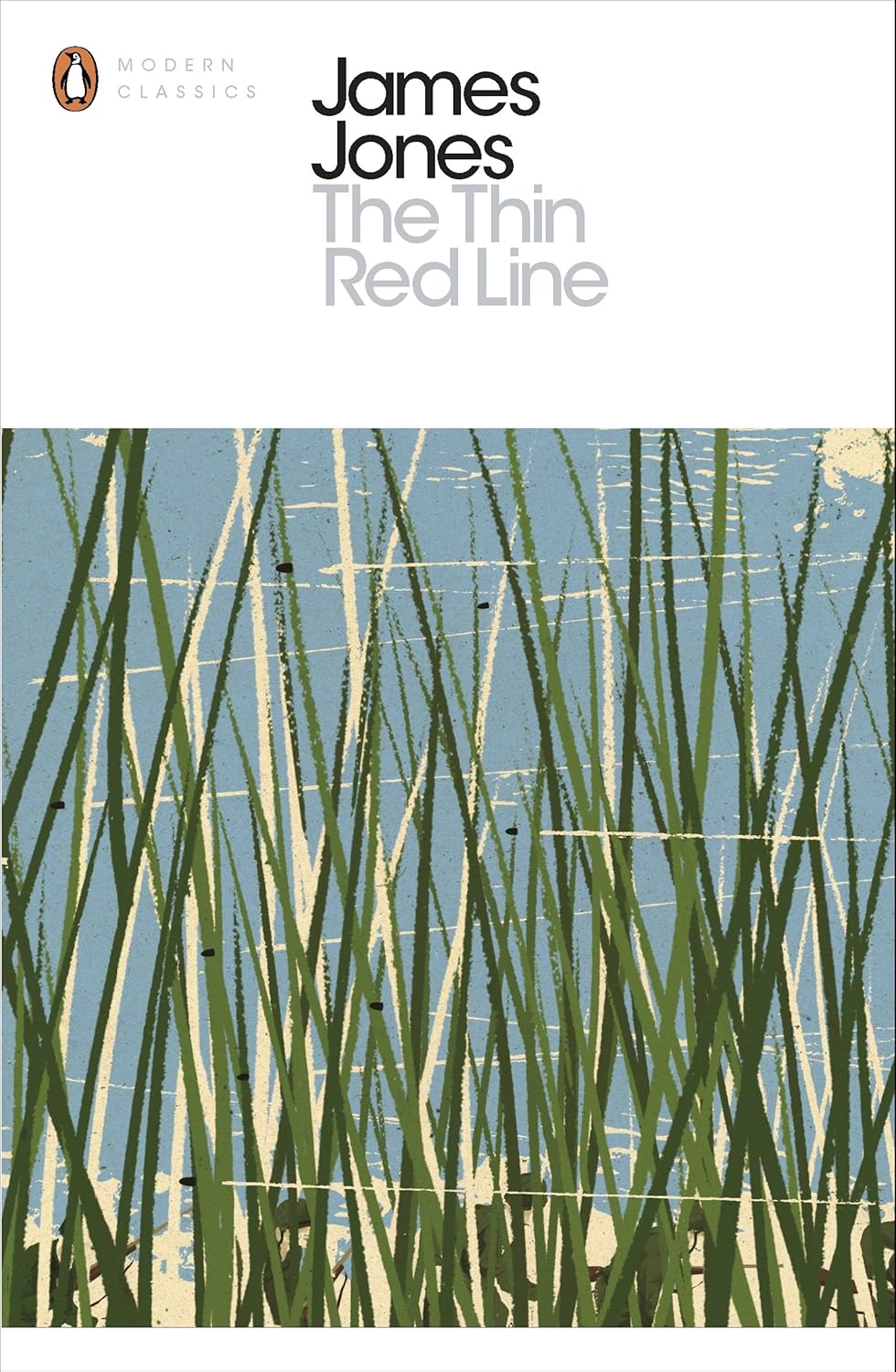
The Thin Red Line (Penguin Modern Classics)

Description:

'Moves so intensely and inexorably that it almost seems like the war it is describing' The New York Times Book Review

'Is it really worth it to die, to be dead, just to prove to everybody that you're not a coward?'

On Guadalcanal in the south Pacific, the soldiers of C Company are about to enter the war. The men know they face their baptism of fire. But none know if they will be one of 'the lucky ones' to make it safely off the island. From Captain Stein, who feels like a father to his troops, and 'Mad' Sergeant Welsh, condemning all nations while swigging gin from his canteen, to Private Bell, who just wants to get home to his wife, they will discover the line that divides sanity from madness, and life from death.

A scathing critique of heroism,
The Thin Red Line is among the greatest masterpieces of war writing.

'The men are real, the words are real, death is real, imminent and immediate'
Los Angeles Times


Review

Select Guide Rating

About the Author

James Jones (1921-1977) was born in Robinson, Illinois and enlisted in the US army in 1939, serving in the 25th Infantry Division in Hawaii during Pearl Harbor and later in Guadalcanal in the Pacfic, where he was wounded in action. He is the author of many acclaimed novels, including the National Book Award-winner From Here to Eternity.

Reviews:

5.0 out of 5 stars 2nd of 3

m. · 10 March 2019

First read this 30 odd years ago,lost my copy,hence Kindle order.Can remember being surprised that it was 2nd in a trilogy."From Here to Eternity"stole the limelight.This,however is my favorite of the 3.

4.0 out of 5 stars C-for-Charlie

P. · 26 November 2011

Well, I finished the book last night and then watched the 1998 film adaptation. The novel was a big read, with solid dense prose for 500 odd pages that took me two weeks to complete. The writing felt modern especially with the use of the F-word; it hadn't really dated except for the in-depth character description and analysis.From a slow start, it built to the stage where I needed to settle down with this book and rejoin C-for-Charlie in their battles for the variously named hills. To find out how Witt, Bell, Fife, Welsh, Storm, Queen, et al where surviving. As an ensemble piece it really works, reminding me of Band of Brothers, but of course it pre-dates that.The book is about men in war, and how they cope with debilitating fear, cowardice, chance, luck, fate, bravery, glory and death. There are some really brilliantly well drawn characters. Welsh and Witt are so so disappointing in the film...In fact the film is disappointing all round except for Nick Nolte as Tall. It needed character actors not pretty boys. Jones gives us such great insights into all their personalities the casting director should have been taken out and shot!I think it's worth 4.5 stars - with half a star taken off for the lack of maps - my only gripe about the book. A reader needs to kept informed and I hadn't much of an idea about Guadalcanal's topography before I read this book. Jones could see it in his mind's eye, he'd been there after all... as he tells us on the last page.

5.0 out of 5 stars Thanks

M.T.S. · 4 April 2021

Great book. As advertised. No problems with the purchase.

5.0 out of 5 stars GREAT READ

A.W. · 27 September 2014

What a great read, captures the scene and the characters so well, its clear he served in the same conflict to be able to put this down on paper so well.

4.0 out of 5 stars Helps to understand the film better

M. · 22 January 2016

The detailed descriptions of the terrain and troop movements are very difficult to follow or imagine. That said, the book really makes the reader think hard about how they themselves might behave in combat conditions. Sgt. Welsh was right.

5.0 out of 5 stars great book.

e. · 8 September 2017

excellent. harsh read and sad but one of the best war books I ever read..

5.0 out of 5 stars Five Stars

A.C. · 6 February 2016

brilliant book. I watched film as well which was dire. the film is not the book.

4.0 out of 5 stars Four Stars

M.R.D. · 24 June 2016

Classic

very satisfied

l. · 6 January 2019

great story

Edición buena y agradable

E.M. · 9 May 2021

Sin entrar a valorar el contenido, sólo indicar que es una edición buena y agradable por el precio marcado. Totalmente recomendable si estás interesado en el libro

More instructive (and more honest?) than most war novels

R.M.P. · 25 November 2011

Although not a great work of literature, THE THIN RED LINE is a powerful novel, one of the best in my experience of the American soldier in war. (Curiously, it is a very American novel, and I doubt that it would be as captivating for non-Americans.) It follows C-for-Charlie Company, an army rifle company, during its two months or so on Guadalcanal, from the time it is off-loaded by LCIs from a troop transport in November 1942, through two major battles and numerous patrols and skirmishes, to when it is about to board LCIs to be transported on to New Georgia. By then C-for-Charlie Company has been thoroughly transformed, through attrition by death, wounding, psychological breakdown, promotion and transfer, etc., and then gradual replacement with new green men. It has even gone through four commanding officers.One of the strengths of the novel is its ensemble cast of characters, and its constantly shifting perspective from one to another. The novel, then, is a kaleidoscope of combat experiences. It is also studded with brilliant combat scenes, some of them shocking. And it has its share of brutal atrocities - among them, an orgy of killing in a surprised bivouac, numerous slaughters of surrendering and unarmed Japanese soldiers, raucous disinterment of a corpse, and a mason jar collection of gold teeth yanked by pliers from the mouths of dead soldiers. (The novel also notes the barbarity of the Japanese.)Jones's writing is direct and forthright, though not particularly distinguished. The novel reads quite easily, but Jones is prone to being verbose and repetitious. He also tends to the vulgar, with a liberal dose of the four-letter words that had only recently begun appearing in mainstream American fiction when THE THIN RED LINE was published in 1962. Also groundbreaking, even scandalous, for that time were the novel's several homosexual encounters and its frequent references to a primal sexual drive engendered by combat and the threat of death.I first read THE THIN RED LINE about 1966, when I was nearing the end of high school. Vietnam and the prospect of my own military service loomed large. What most affected me then about the novel - and still registers with me on re-reading it forty-five years later - are the different takes on the enterprise of war. Here are three of them:* Staff Sergeant Storm knows and accepts that he is a coward. So why is he here? "If a man's government told him he had to go and fight a war, he had to go, that was all. The government was bigger than him and it could make him. It wasn't even a matter of duty; he HAD to go. And if he was the right kind of man he would want to go, no matter how much he didn't really want to."* Corporal Fife also is a coward, although he keeps putting himself in situations of danger. Why? "[H]e could not believe that he was fighting this war for God. And he did not believe he was fighting it for freedom, or democracy, or the dignity of the human race. When he analyzed it, as he tried to do now, he could find only one reason why he was here, and that was because he would be ashamed for people to think he was a coward, embarrassed to be put to jail."* "So Private Doll had killed his first Japanese. For that matter, his first human being of any kind. Doll had hunted quite a lot, and he could remember his first deer. But this was an experience which required extra tasting. Like getting screwed the first time, it was too complex to be classed solely as pride of accomplishment."THE THIN RED LINE likewise is complex. It neither glorifies nor condemns warfare. It depicts it, presumably as James Jones experienced it (he fought and was wounded on Guadalcanal). Given that it has no political agenda, the novel is more instructive (and more honest?) than most war novels. And the last sentence is superb.

A huge book! A huge read!!

J. · 21 October 2017

Hemingway, Wilder, Fitzgerald and part Michener among others, in one tough-to-read book. Books such as this are rarely written. You will personally know the characters soon after beginning this amazing book. It will become a part of your thoughts perhaps permanently. Amazing is an understatement. Very few are in this echelon of writers.

War at the coal face – flip side sequel to From Here to Eternity

M.C.D. · 24 March 2019

It is interesting to read “The Thin Red Line” directly after “From Here to Eternity”, as although the book is labelled as a “sequel” by James Jones, it is in most ways a very different book. “From Here to Eternity” is a rollicking, carousing novel of the lives, loves and pre-war antics at Schofield Army Barracks in the lead up to Pearl Harbour, where military life is at the centre of the novel but the rest of the population, including women and civilians are also part of the rich tapestry of the story. “The Thin Red Line” in comparison is a one act play. It centres on the landing and battles of C for Charlie Company on the island of Guadalcanal in the Pacific campaign during World War 2. Jones wasn’t the first to write about men at war, with the likes of Erich Maria Remarque writing about it brilliantly during the First World War, recounting in factual detail its horrors. But where Jones excels is on the inner life of his characters. The novel is unsparing in its descriptions of the hardships and behaviours of men at arms, from landing on the beach to jungle warfare, covering the entire spectrum of human emotions. Jones leaves no stone unturned, the novel switching from various characters at different ranks within the company, describing their individual reactions to a common experience.Whether it the fear of men before battle, their bloodlust in attack, homosexual desires, cannibalism, rampant alcoholism, anxiety over infidelity by wives back home, the arrogance of leadership or the randomness of death, Jones covers it all. In many ways it reads like a “documentary novel”. Jones gives great time and detail to military tactics and manoeuvres, obviously based on his own experience. These are men struggling in the heat and thirst of jungle warfare, aware that they could die any day, fighting the jungle and its conditions as much as the Imperial Japanese Army. It is a stream of consciousness of character thoughts, and Jones deftly manages the transformation, for good and for ill, of characters as they experience war. The book is infinitely darker and heavier going than its predecessor, and I am guessing that most of the people who read and enjoyed Jones’ first novel would struggle with this next instalment. There are versions of Pruett, Warden and Maggio, but most of the characters are generally unlikeable.Where Jones succeeds is in his honesty in the portrayal of humans, their frailties and all too human needs, pressure cooked in a time of war. He continues to shine in his understanding and insights into human behaviour in the most difficult of circumstances, and is outstanding in his revelation on what war in the Pacific was like, and the high price physically and emotionally its combatants paid, demonstrating the full spectrum of human nature, from the inspiring to the ugly. My only criticism is the ending – after building the tension and getting the novel fully underway, the ending is anti-climactic as much of C for Charlie Company is replaced by raw recruits and the rest evacuated off Guadalcanal. But this ending is probably closer to the reality of what actually happened. The Thin Red Line was published in 1962, and I’m sure any American soldier reading it in Vietnam, would have strongly related to it and agreed that war is war is war, and that they like the soldiers in C for Charlie company, weren’t fighting for democracy or the star spangled banner - they were fighting for their lives, every minute of every hour of every day, and that if they were one of the lucky ones to return home, they were never the same again. And as a footnote, the book is infinitely superior to the rambling, navel gazing movie.”

The Thin Red Line (Penguin Modern Classics)

Product ID: K0141393246
Condition: New

4.4

AED8161

Price includes VAT & Import Duties
Type: Paperback
Availability: In Stock

Quantity:

|

Order today to get by 7-14 business days

Delivery fee of AED 20. Free for orders above AED 200.

Returns & Warranty policies

Imported From: United Kingdom

At BOLO, we work hard to ensure the products you receive are new, genuine, and sourced from reputable suppliers.

BOLO is not an authorized or official retailer for most brands, nor are we affiliated with manufacturers unless specifically stated on a product page. Instead, we source verified sellers, authorized distributors or directly from the manufacturer.

Each product undergoes thorough inspection and verification at our consolidation and fulfilment centers to ensure it meets our strict authenticity and quality standards before being shipped and delivered to you.

If you ever have concerns regarding the authenticity of a product purchased from us, please contact Bolo Support. We will review your inquiry promptly and, if necessary, provide documentation verifying authenticity or offer a suitable resolution.

Your trust is our top priority, and we are committed to maintaining transparency and integrity in every transaction.

All product information, images, descriptions, and reviews originate from the manufacturer or from trusted sellers overseas. BOLO is not affiliated with, endorsed by, or an authorized retailer for most brands listed on our website unless stated otherwise.

While we strive to display accurate information, variations in packaging, labeling, instructions, or formulation may occasionally occur due to regional differences or supplier updates. For detailed or manufacturer-specific information, please contact the brand directly or reach out to BOLO Support for assistance.

Unless otherwise stated, all prices displayed on the product page include applicable taxes and import duties.

BOLO operates in accordance with the laws and regulations of United Arab Emirates. Any items found to be restricted or prohibited for sale within the UAE will be cancelled prior to shipment. We take proactive measures to ensure that only products permitted for sale in United Arab Emirates are listed on our website.

All items are shipped by air, and any products classified as “Dangerous Goods (DG)” under IATA regulations will be removed from the order and cancelled.

All orders are processed manually, and we make every effort to process them promptly once confirmed. Products cancelled due to the above reasons will be permanently removed from listings across the website.

Similar suggestions by Bolo

More from this brand

Similar items from “Historical”

The Thin Red Line (Penguin Modern Classics)

Product ID: K0141393246
Condition: New

4.4

The Thin Red Line (Penguin Modern Classics)-0
Type: Paperback

AED8161

Price includes VAT & Import Duties
Availability: In Stock

Quantity:

|

Order today to get by 7-14 business days

Delivery fee of AED 20. Free for orders above AED 200.

Returns & Warranty policies

Imported From: United Kingdom

At BOLO, we work hard to ensure the products you receive are new, genuine, and sourced from reputable suppliers.

BOLO is not an authorized or official retailer for most brands, nor are we affiliated with manufacturers unless specifically stated on a product page. Instead, we source verified sellers, authorized distributors or directly from the manufacturer.

Each product undergoes thorough inspection and verification at our consolidation and fulfilment centers to ensure it meets our strict authenticity and quality standards before being shipped and delivered to you.

If you ever have concerns regarding the authenticity of a product purchased from us, please contact Bolo Support. We will review your inquiry promptly and, if necessary, provide documentation verifying authenticity or offer a suitable resolution.

Your trust is our top priority, and we are committed to maintaining transparency and integrity in every transaction.

All product information, images, descriptions, and reviews originate from the manufacturer or from trusted sellers overseas. BOLO is not affiliated with, endorsed by, or an authorized retailer for most brands listed on our website unless stated otherwise.

While we strive to display accurate information, variations in packaging, labeling, instructions, or formulation may occasionally occur due to regional differences or supplier updates. For detailed or manufacturer-specific information, please contact the brand directly or reach out to BOLO Support for assistance.

Unless otherwise stated, all prices displayed on the product page include applicable taxes and import duties.

BOLO operates in accordance with the laws and regulations of United Arab Emirates. Any items found to be restricted or prohibited for sale within the UAE will be cancelled prior to shipment. We take proactive measures to ensure that only products permitted for sale in United Arab Emirates are listed on our website.

All items are shipped by air, and any products classified as “Dangerous Goods (DG)” under IATA regulations will be removed from the order and cancelled.

All orders are processed manually, and we make every effort to process them promptly once confirmed. Products cancelled due to the above reasons will be permanently removed from listings across the website.

Description:

'Moves so intensely and inexorably that it almost seems like the war it is describing' The New York Times Book Review

'Is it really worth it to die, to be dead, just to prove to everybody that you're not a coward?'

On Guadalcanal in the south Pacific, the soldiers of C Company are about to enter the war. The men know they face their baptism of fire. But none know if they will be one of 'the lucky ones' to make it safely off the island. From Captain Stein, who feels like a father to his troops, and 'Mad' Sergeant Welsh, condemning all nations while swigging gin from his canteen, to Private Bell, who just wants to get home to his wife, they will discover the line that divides sanity from madness, and life from death.

A scathing critique of heroism,
The Thin Red Line is among the greatest masterpieces of war writing.

'The men are real, the words are real, death is real, imminent and immediate'
Los Angeles Times


Review

Select Guide Rating

About the Author

James Jones (1921-1977) was born in Robinson, Illinois and enlisted in the US army in 1939, serving in the 25th Infantry Division in Hawaii during Pearl Harbor and later in Guadalcanal in the Pacfic, where he was wounded in action. He is the author of many acclaimed novels, including the National Book Award-winner From Here to Eternity.

Reviews:

5.0 out of 5 stars 2nd of 3

m. · 10 March 2019

First read this 30 odd years ago,lost my copy,hence Kindle order.Can remember being surprised that it was 2nd in a trilogy."From Here to Eternity"stole the limelight.This,however is my favorite of the 3.

4.0 out of 5 stars C-for-Charlie

P. · 26 November 2011

Well, I finished the book last night and then watched the 1998 film adaptation. The novel was a big read, with solid dense prose for 500 odd pages that took me two weeks to complete. The writing felt modern especially with the use of the F-word; it hadn't really dated except for the in-depth character description and analysis.From a slow start, it built to the stage where I needed to settle down with this book and rejoin C-for-Charlie in their battles for the variously named hills. To find out how Witt, Bell, Fife, Welsh, Storm, Queen, et al where surviving. As an ensemble piece it really works, reminding me of Band of Brothers, but of course it pre-dates that.The book is about men in war, and how they cope with debilitating fear, cowardice, chance, luck, fate, bravery, glory and death. There are some really brilliantly well drawn characters. Welsh and Witt are so so disappointing in the film...In fact the film is disappointing all round except for Nick Nolte as Tall. It needed character actors not pretty boys. Jones gives us such great insights into all their personalities the casting director should have been taken out and shot!I think it's worth 4.5 stars - with half a star taken off for the lack of maps - my only gripe about the book. A reader needs to kept informed and I hadn't much of an idea about Guadalcanal's topography before I read this book. Jones could see it in his mind's eye, he'd been there after all... as he tells us on the last page.

5.0 out of 5 stars Thanks

M.T.S. · 4 April 2021

Great book. As advertised. No problems with the purchase.

5.0 out of 5 stars GREAT READ

A.W. · 27 September 2014

What a great read, captures the scene and the characters so well, its clear he served in the same conflict to be able to put this down on paper so well.

4.0 out of 5 stars Helps to understand the film better

M. · 22 January 2016

The detailed descriptions of the terrain and troop movements are very difficult to follow or imagine. That said, the book really makes the reader think hard about how they themselves might behave in combat conditions. Sgt. Welsh was right.

5.0 out of 5 stars great book.

e. · 8 September 2017

excellent. harsh read and sad but one of the best war books I ever read..

5.0 out of 5 stars Five Stars

A.C. · 6 February 2016

brilliant book. I watched film as well which was dire. the film is not the book.

4.0 out of 5 stars Four Stars

M.R.D. · 24 June 2016

Classic

very satisfied

l. · 6 January 2019

great story

Edición buena y agradable

E.M. · 9 May 2021

Sin entrar a valorar el contenido, sólo indicar que es una edición buena y agradable por el precio marcado. Totalmente recomendable si estás interesado en el libro

More instructive (and more honest?) than most war novels

R.M.P. · 25 November 2011

Although not a great work of literature, THE THIN RED LINE is a powerful novel, one of the best in my experience of the American soldier in war. (Curiously, it is a very American novel, and I doubt that it would be as captivating for non-Americans.) It follows C-for-Charlie Company, an army rifle company, during its two months or so on Guadalcanal, from the time it is off-loaded by LCIs from a troop transport in November 1942, through two major battles and numerous patrols and skirmishes, to when it is about to board LCIs to be transported on to New Georgia. By then C-for-Charlie Company has been thoroughly transformed, through attrition by death, wounding, psychological breakdown, promotion and transfer, etc., and then gradual replacement with new green men. It has even gone through four commanding officers.One of the strengths of the novel is its ensemble cast of characters, and its constantly shifting perspective from one to another. The novel, then, is a kaleidoscope of combat experiences. It is also studded with brilliant combat scenes, some of them shocking. And it has its share of brutal atrocities - among them, an orgy of killing in a surprised bivouac, numerous slaughters of surrendering and unarmed Japanese soldiers, raucous disinterment of a corpse, and a mason jar collection of gold teeth yanked by pliers from the mouths of dead soldiers. (The novel also notes the barbarity of the Japanese.)Jones's writing is direct and forthright, though not particularly distinguished. The novel reads quite easily, but Jones is prone to being verbose and repetitious. He also tends to the vulgar, with a liberal dose of the four-letter words that had only recently begun appearing in mainstream American fiction when THE THIN RED LINE was published in 1962. Also groundbreaking, even scandalous, for that time were the novel's several homosexual encounters and its frequent references to a primal sexual drive engendered by combat and the threat of death.I first read THE THIN RED LINE about 1966, when I was nearing the end of high school. Vietnam and the prospect of my own military service loomed large. What most affected me then about the novel - and still registers with me on re-reading it forty-five years later - are the different takes on the enterprise of war. Here are three of them:* Staff Sergeant Storm knows and accepts that he is a coward. So why is he here? "If a man's government told him he had to go and fight a war, he had to go, that was all. The government was bigger than him and it could make him. It wasn't even a matter of duty; he HAD to go. And if he was the right kind of man he would want to go, no matter how much he didn't really want to."* Corporal Fife also is a coward, although he keeps putting himself in situations of danger. Why? "[H]e could not believe that he was fighting this war for God. And he did not believe he was fighting it for freedom, or democracy, or the dignity of the human race. When he analyzed it, as he tried to do now, he could find only one reason why he was here, and that was because he would be ashamed for people to think he was a coward, embarrassed to be put to jail."* "So Private Doll had killed his first Japanese. For that matter, his first human being of any kind. Doll had hunted quite a lot, and he could remember his first deer. But this was an experience which required extra tasting. Like getting screwed the first time, it was too complex to be classed solely as pride of accomplishment."THE THIN RED LINE likewise is complex. It neither glorifies nor condemns warfare. It depicts it, presumably as James Jones experienced it (he fought and was wounded on Guadalcanal). Given that it has no political agenda, the novel is more instructive (and more honest?) than most war novels. And the last sentence is superb.

A huge book! A huge read!!

J. · 21 October 2017

Hemingway, Wilder, Fitzgerald and part Michener among others, in one tough-to-read book. Books such as this are rarely written. You will personally know the characters soon after beginning this amazing book. It will become a part of your thoughts perhaps permanently. Amazing is an understatement. Very few are in this echelon of writers.

War at the coal face – flip side sequel to From Here to Eternity

M.C.D. · 24 March 2019

It is interesting to read “The Thin Red Line” directly after “From Here to Eternity”, as although the book is labelled as a “sequel” by James Jones, it is in most ways a very different book. “From Here to Eternity” is a rollicking, carousing novel of the lives, loves and pre-war antics at Schofield Army Barracks in the lead up to Pearl Harbour, where military life is at the centre of the novel but the rest of the population, including women and civilians are also part of the rich tapestry of the story. “The Thin Red Line” in comparison is a one act play. It centres on the landing and battles of C for Charlie Company on the island of Guadalcanal in the Pacific campaign during World War 2. Jones wasn’t the first to write about men at war, with the likes of Erich Maria Remarque writing about it brilliantly during the First World War, recounting in factual detail its horrors. But where Jones excels is on the inner life of his characters. The novel is unsparing in its descriptions of the hardships and behaviours of men at arms, from landing on the beach to jungle warfare, covering the entire spectrum of human emotions. Jones leaves no stone unturned, the novel switching from various characters at different ranks within the company, describing their individual reactions to a common experience.Whether it the fear of men before battle, their bloodlust in attack, homosexual desires, cannibalism, rampant alcoholism, anxiety over infidelity by wives back home, the arrogance of leadership or the randomness of death, Jones covers it all. In many ways it reads like a “documentary novel”. Jones gives great time and detail to military tactics and manoeuvres, obviously based on his own experience. These are men struggling in the heat and thirst of jungle warfare, aware that they could die any day, fighting the jungle and its conditions as much as the Imperial Japanese Army. It is a stream of consciousness of character thoughts, and Jones deftly manages the transformation, for good and for ill, of characters as they experience war. The book is infinitely darker and heavier going than its predecessor, and I am guessing that most of the people who read and enjoyed Jones’ first novel would struggle with this next instalment. There are versions of Pruett, Warden and Maggio, but most of the characters are generally unlikeable.Where Jones succeeds is in his honesty in the portrayal of humans, their frailties and all too human needs, pressure cooked in a time of war. He continues to shine in his understanding and insights into human behaviour in the most difficult of circumstances, and is outstanding in his revelation on what war in the Pacific was like, and the high price physically and emotionally its combatants paid, demonstrating the full spectrum of human nature, from the inspiring to the ugly. My only criticism is the ending – after building the tension and getting the novel fully underway, the ending is anti-climactic as much of C for Charlie Company is replaced by raw recruits and the rest evacuated off Guadalcanal. But this ending is probably closer to the reality of what actually happened. The Thin Red Line was published in 1962, and I’m sure any American soldier reading it in Vietnam, would have strongly related to it and agreed that war is war is war, and that they like the soldiers in C for Charlie company, weren’t fighting for democracy or the star spangled banner - they were fighting for their lives, every minute of every hour of every day, and that if they were one of the lucky ones to return home, they were never the same again. And as a footnote, the book is infinitely superior to the rambling, navel gazing movie.”

Similar suggestions by Bolo

More from this brand

Similar items from “Historical”