Description:
Review
Justice is a lucid and compelling analysis of our current moral dilemmas, which argues for a new commitment to citizenship and the common good ― Shirley Williams
In the beautifully concise explanations of American philosopher Michael Sandel, I see great insight into our current predicaments. If any political reckoning is on its way . . . then perhaps it might come from the philosophy department of Harvard ― Madeleine Bunting
Michael Sandel, perhaps the most prominent college professor in America,...practices the best kind of academic populism, managing to simplify John Stuart Mill and John Rawls without being simplistic. But Sandel is best at what he calls bringing 'moral clarity to the alternatives we confront as democratic citizens'.... He ends up clarifying a basic political divide - not between left and right, but between those who recognize nothing greater than individual rights and choices, and those who affirm a 'politics of the common good,' rooted in moral beliefs that can't be ignored
-- Michael Gerson ― Washington PostMichael Sandel transforms moral philosophy by putting it at the heart of civic debate....Sandel's insistence on the inescapably ethical character of political debate is enormously refreshing -- Edward Skidelsky ― New Statesman
A spellbinding philosopher.... For Michael Sandel, justice is not a spectator sport.... He is calling for nothing less than a reinvigoration of citizenship -- Samuel Moyn ― The Nation
An ambitious and an appealing idea. Intriguingly, I find myself persuaded that it might well be worth a try ― Lisa Jardine, The Times
More than exhilarating; exciting in its ability to persuade this student/reader, time and again, that the principle now being invoked-on this page, in this chapter-is the one to deliver the sufficiently inclusive guide to the making of a decent life -- Vivien Gornick ― Boston Review
Sandel explains theories of justice...with clarity and immediacy; the ideas of Aristotle, Jeremy Bentham, Immanuel Kant, John Stuart Mill, Robert Nozick and John Rawls have rarely, if ever, been set out as accessibly... In terms we can all understand, Justice confronts us with the concepts that lurk, so often unacknowledged, beneath our conflicts -- Jonathan Rauch ― New York Times
This book is absolutely indispensable for anyone who wants to be a good citizen. It shows how to balance competing values, a talent our nation desperately needs nowadays -- Walter Isaacson, author of 'Benjamin Franklin: An American Life'
Manufacturer Contact Information
Reviews:
5.0 out of 5 stars A marvellously accessible overview on a serious subject which challenges all our decisions
I am glad that I have persevered with this book, and done it justice by finishing it and thereby hearing the author's conclusion on the subject. Reading the first 60 or so pages, I found myself sick to the stomach; I found the notion of utilitarianism revolting. The concept of thinking about justice and moral by calculation and treating human beings like "arguments" in the utility or happiness maximisation function, governed only by human's primeval makeup of pain and pleasures, is, to me, hugely degrading. Forcing my mind to comprehend such alien notion turned out to be very disagreeable to my mind that it rebelled! I soldiered on and was glad to find the critiques of utilitarianism, which came afterwards, and where humans were described like humans, moral agents.It is no denying that this book is thought provoking, because it challenges our assumptions and beliefs so ingrained in our thinking and debate about social issues of the day. In our inclination, we are not even aware of our biases. This book helps take apart all those assumptions, which have been taken for granted, and presents alternative or competing approaches to think about the same issues. In so doing, it broadens our view and considerations. Along the wider spectrum, we work out where our inclination is situated. Once we know the positioning of our inclination, we may start to review if we would like to adjust its placement and why.For example, after reading this book, I realise how much our politics and public discourse are influenced by liberalism and individualism. Interestingly, no political parties are actually consistent in advocating the same principles in all area of policies. This is a reckoning. In the past I believe that economic justice is defined clearly by the market discipline and mechanism, although success is not always in direct proportion to talents and effort, not to say that we did not choose our initial endowments. Rawls has expounded on this randomness from "an original position of equality" (while a similar concept has been coined by Warren Buffett as "the ovarian lottery"). However what is most interesting is the notion of moral desert. We think justice is done when we get what we deserve. But what we deserve cannot be defined without referring to the purpose of the social institution under concern or the virtues to be honoured and rewarded, and in turn the rules of the game. Purposes and virtues are moral values.But what is most powerful in swaying me away from minimal state is not Rawls' liberalism egalitarianism but our sense of belonging to a community, which is part of our identity. I don't think it is realistic to think that we can abstract ourselves from all our ties and links in making moral decisions behind "a veil of ignorance", as required by Rawls' theory. It is to me more natural to think that we are indeed "storytelling beings" living in narratives, as "situated selves" rather than "individuals" living in isolation. How big is and who are in this community that we align our loyalty with, and what our membership to this community entails are yet to be thought through on a case-by-case basis, I guess. But at the very least, this sense of belonging and membership will give rise to a sense of collective responsibility within this community, past and present.There are other highlights from the book. For example, Aristotle's concept that moral virtues have to be practised and exercised through choice. This reminds me of Hayek's point about socialism as amoral because people no longer exercised choice. As the author eloquently argues, deliberation reflects the quality of character, and "to have character is to live in recognition of one's (sometime conflicting) encumbrances." (p. 237)Also Kant's critique to utilitarianism is brilliant to the point. We are not free agents as we think, if our actions are governed by our desires which we haven't chosen in the first place. "Trying to derive moral principles from the desires we happen to have is the wrong way to think about morality." (p.106) Morality based on interests, wants, desires and preferences people have at any time cannot give rise to universal principles, because these factors are variable and contingent, and can hardly be a consistent basis for a set of coherent moral principles! Even the pursuit of happiness, which has been taken by many as a legitimate pursuit in life, cannot be the basis for the same reasons. If our desires and wants can't serve as the basis of morality, what's left? One possibility is God, but Kant appeals to our "pure practical reason". Furthermore, our capacity for reason underlies our capacity for freedom.I think the author's reflection of today's politics is accurate: "Asking democratic citizens to leave their moral and religious convictions behind when they enter the public realm may seem a way of ensuring toleration and mutual respect. In practice, however, the opposite can be true. Deciding important public questions while pretending to a neutrality that cannot be achieved is a recipe for backlash and resentment. A politics emptied of substantive moral engagement makes for an impoverished civic life. It is also an open invitation to narrow, intolerant moralisms. Fundamentalists rush in where liberals fear to tread." (p.243)Today the pressure to have everything permissible in our society under the name of liberalism, which seeks to provide scope for everyone to choose his good life (as long as it does not infringe on others' rights), without defining for anyone what a good life is. It is believed that liberalism is the way to accommodate a pluralistic society. But after decades of following this ideology we see our sense of community weakened and replaced by apathy and divisive politics, and we see increasingly our society moves to value the wrong things. Is it time that we challenge a politics that is void of substance? The author thinks so, as he concludes, "A politics of moral engagement is not only a more inspiring ideal than a politics of avoidance. It is also a more promising basis for a just society." (p.269) Do you agree it is time to rethink?
5.0 out of 5 stars Not an easy read but a worthwhile one!
This well written and interesting book is simply the written version of his infamous online Harvard teaching series of the same name, so if you are expecting something new you won't find it. However, I still enjoyed reading it and it was nice to have his ideas set out clearly and at times elaborated on in a little more detail than what he has time for in his lectures, ideally I would recommend reading the book first and then watching his free lectures online afterwards.The book has a quality feel about it as is the usual quality expected from Penguin books.
5.0 out of 5 stars Present for daughter, she finds it awesome
I heard the author speaking on radio 4 or was it someone summing up his book. What I heard was enough for me to take the risk of purchasing it for my teenage daughter. As always a little concern as to it being read. I need not have feared the book was soon finished with regular references and re-reading. Studying 'A' levels in the subjects coherent to take a path into international law I think this book is likely to stay close to her for a number of yearsHighly recommend to all age groups it is well written and its contents are inspiring
4.0 out of 5 stars Very good
This is an excellent book on the always tricky subject of "what's the right thing to do", or simply "what's right or wrong". The author is an eminent scholar and the range of his knowledge is remarkable. However, he manages to turn a complex matter into a very clear book, helped by very clear and useful examples.Some authors appear constantly, yet they've never been so clear, such as Kant or Mill's utilitarism.Equally, some notions, such as justice, fairness, liberty and other similar ones, are explained beautifully and, importantly, in their different meanings throughout history.A very good book who repays repeated readings.
5.0 out of 5 stars A very accessible, but in no way shallow, introduction to 'working' philosophy
This is the second copy I have bought of this book (the perils of lending to friends). It is a fascinating, thought provoking, mind-opening piece of work. It doesn't seek to give the answers but gives a person the tools to ask the right questions of an issue, in order to find an answer that they are happy with. It will make you think seriously about issues that you had thought you had made your mind up on; some controversial and some so seemingly obvious, you didn't think worth consideration. Very interesting, full of examples from life. You thought philosophy was a subject for academia only? Think again! Cannot recommend highly enough.
5.0 out of 5 stars Jurisprudence at its Best!
I do not give this five stars lightly. I think there is a clear need for more accessible Jurisprudence and Legal History Texts. This is one of those texts that are a modern approach to Jurisprudence and an introduction that will actually encourage further reading rather than discourage it (like ahem Lloyds for example).Buy it for the major core long term and perpetual debates. It is worth it for that. It is also worth it for the clarity of writing on the one hand but still profundity of content on the other - not an easy thing for an academic to achieve.I suspect it will lead one onto further investigation of topics in Jurisprudence - including the Hart-Devlin and Hart-Fuller debates.
5.0 out of 5 stars philosophy for real life
thrilling, crystal clear philosophical writing, applied with empathy to real ethical dilemmas. moral philosophy as a tool for living life more intelligently and ethically: fantastic.from bentham, mill, kant, rawls, to alasdair macintyre, revolutionary aristotleians, and a 'narrative conception of morality'. this made me think more deeply, and more sympathetically, outside my usual prejudices. as sorry to finish this as i am when i come to the end of a good thriller.off to alasdair macintyre's 'after virtue' now, on the basis of sandel's treatment of it.
after unpacking
Not objective
Perspective is limited and can appear biased-have to consider it contextually and as a left leaning idealistic viewpoint, certainly not objective but does raise debate.
Five Stars
Came on time; book's quality matched its description!
Morality
So iteresting questions about morality totally different thinking
Fachbuch
Super Zusammenfassung der ganzen politischen Philosophie, auch in einem sehr sorgfältigen und beispielhaft guten Rahmen. Theorie zu was man für Geld nicht kaufen kann
Visit the Penguin Store
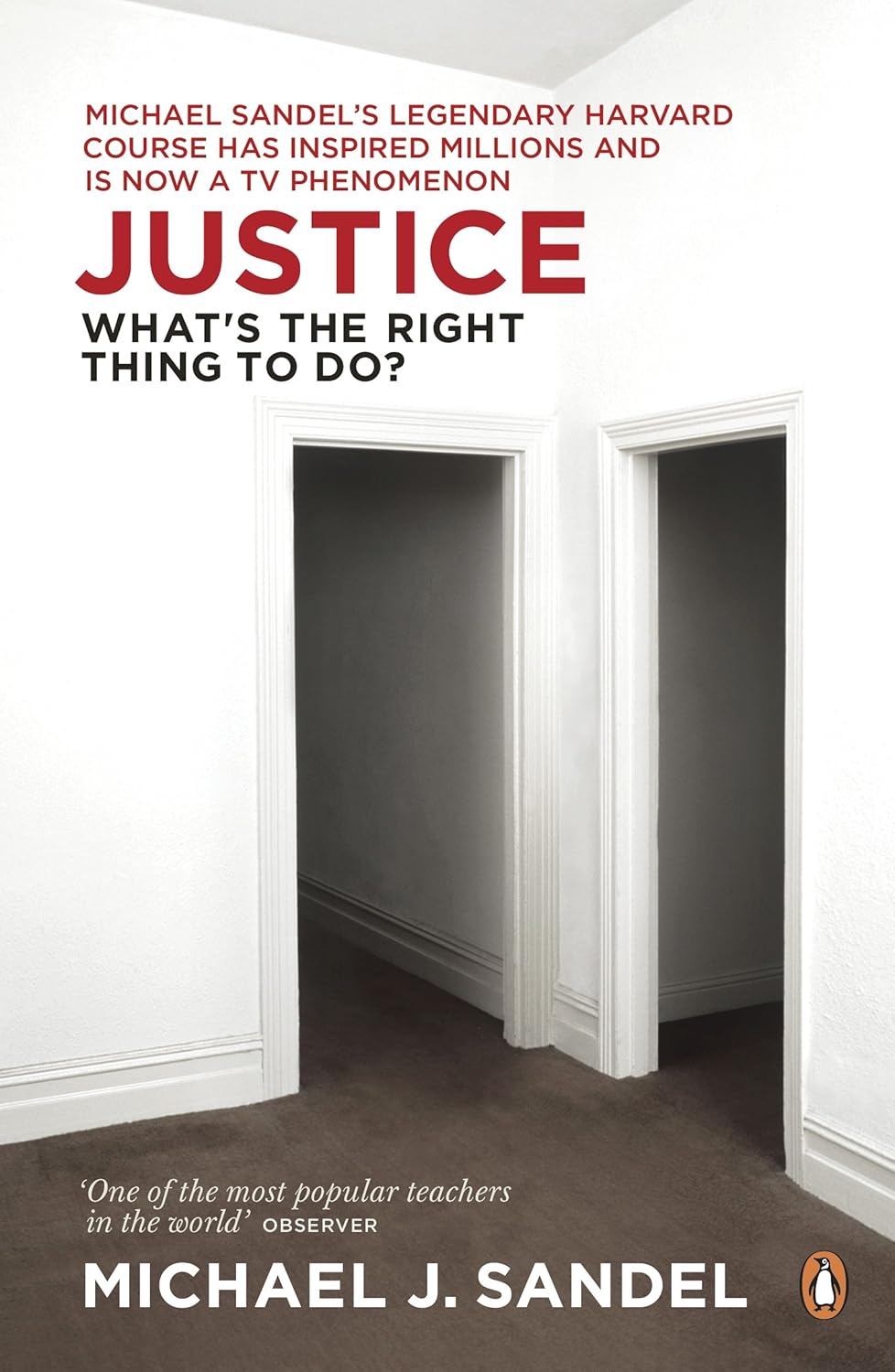
Justice: What's the Right Thing to Do?
AED8257
Quantity:
Order today to get by 7-14 business days
Delivery fee of AED 20. Free for orders above AED 200.
Imported From: United Kingdom
At BOLO, we work hard to ensure the products you receive are new, genuine, and sourced from reputable suppliers.
BOLO is not an authorized or official retailer for most brands, nor are we affiliated with manufacturers unless specifically stated on a product page. Instead, we source verified sellers, authorized distributors or directly from the manufacturer.
Each product undergoes thorough inspection and verification at our consolidation and fulfilment centers to ensure it meets our strict authenticity and quality standards before being shipped and delivered to you.
If you ever have concerns regarding the authenticity of a product purchased from us, please contact Bolo Support. We will review your inquiry promptly and, if necessary, provide documentation verifying authenticity or offer a suitable resolution.
Your trust is our top priority, and we are committed to maintaining transparency and integrity in every transaction.
All product information, images, descriptions, and reviews originate from the manufacturer or from trusted sellers overseas. BOLO is not affiliated with, endorsed by, or an authorized retailer for most brands listed on our website unless stated otherwise.
While we strive to display accurate information, variations in packaging, labeling, instructions, or formulation may occasionally occur due to regional differences or supplier updates. For detailed or manufacturer-specific information, please contact the brand directly or reach out to BOLO Support for assistance.
Unless otherwise stated, all prices displayed on the product page include applicable taxes and import duties.
BOLO operates in accordance with the laws and regulations of United Arab Emirates. Any items found to be restricted or prohibited for sale within the UAE will be cancelled prior to shipment. We take proactive measures to ensure that only products permitted for sale in United Arab Emirates are listed on our website.
All items are shipped by air, and any products classified as “Dangerous Goods (DG)” under IATA regulations will be removed from the order and cancelled.
All orders are processed manually, and we make every effort to process them promptly once confirmed. Products cancelled due to the above reasons will be permanently removed from listings across the website.
Similar suggestions by Bolo
More from this brand
Similar items from “History”
Share with
Or share with link
https://www.bolo.ae/products/K0141041331
Visit the Penguin Store
Justice: What's the Right Thing to Do?

AED8257
Quantity:
Order today to get by 7-14 business days
Delivery fee of AED 20. Free for orders above AED 200.
Imported From: United Kingdom
At BOLO, we work hard to ensure the products you receive are new, genuine, and sourced from reputable suppliers.
BOLO is not an authorized or official retailer for most brands, nor are we affiliated with manufacturers unless specifically stated on a product page. Instead, we source verified sellers, authorized distributors or directly from the manufacturer.
Each product undergoes thorough inspection and verification at our consolidation and fulfilment centers to ensure it meets our strict authenticity and quality standards before being shipped and delivered to you.
If you ever have concerns regarding the authenticity of a product purchased from us, please contact Bolo Support. We will review your inquiry promptly and, if necessary, provide documentation verifying authenticity or offer a suitable resolution.
Your trust is our top priority, and we are committed to maintaining transparency and integrity in every transaction.
All product information, images, descriptions, and reviews originate from the manufacturer or from trusted sellers overseas. BOLO is not affiliated with, endorsed by, or an authorized retailer for most brands listed on our website unless stated otherwise.
While we strive to display accurate information, variations in packaging, labeling, instructions, or formulation may occasionally occur due to regional differences or supplier updates. For detailed or manufacturer-specific information, please contact the brand directly or reach out to BOLO Support for assistance.
Unless otherwise stated, all prices displayed on the product page include applicable taxes and import duties.
BOLO operates in accordance with the laws and regulations of United Arab Emirates. Any items found to be restricted or prohibited for sale within the UAE will be cancelled prior to shipment. We take proactive measures to ensure that only products permitted for sale in United Arab Emirates are listed on our website.
All items are shipped by air, and any products classified as “Dangerous Goods (DG)” under IATA regulations will be removed from the order and cancelled.
All orders are processed manually, and we make every effort to process them promptly once confirmed. Products cancelled due to the above reasons will be permanently removed from listings across the website.
Description:
Review
Justice is a lucid and compelling analysis of our current moral dilemmas, which argues for a new commitment to citizenship and the common good ― Shirley Williams
In the beautifully concise explanations of American philosopher Michael Sandel, I see great insight into our current predicaments. If any political reckoning is on its way . . . then perhaps it might come from the philosophy department of Harvard ― Madeleine Bunting
Michael Sandel, perhaps the most prominent college professor in America,...practices the best kind of academic populism, managing to simplify John Stuart Mill and John Rawls without being simplistic. But Sandel is best at what he calls bringing 'moral clarity to the alternatives we confront as democratic citizens'.... He ends up clarifying a basic political divide - not between left and right, but between those who recognize nothing greater than individual rights and choices, and those who affirm a 'politics of the common good,' rooted in moral beliefs that can't be ignored
-- Michael Gerson ― Washington PostMichael Sandel transforms moral philosophy by putting it at the heart of civic debate....Sandel's insistence on the inescapably ethical character of political debate is enormously refreshing -- Edward Skidelsky ― New Statesman
A spellbinding philosopher.... For Michael Sandel, justice is not a spectator sport.... He is calling for nothing less than a reinvigoration of citizenship -- Samuel Moyn ― The Nation
An ambitious and an appealing idea. Intriguingly, I find myself persuaded that it might well be worth a try ― Lisa Jardine, The Times
More than exhilarating; exciting in its ability to persuade this student/reader, time and again, that the principle now being invoked-on this page, in this chapter-is the one to deliver the sufficiently inclusive guide to the making of a decent life -- Vivien Gornick ― Boston Review
Sandel explains theories of justice...with clarity and immediacy; the ideas of Aristotle, Jeremy Bentham, Immanuel Kant, John Stuart Mill, Robert Nozick and John Rawls have rarely, if ever, been set out as accessibly... In terms we can all understand, Justice confronts us with the concepts that lurk, so often unacknowledged, beneath our conflicts -- Jonathan Rauch ― New York Times
This book is absolutely indispensable for anyone who wants to be a good citizen. It shows how to balance competing values, a talent our nation desperately needs nowadays -- Walter Isaacson, author of 'Benjamin Franklin: An American Life'
Manufacturer Contact Information
Reviews:
5.0 out of 5 stars A marvellously accessible overview on a serious subject which challenges all our decisions
I am glad that I have persevered with this book, and done it justice by finishing it and thereby hearing the author's conclusion on the subject. Reading the first 60 or so pages, I found myself sick to the stomach; I found the notion of utilitarianism revolting. The concept of thinking about justice and moral by calculation and treating human beings like "arguments" in the utility or happiness maximisation function, governed only by human's primeval makeup of pain and pleasures, is, to me, hugely degrading. Forcing my mind to comprehend such alien notion turned out to be very disagreeable to my mind that it rebelled! I soldiered on and was glad to find the critiques of utilitarianism, which came afterwards, and where humans were described like humans, moral agents.It is no denying that this book is thought provoking, because it challenges our assumptions and beliefs so ingrained in our thinking and debate about social issues of the day. In our inclination, we are not even aware of our biases. This book helps take apart all those assumptions, which have been taken for granted, and presents alternative or competing approaches to think about the same issues. In so doing, it broadens our view and considerations. Along the wider spectrum, we work out where our inclination is situated. Once we know the positioning of our inclination, we may start to review if we would like to adjust its placement and why.For example, after reading this book, I realise how much our politics and public discourse are influenced by liberalism and individualism. Interestingly, no political parties are actually consistent in advocating the same principles in all area of policies. This is a reckoning. In the past I believe that economic justice is defined clearly by the market discipline and mechanism, although success is not always in direct proportion to talents and effort, not to say that we did not choose our initial endowments. Rawls has expounded on this randomness from "an original position of equality" (while a similar concept has been coined by Warren Buffett as "the ovarian lottery"). However what is most interesting is the notion of moral desert. We think justice is done when we get what we deserve. But what we deserve cannot be defined without referring to the purpose of the social institution under concern or the virtues to be honoured and rewarded, and in turn the rules of the game. Purposes and virtues are moral values.But what is most powerful in swaying me away from minimal state is not Rawls' liberalism egalitarianism but our sense of belonging to a community, which is part of our identity. I don't think it is realistic to think that we can abstract ourselves from all our ties and links in making moral decisions behind "a veil of ignorance", as required by Rawls' theory. It is to me more natural to think that we are indeed "storytelling beings" living in narratives, as "situated selves" rather than "individuals" living in isolation. How big is and who are in this community that we align our loyalty with, and what our membership to this community entails are yet to be thought through on a case-by-case basis, I guess. But at the very least, this sense of belonging and membership will give rise to a sense of collective responsibility within this community, past and present.There are other highlights from the book. For example, Aristotle's concept that moral virtues have to be practised and exercised through choice. This reminds me of Hayek's point about socialism as amoral because people no longer exercised choice. As the author eloquently argues, deliberation reflects the quality of character, and "to have character is to live in recognition of one's (sometime conflicting) encumbrances." (p. 237)Also Kant's critique to utilitarianism is brilliant to the point. We are not free agents as we think, if our actions are governed by our desires which we haven't chosen in the first place. "Trying to derive moral principles from the desires we happen to have is the wrong way to think about morality." (p.106) Morality based on interests, wants, desires and preferences people have at any time cannot give rise to universal principles, because these factors are variable and contingent, and can hardly be a consistent basis for a set of coherent moral principles! Even the pursuit of happiness, which has been taken by many as a legitimate pursuit in life, cannot be the basis for the same reasons. If our desires and wants can't serve as the basis of morality, what's left? One possibility is God, but Kant appeals to our "pure practical reason". Furthermore, our capacity for reason underlies our capacity for freedom.I think the author's reflection of today's politics is accurate: "Asking democratic citizens to leave their moral and religious convictions behind when they enter the public realm may seem a way of ensuring toleration and mutual respect. In practice, however, the opposite can be true. Deciding important public questions while pretending to a neutrality that cannot be achieved is a recipe for backlash and resentment. A politics emptied of substantive moral engagement makes for an impoverished civic life. It is also an open invitation to narrow, intolerant moralisms. Fundamentalists rush in where liberals fear to tread." (p.243)Today the pressure to have everything permissible in our society under the name of liberalism, which seeks to provide scope for everyone to choose his good life (as long as it does not infringe on others' rights), without defining for anyone what a good life is. It is believed that liberalism is the way to accommodate a pluralistic society. But after decades of following this ideology we see our sense of community weakened and replaced by apathy and divisive politics, and we see increasingly our society moves to value the wrong things. Is it time that we challenge a politics that is void of substance? The author thinks so, as he concludes, "A politics of moral engagement is not only a more inspiring ideal than a politics of avoidance. It is also a more promising basis for a just society." (p.269) Do you agree it is time to rethink?
5.0 out of 5 stars Not an easy read but a worthwhile one!
This well written and interesting book is simply the written version of his infamous online Harvard teaching series of the same name, so if you are expecting something new you won't find it. However, I still enjoyed reading it and it was nice to have his ideas set out clearly and at times elaborated on in a little more detail than what he has time for in his lectures, ideally I would recommend reading the book first and then watching his free lectures online afterwards.The book has a quality feel about it as is the usual quality expected from Penguin books.
5.0 out of 5 stars Present for daughter, she finds it awesome
I heard the author speaking on radio 4 or was it someone summing up his book. What I heard was enough for me to take the risk of purchasing it for my teenage daughter. As always a little concern as to it being read. I need not have feared the book was soon finished with regular references and re-reading. Studying 'A' levels in the subjects coherent to take a path into international law I think this book is likely to stay close to her for a number of yearsHighly recommend to all age groups it is well written and its contents are inspiring
4.0 out of 5 stars Very good
This is an excellent book on the always tricky subject of "what's the right thing to do", or simply "what's right or wrong". The author is an eminent scholar and the range of his knowledge is remarkable. However, he manages to turn a complex matter into a very clear book, helped by very clear and useful examples.Some authors appear constantly, yet they've never been so clear, such as Kant or Mill's utilitarism.Equally, some notions, such as justice, fairness, liberty and other similar ones, are explained beautifully and, importantly, in their different meanings throughout history.A very good book who repays repeated readings.
5.0 out of 5 stars A very accessible, but in no way shallow, introduction to 'working' philosophy
This is the second copy I have bought of this book (the perils of lending to friends). It is a fascinating, thought provoking, mind-opening piece of work. It doesn't seek to give the answers but gives a person the tools to ask the right questions of an issue, in order to find an answer that they are happy with. It will make you think seriously about issues that you had thought you had made your mind up on; some controversial and some so seemingly obvious, you didn't think worth consideration. Very interesting, full of examples from life. You thought philosophy was a subject for academia only? Think again! Cannot recommend highly enough.
5.0 out of 5 stars Jurisprudence at its Best!
I do not give this five stars lightly. I think there is a clear need for more accessible Jurisprudence and Legal History Texts. This is one of those texts that are a modern approach to Jurisprudence and an introduction that will actually encourage further reading rather than discourage it (like ahem Lloyds for example).Buy it for the major core long term and perpetual debates. It is worth it for that. It is also worth it for the clarity of writing on the one hand but still profundity of content on the other - not an easy thing for an academic to achieve.I suspect it will lead one onto further investigation of topics in Jurisprudence - including the Hart-Devlin and Hart-Fuller debates.
5.0 out of 5 stars philosophy for real life
thrilling, crystal clear philosophical writing, applied with empathy to real ethical dilemmas. moral philosophy as a tool for living life more intelligently and ethically: fantastic.from bentham, mill, kant, rawls, to alasdair macintyre, revolutionary aristotleians, and a 'narrative conception of morality'. this made me think more deeply, and more sympathetically, outside my usual prejudices. as sorry to finish this as i am when i come to the end of a good thriller.off to alasdair macintyre's 'after virtue' now, on the basis of sandel's treatment of it.
after unpacking
Not objective
Perspective is limited and can appear biased-have to consider it contextually and as a left leaning idealistic viewpoint, certainly not objective but does raise debate.
Five Stars
Came on time; book's quality matched its description!
Morality
So iteresting questions about morality totally different thinking
Fachbuch
Super Zusammenfassung der ganzen politischen Philosophie, auch in einem sehr sorgfältigen und beispielhaft guten Rahmen. Theorie zu was man für Geld nicht kaufen kann
Similar suggestions by Bolo
More from this brand
Similar items from “History”
Share with
Or share with link
https://www.bolo.ae/products/K0141041331