Description:
Review
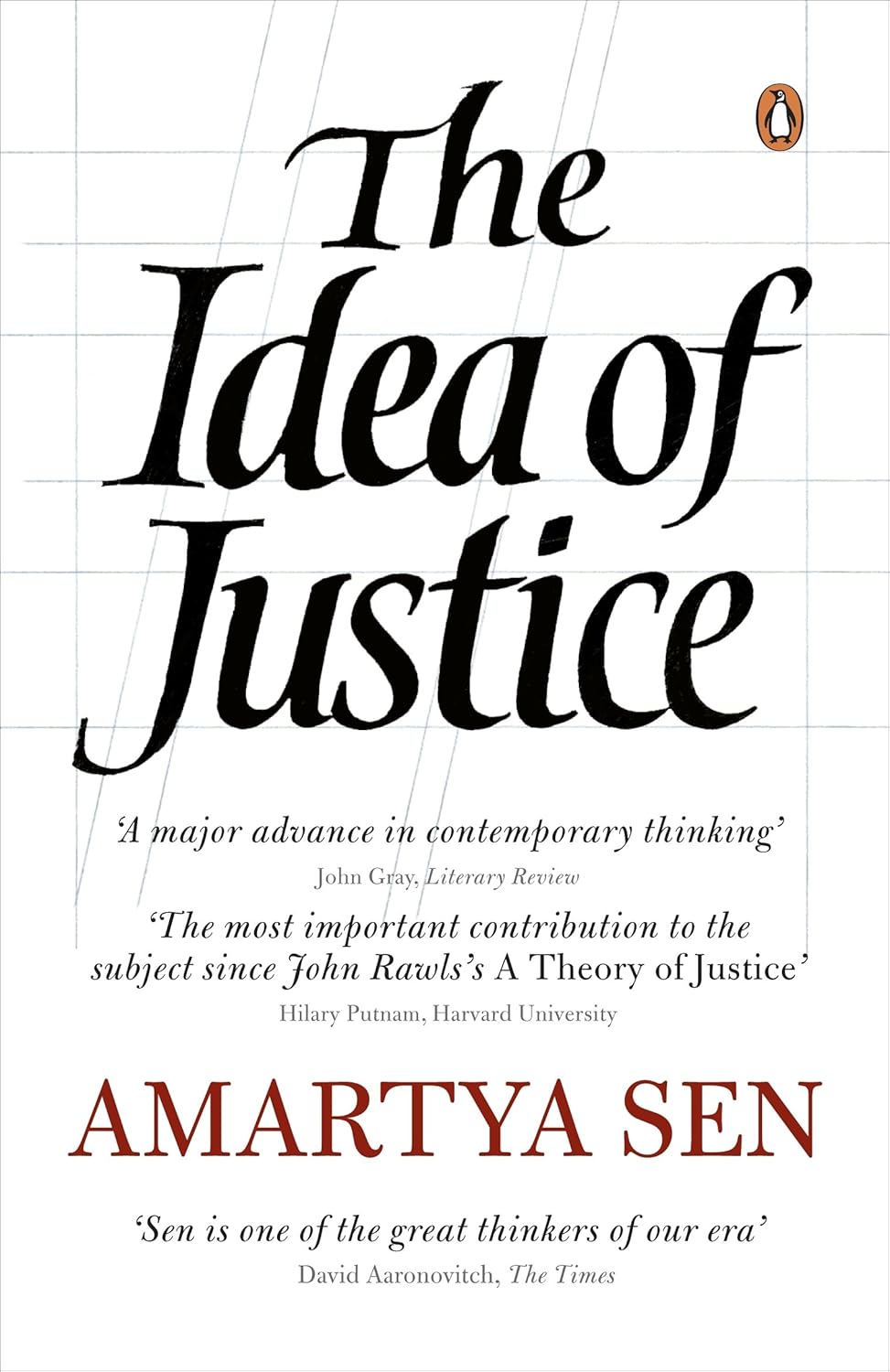
I believe that Amartya Sen's THE IDEA OF JUSTICE is the most important contribution to the subject since John Rawls's A THEORY OF JUSTICE appeared in 1971 --Hilary Putnam,Harvard University
A Majestic Book.......Reading the Idea of Justice is like attending a masterclass in practical reasoning. --Ziauddin Sardar, The Independent
I believe that Amartya Sen's THE IDEA OF JUSTICE is the most important contribution to the subject since John Rawls's A THEORY OF JUSTICE appeared in 1971 --Hilary Putman, Harvard University
A Majestic Book.......Reading the Idea of Justice is like attending a masterclass in practical reasoning. --Ziauddin Sardar, The Independent
About the Author
Reviews:
5.0 out of 5 stars The consummation of Economics and Ethics
(function() { P.when('cr-A', 'ready').execute(function(A) { if(typeof A.toggleExpanderAriaLabel === 'function') { A.toggleExpanderAriaLabel('review_text_read_more', 'Read more of this review', 'Read less of this review'); } }); })(); .review-text-read-more-expander:focus-visible { outline: 2px solid #2162a1; outline-offset: 2px; border-radius: 5px; } The book is not merely excellent, it is profound.The author, Dr Amartya Sen, is the Nobel prize laureate in Economics for 1998 but his Economics is informed with morality. This fact did not elude the Nobel Prize committee who commented that he had restored an ethical dimension to the discussion of economic problems. In addition to being imbued with morality, Amartya Sen is endowed with erudition and philosophical disposition. He is a prolific author and I mention here just two of his books:Poverty and Famines;and Development as Freedom in which he persuasively argues that Freedom is at once the ultimate goal of Economic life and the most efficient means of realizing general welfare.The present book represents the consummation of a life long effort and work by the author at humanizing economics and bringing content from the real world to ethics.The book also serves as a summation of the author's work on economic reasoning and on the elememts and measurement of human well-being.His conviction is that the mission of economists and philosophers is to improve the world which is a recurring theme in the book.The author writes with wit, a feel for history and a global perspective. He presumes that the values in play are of global, not purely Western origin.Two themes predominate in the book - economic rationality and social injustice.The author argues that economists have tended to content themselves with an overly simple picture of human motivation, rationality and well-being. The author argues that people are not purely self-interested. They care for others and observe social norms. They do not always reason mechanistically, seeking least-cost to given ends. They question the point of their aims and the worth of their wants. Well-being has no single measure but is comprehensible. Its elements are many and do not amount to just utility or some cash value equivalent.Well-being though a complex concept is not elusive. Among its diverse elements, there are important ones such as freedom from hunger, disease, indignity and discrimination which are generally observable and the author contends measurable.Unlike John Rawls who held that social justice depended on having just institutions, Amartya Sen thinks that good social outcoms are what matter.Tying the whole together is the author's confidence that, though values are complex, economics provides tools for thinking clearly about complexity.The author concludes with democracy which can take many institutional forms. But non succeds without open debate about values and principles. To that vital element in public reason, 'The Idea of Justice' is an important contribution.
5.0 out of 5 stars A classic
Yes it is quite repetitive, Sen really wants you to actually understand his ideas, so repeats his key messages quite a lot. Perhaps too often. But I'll forgive this as it convincingly demolishes some of the standard ideas in political philosophy. There is a nice irony in an Economist (an academic field largely filled with irrelevant work) showing that political philosophy is an academic field largely filled with irrelevant work.Sen's Idea of Justice, isn't so much a concept of Justice, but a framework in which to think about justice. One should reject any form of transcendental institutionalism (we just need to figure out what the perfect institutions are) and instead urges us to ask "how do we change society for the better?" He doesn't so much propose an answer to this question, but that this should be the question we ask (and respond to from varying perspectives).We will often have multiple conflicting objectives but perhaps in practice this isn't a problem, after there are many banal decisions we make everyday which have multiple objectives (cost/time/hunger/thirst/...). An important book, one of the best I've read in a long time.
4.0 out of 5 stars Some interesting and important points made here, I found ...
Some interesting and important points made here, I found a pleasing contrast by also reading 'Freedom from the Known' by Jiddu Krishnamurti.
5.0 out of 5 stars Improving justice depends on ranking alternatives
Amartya Sen presents the remarkable conclusion that justice is a process that never becomes absolutely perfect. He presents very convincingly the view that you need to compare many alternatives "social choice" and discuss them widely with many people from different categories, also considering what other countries have done and rank these alternatives. In ranking you should not fall in the trap of mathematical optimization procedures. It requires common sense.This does not mean you need ranking for gross injustices like racial discrimination. Sen rejects the Rawls idea of Justice as Fairness as it is one, may be the best one, of the absolute just systems. In fact all thinkers or politicians that claim to have developed an absolutely perfect system are wrong. Very important is to look not only at a system from a theoretical justice point of view but also equally important what is the reality of application at the level of all citizens.He also makes a very interesting review of the Universal Declaration of Human Rights of the United Nations. His view is that the "rights" are not rights in the sense that they are all legal rights to be enforced. These rights are however very important as aspects to be considered in the ranking of alternatives.Those that might have hoped to find a system of justice that is absolutely right will be disappointed, those are looking ways to improve justice will be very enthusiastic about this book
5.0 out of 5 stars It's good quality
Great quality book. Even for paperback. But the author is absolutely amazing, distinctly revolutionary ideas. The new ideas in the cross section of politics and economic theory and practice is just too interesting
4.0 out of 5 stars the Idea of justice
I have not yet finished reading the book.However, I can say without any hesitation that it is the most informative and intellectual book on the subject of justice I have come across.It is absolutely brilliant.
5.0 out of 5 stars This is a famous book like the others of Amartya Sen
This is a famous book like the others of Amartya Sen.When a book is written by Amartya Sen, it does not require any comments. We are not able to judge this world-level scholar's work. I love his work.
happy!
(function() { P.when('cr-A', 'ready').execute(function(A) { if(typeof A.toggleExpanderAriaLabel === 'function') { A.toggleExpanderAriaLabel('review_text_read_more', 'Read more of this review', 'Read less of this review'); } }); })(); .review-text-read-more-expander:focus-visible { outline: 2px solid #2162a1; outline-offset: 2px; border-radius: 5px; } It is a good book, it is in good condition, arrived in the said time and no problem whatsoever! best, eva
Complex, engaging but very readable.
Sen is remarkable. These are not easy concepts but Sen presents them with a level of elegance and eloquence that makes them accessible. I am not an expert in this area but Sen took me through the complexity of the issues and left me feeling that I had a nuanced insight based in his profound respect for humanity. This is one of the most useful, authoritative and readable books on philosophy I have read.
Excelente
Amartya Sen mais uma vez mostra a sua imensa capacidade de trazer à tona o que há de melhor nas mais diversas tradições, sejam do ocidente ou do subcontinente, construindo visão rica e profunda dos dilemas dos seres humanos. Embora profundamente influenciado por Rawls, mostra como a justiça não pode ser uma ideia de cunho universal e retoma Adam Smith , autores indianos e outros, para lembrar que as noções de justiça estão sempre enraizadas na nossa vida social.
An outstanding effort to bridge the fault line in our society
Professor Sen book is an outstanding effort to bridge the fault line in our western society created by its main conception of justice. What is justice? And, in a sense, what is moral justice? A must read for someone who which to go beyond the individualistic fallacy of our age.
社会的孤立からの解放
著者について前知識なく読んだレビューであることをお断りしておく。著者は、ロールズの正義論から啓発されたことを断りながら、彼の正義論の限界を指摘する。センは、これを方法論的に"transcendental institutionalism"(超越論的制度主義)と呼び、自らの"Realization-focused Comparative Perspective"(現実志向型対比視点)を対置させる。Hobbes,Rousseau,Kantなど契約論的系譜が属するとされる前者の問題点について、センは以下のように語る。要は「正しい制度は・・・?」と問うことで正義の問題を尽くすことはできない。なぜなら「どんな正しい制度」でもその運用において不公正や不正義が避けられないのだから、その現実の不正義を問題にする態度を堅持することが重要なのだということになる。こうした立場から彼が依拠するのは、コンドルセ、ウルストンクラーフト、スミス、ベンサム、J.S.ミル、マルクスなどである。例えば、ウルストンクラーフトは、E.バークがイギリスによるアメリカの支配を批判し後者の独立と憲法(正しい制度)を支持するが、独立したアメリカの実態としての奴隷制(上記制度の下で生じている不公正)には言及しないことを批判する。彼が依拠するのは正義をみるこうした視点なのである。 第二部を締めくくる章では、古代サンスクリットの叙事詩マハバーラタの偉大な英雄戦士アルジュナとその従者であり神の化身といわれるクリシュナとの間の見解の相違が取り上げられる。比喩的に言うとアルジュナはハムレットのような立場に立たされ、従兄弟が不正な手段で就いている王位を奪還する戦いに踏み出すことを逡巡する。クリシュナは「結果を考えずに自らに課せられた義務を果たすこと」こそが正義(←動機を重視する義務論的正義観)なのだと説く。しかし、アルジュナは自らの決断がもたらす数多くの犠牲を想像する、つまり"Consequence-sensitive"な包括的結果主義の立場から正義の意味をより深く吟味しようとするのである。この違いをセンは安っぽい「正義」の戦争に赴いたブッシュ政権のもたらした悲惨を事例に検証する。センは、こうした包括的結果'Comprehensive outcomes'を重視する結果主義を、それが生起した諸過程との連関を切り離した結果'Culmination outcomes'のみを重視する成果主義的結果主義'とも区別する。 ところで、アメリカのブッシュ前政権は、「大量破壊兵器が存在する」というイラク攻撃の最大の口実を失った後、「独裁政権を倒してイラク国民に民主主義を与える」と戦争目的を変更した。これに対して国際世論は、1)武力による押し付けは間違いだ、という反対理由の他に、2)民主主義は、それを支える共和制という固有の伝統に支えられなければ意味はない、とする批判が聞かれた。この2)が提起する問題についてセンは「公共的論理"Public reasoning"が直接必要とされ、力を持つのは、歴史的に継承された伝統や信念によるというよりも、制度や慣習が提供する"議論する機会や意思疎通機会"による」として、民主主義の理念的普遍性を擁護する。ここでも投票制度など制度指向型の思考を脱却して「公共的議論」に焦点を当てる理念重視の民主主義理解が必要だと説く。その意味で、インドや中東はじめ世界どこにでも民主主義の芽は存在するのだとし、日本については聖徳太子の17条憲法の条文にもその精神が宿るとされる。 他に、センはロールズの"Primary Goods"の配分を基準とする公正さにも疑問を呈する。彼の立場は"freedom based capability Approach"であるとされ、財そのものの平等な配分や、結果的に選択された行為がなんであるかが問題なのではなく、各人がそれぞれに所持する財に基づいて行為する際の自由度、あるいはどんな選択肢の中で選択された行為であるか、というところで不平等・不公正がないかどうかを見なければならないという。この点で、客観的な財の質を広げてその配分の不公正を問題にする、同じ"Capability Approach”を志向するM.ヌスバウム等とも見解を異にする。 ロールズの格差原理に対する理論的批判は、排他的無視'Exclusionary Neglect'、内包的矛盾と焦点集団の可塑性'Inclusive Incoherence and Focal group plasticity'、および手続き的偏狭さ'Closed Impartiality and Parochialism'の問題として3点に渡って展開される。その際、アダム・スミスのより開かれた「公平な観察者」視点との対比で、ロールズのそれが一つの社会や国家に限定される閉じられた公平性であることが問題だとされる。 最後に、ロールズなど制度論的立場をとる論者と自らの立場に共通する「正義」への視点は何かと問いかける。そこでホッブズによる「自然状態」における人々の孤立状態の描写が引用される。センはそれが世界のどこで起こっていることであるにせよ「意思疎通も協力し合うこともない孤立的な生活に不可避的に追いやられている人々」の存在について理解を深め、共感を持って論ずることこそ人間生活の質を確保する上でも、他の剥奪を理解し、それに対応するうえでも最重要課題であると結論付ける。これは、遠いアフリカの問題であるだけではなく、OECD統計で、世界第一の相対的貧困率を誇るアメリカや、第二位につける我が日本で進行している事態そのものでもある。正義の今日的な意味を考える上で特に示唆的な問題提起であると思える。(7/13 一部修正)
Visit the Amartya Sen (Author) Store
The Idea of Justice
AED11297
Quantity:
Order today to get by 7-14 business days
Delivery fee of AED 20. Free for orders above AED 200.
Imported From: United Kingdom
At BOLO, we work hard to ensure the products you receive are new, genuine, and sourced from reputable suppliers.
BOLO is not an authorized or official retailer for most brands, nor are we affiliated with manufacturers unless specifically stated on a product page. Instead, we source verified sellers, authorized distributors or directly from the manufacturer.
Each product undergoes thorough inspection and verification at our consolidation and fulfilment centers to ensure it meets our strict authenticity and quality standards before being shipped and delivered to you.
If you ever have concerns regarding the authenticity of a product purchased from us, please contact Bolo Support. We will review your inquiry promptly and, if necessary, provide documentation verifying authenticity or offer a suitable resolution.
Your trust is our top priority, and we are committed to maintaining transparency and integrity in every transaction.
All product information, images, descriptions, and reviews originate from the manufacturer or from trusted sellers overseas. BOLO is not affiliated with, endorsed by, or an authorized retailer for most brands listed on our website unless stated otherwise.
While we strive to display accurate information, variations in packaging, labeling, instructions, or formulation may occasionally occur due to regional differences or supplier updates. For detailed or manufacturer-specific information, please contact the brand directly or reach out to BOLO Support for assistance.
Unless otherwise stated, all prices displayed on the product page include applicable taxes and import duties.
BOLO operates in accordance with the laws and regulations of United Arab Emirates. Any items found to be restricted or prohibited for sale within the UAE will be cancelled prior to shipment. We take proactive measures to ensure that only products permitted for sale in United Arab Emirates are listed on our website.
All items are shipped by air, and any products classified as “Dangerous Goods (DG)” under IATA regulations will be removed from the order and cancelled.
All orders are processed manually, and we make every effort to process them promptly once confirmed. Products cancelled due to the above reasons will be permanently removed from listings across the website.
Similar suggestions by Bolo
More from this brand
Similar items from “Higher Education”
Share with
Or share with link
https://www.bolo.ae/products/K0141037857
Visit the Amartya Sen (Author) Store
The Idea of Justice

AED11297
Quantity:
Order today to get by 7-14 business days
Delivery fee of AED 20. Free for orders above AED 200.
Imported From: United Kingdom
At BOLO, we work hard to ensure the products you receive are new, genuine, and sourced from reputable suppliers.
BOLO is not an authorized or official retailer for most brands, nor are we affiliated with manufacturers unless specifically stated on a product page. Instead, we source verified sellers, authorized distributors or directly from the manufacturer.
Each product undergoes thorough inspection and verification at our consolidation and fulfilment centers to ensure it meets our strict authenticity and quality standards before being shipped and delivered to you.
If you ever have concerns regarding the authenticity of a product purchased from us, please contact Bolo Support. We will review your inquiry promptly and, if necessary, provide documentation verifying authenticity or offer a suitable resolution.
Your trust is our top priority, and we are committed to maintaining transparency and integrity in every transaction.
All product information, images, descriptions, and reviews originate from the manufacturer or from trusted sellers overseas. BOLO is not affiliated with, endorsed by, or an authorized retailer for most brands listed on our website unless stated otherwise.
While we strive to display accurate information, variations in packaging, labeling, instructions, or formulation may occasionally occur due to regional differences or supplier updates. For detailed or manufacturer-specific information, please contact the brand directly or reach out to BOLO Support for assistance.
Unless otherwise stated, all prices displayed on the product page include applicable taxes and import duties.
BOLO operates in accordance with the laws and regulations of United Arab Emirates. Any items found to be restricted or prohibited for sale within the UAE will be cancelled prior to shipment. We take proactive measures to ensure that only products permitted for sale in United Arab Emirates are listed on our website.
All items are shipped by air, and any products classified as “Dangerous Goods (DG)” under IATA regulations will be removed from the order and cancelled.
All orders are processed manually, and we make every effort to process them promptly once confirmed. Products cancelled due to the above reasons will be permanently removed from listings across the website.
Description:
Review
I believe that Amartya Sen's THE IDEA OF JUSTICE is the most important contribution to the subject since John Rawls's A THEORY OF JUSTICE appeared in 1971 --Hilary Putnam,Harvard University
A Majestic Book.......Reading the Idea of Justice is like attending a masterclass in practical reasoning. --Ziauddin Sardar, The Independent
I believe that Amartya Sen's THE IDEA OF JUSTICE is the most important contribution to the subject since John Rawls's A THEORY OF JUSTICE appeared in 1971 --Hilary Putman, Harvard University
A Majestic Book.......Reading the Idea of Justice is like attending a masterclass in practical reasoning. --Ziauddin Sardar, The Independent
About the Author
Reviews:
5.0 out of 5 stars The consummation of Economics and Ethics
(function() { P.when('cr-A', 'ready').execute(function(A) { if(typeof A.toggleExpanderAriaLabel === 'function') { A.toggleExpanderAriaLabel('review_text_read_more', 'Read more of this review', 'Read less of this review'); } }); })(); .review-text-read-more-expander:focus-visible { outline: 2px solid #2162a1; outline-offset: 2px; border-radius: 5px; } The book is not merely excellent, it is profound.The author, Dr Amartya Sen, is the Nobel prize laureate in Economics for 1998 but his Economics is informed with morality. This fact did not elude the Nobel Prize committee who commented that he had restored an ethical dimension to the discussion of economic problems. In addition to being imbued with morality, Amartya Sen is endowed with erudition and philosophical disposition. He is a prolific author and I mention here just two of his books:Poverty and Famines;and Development as Freedom in which he persuasively argues that Freedom is at once the ultimate goal of Economic life and the most efficient means of realizing general welfare.The present book represents the consummation of a life long effort and work by the author at humanizing economics and bringing content from the real world to ethics.The book also serves as a summation of the author's work on economic reasoning and on the elememts and measurement of human well-being.His conviction is that the mission of economists and philosophers is to improve the world which is a recurring theme in the book.The author writes with wit, a feel for history and a global perspective. He presumes that the values in play are of global, not purely Western origin.Two themes predominate in the book - economic rationality and social injustice.The author argues that economists have tended to content themselves with an overly simple picture of human motivation, rationality and well-being. The author argues that people are not purely self-interested. They care for others and observe social norms. They do not always reason mechanistically, seeking least-cost to given ends. They question the point of their aims and the worth of their wants. Well-being has no single measure but is comprehensible. Its elements are many and do not amount to just utility or some cash value equivalent.Well-being though a complex concept is not elusive. Among its diverse elements, there are important ones such as freedom from hunger, disease, indignity and discrimination which are generally observable and the author contends measurable.Unlike John Rawls who held that social justice depended on having just institutions, Amartya Sen thinks that good social outcoms are what matter.Tying the whole together is the author's confidence that, though values are complex, economics provides tools for thinking clearly about complexity.The author concludes with democracy which can take many institutional forms. But non succeds without open debate about values and principles. To that vital element in public reason, 'The Idea of Justice' is an important contribution.
5.0 out of 5 stars A classic
Yes it is quite repetitive, Sen really wants you to actually understand his ideas, so repeats his key messages quite a lot. Perhaps too often. But I'll forgive this as it convincingly demolishes some of the standard ideas in political philosophy. There is a nice irony in an Economist (an academic field largely filled with irrelevant work) showing that political philosophy is an academic field largely filled with irrelevant work.Sen's Idea of Justice, isn't so much a concept of Justice, but a framework in which to think about justice. One should reject any form of transcendental institutionalism (we just need to figure out what the perfect institutions are) and instead urges us to ask "how do we change society for the better?" He doesn't so much propose an answer to this question, but that this should be the question we ask (and respond to from varying perspectives).We will often have multiple conflicting objectives but perhaps in practice this isn't a problem, after there are many banal decisions we make everyday which have multiple objectives (cost/time/hunger/thirst/...). An important book, one of the best I've read in a long time.
4.0 out of 5 stars Some interesting and important points made here, I found ...
Some interesting and important points made here, I found a pleasing contrast by also reading 'Freedom from the Known' by Jiddu Krishnamurti.
5.0 out of 5 stars Improving justice depends on ranking alternatives
Amartya Sen presents the remarkable conclusion that justice is a process that never becomes absolutely perfect. He presents very convincingly the view that you need to compare many alternatives "social choice" and discuss them widely with many people from different categories, also considering what other countries have done and rank these alternatives. In ranking you should not fall in the trap of mathematical optimization procedures. It requires common sense.This does not mean you need ranking for gross injustices like racial discrimination. Sen rejects the Rawls idea of Justice as Fairness as it is one, may be the best one, of the absolute just systems. In fact all thinkers or politicians that claim to have developed an absolutely perfect system are wrong. Very important is to look not only at a system from a theoretical justice point of view but also equally important what is the reality of application at the level of all citizens.He also makes a very interesting review of the Universal Declaration of Human Rights of the United Nations. His view is that the "rights" are not rights in the sense that they are all legal rights to be enforced. These rights are however very important as aspects to be considered in the ranking of alternatives.Those that might have hoped to find a system of justice that is absolutely right will be disappointed, those are looking ways to improve justice will be very enthusiastic about this book
5.0 out of 5 stars It's good quality
Great quality book. Even for paperback. But the author is absolutely amazing, distinctly revolutionary ideas. The new ideas in the cross section of politics and economic theory and practice is just too interesting
4.0 out of 5 stars the Idea of justice
I have not yet finished reading the book.However, I can say without any hesitation that it is the most informative and intellectual book on the subject of justice I have come across.It is absolutely brilliant.
5.0 out of 5 stars This is a famous book like the others of Amartya Sen
This is a famous book like the others of Amartya Sen.When a book is written by Amartya Sen, it does not require any comments. We are not able to judge this world-level scholar's work. I love his work.
happy!
(function() { P.when('cr-A', 'ready').execute(function(A) { if(typeof A.toggleExpanderAriaLabel === 'function') { A.toggleExpanderAriaLabel('review_text_read_more', 'Read more of this review', 'Read less of this review'); } }); })(); .review-text-read-more-expander:focus-visible { outline: 2px solid #2162a1; outline-offset: 2px; border-radius: 5px; } It is a good book, it is in good condition, arrived in the said time and no problem whatsoever! best, eva
Complex, engaging but very readable.
Sen is remarkable. These are not easy concepts but Sen presents them with a level of elegance and eloquence that makes them accessible. I am not an expert in this area but Sen took me through the complexity of the issues and left me feeling that I had a nuanced insight based in his profound respect for humanity. This is one of the most useful, authoritative and readable books on philosophy I have read.
Excelente
Amartya Sen mais uma vez mostra a sua imensa capacidade de trazer à tona o que há de melhor nas mais diversas tradições, sejam do ocidente ou do subcontinente, construindo visão rica e profunda dos dilemas dos seres humanos. Embora profundamente influenciado por Rawls, mostra como a justiça não pode ser uma ideia de cunho universal e retoma Adam Smith , autores indianos e outros, para lembrar que as noções de justiça estão sempre enraizadas na nossa vida social.
An outstanding effort to bridge the fault line in our society
Professor Sen book is an outstanding effort to bridge the fault line in our western society created by its main conception of justice. What is justice? And, in a sense, what is moral justice? A must read for someone who which to go beyond the individualistic fallacy of our age.
社会的孤立からの解放
著者について前知識なく読んだレビューであることをお断りしておく。著者は、ロールズの正義論から啓発されたことを断りながら、彼の正義論の限界を指摘する。センは、これを方法論的に"transcendental institutionalism"(超越論的制度主義)と呼び、自らの"Realization-focused Comparative Perspective"(現実志向型対比視点)を対置させる。Hobbes,Rousseau,Kantなど契約論的系譜が属するとされる前者の問題点について、センは以下のように語る。要は「正しい制度は・・・?」と問うことで正義の問題を尽くすことはできない。なぜなら「どんな正しい制度」でもその運用において不公正や不正義が避けられないのだから、その現実の不正義を問題にする態度を堅持することが重要なのだということになる。こうした立場から彼が依拠するのは、コンドルセ、ウルストンクラーフト、スミス、ベンサム、J.S.ミル、マルクスなどである。例えば、ウルストンクラーフトは、E.バークがイギリスによるアメリカの支配を批判し後者の独立と憲法(正しい制度)を支持するが、独立したアメリカの実態としての奴隷制(上記制度の下で生じている不公正)には言及しないことを批判する。彼が依拠するのは正義をみるこうした視点なのである。 第二部を締めくくる章では、古代サンスクリットの叙事詩マハバーラタの偉大な英雄戦士アルジュナとその従者であり神の化身といわれるクリシュナとの間の見解の相違が取り上げられる。比喩的に言うとアルジュナはハムレットのような立場に立たされ、従兄弟が不正な手段で就いている王位を奪還する戦いに踏み出すことを逡巡する。クリシュナは「結果を考えずに自らに課せられた義務を果たすこと」こそが正義(←動機を重視する義務論的正義観)なのだと説く。しかし、アルジュナは自らの決断がもたらす数多くの犠牲を想像する、つまり"Consequence-sensitive"な包括的結果主義の立場から正義の意味をより深く吟味しようとするのである。この違いをセンは安っぽい「正義」の戦争に赴いたブッシュ政権のもたらした悲惨を事例に検証する。センは、こうした包括的結果'Comprehensive outcomes'を重視する結果主義を、それが生起した諸過程との連関を切り離した結果'Culmination outcomes'のみを重視する成果主義的結果主義'とも区別する。 ところで、アメリカのブッシュ前政権は、「大量破壊兵器が存在する」というイラク攻撃の最大の口実を失った後、「独裁政権を倒してイラク国民に民主主義を与える」と戦争目的を変更した。これに対して国際世論は、1)武力による押し付けは間違いだ、という反対理由の他に、2)民主主義は、それを支える共和制という固有の伝統に支えられなければ意味はない、とする批判が聞かれた。この2)が提起する問題についてセンは「公共的論理"Public reasoning"が直接必要とされ、力を持つのは、歴史的に継承された伝統や信念によるというよりも、制度や慣習が提供する"議論する機会や意思疎通機会"による」として、民主主義の理念的普遍性を擁護する。ここでも投票制度など制度指向型の思考を脱却して「公共的議論」に焦点を当てる理念重視の民主主義理解が必要だと説く。その意味で、インドや中東はじめ世界どこにでも民主主義の芽は存在するのだとし、日本については聖徳太子の17条憲法の条文にもその精神が宿るとされる。 他に、センはロールズの"Primary Goods"の配分を基準とする公正さにも疑問を呈する。彼の立場は"freedom based capability Approach"であるとされ、財そのものの平等な配分や、結果的に選択された行為がなんであるかが問題なのではなく、各人がそれぞれに所持する財に基づいて行為する際の自由度、あるいはどんな選択肢の中で選択された行為であるか、というところで不平等・不公正がないかどうかを見なければならないという。この点で、客観的な財の質を広げてその配分の不公正を問題にする、同じ"Capability Approach”を志向するM.ヌスバウム等とも見解を異にする。 ロールズの格差原理に対する理論的批判は、排他的無視'Exclusionary Neglect'、内包的矛盾と焦点集団の可塑性'Inclusive Incoherence and Focal group plasticity'、および手続き的偏狭さ'Closed Impartiality and Parochialism'の問題として3点に渡って展開される。その際、アダム・スミスのより開かれた「公平な観察者」視点との対比で、ロールズのそれが一つの社会や国家に限定される閉じられた公平性であることが問題だとされる。 最後に、ロールズなど制度論的立場をとる論者と自らの立場に共通する「正義」への視点は何かと問いかける。そこでホッブズによる「自然状態」における人々の孤立状態の描写が引用される。センはそれが世界のどこで起こっていることであるにせよ「意思疎通も協力し合うこともない孤立的な生活に不可避的に追いやられている人々」の存在について理解を深め、共感を持って論ずることこそ人間生活の質を確保する上でも、他の剥奪を理解し、それに対応するうえでも最重要課題であると結論付ける。これは、遠いアフリカの問題であるだけではなく、OECD統計で、世界第一の相対的貧困率を誇るアメリカや、第二位につける我が日本で進行している事態そのものでもある。正義の今日的な意味を考える上で特に示唆的な問題提起であると思える。(7/13 一部修正)
Similar suggestions by Bolo
More from this brand
Similar items from “Higher Education”
Share with
Or share with link
https://www.bolo.ae/products/K0141037857