Deliver toUnited Arab Emirates
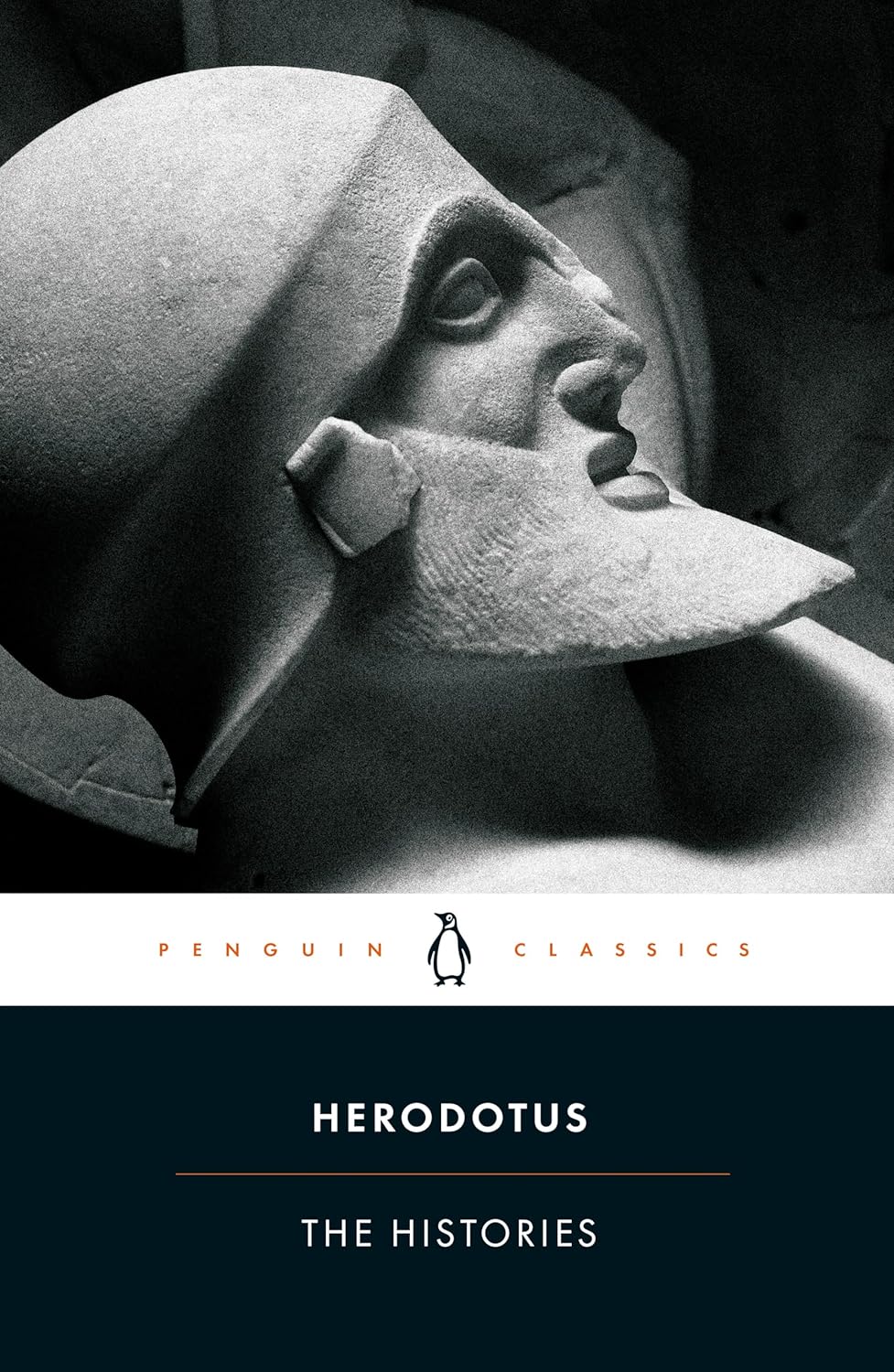
The Histories (Penguin Classics)

Description:

'The first example of non-fiction, the text that underlies the entire discipline of history ... it is above all a treasure trove' Tom Holland

One of the masterpieces of classical literature,
The Histories describes how a small and quarrelsome band of Greek city states united to repel the might of the Persian empire. But while this epic struggle forms the core of his work, Herodotus' natural curiosity frequently gives rise to colourful digressions - a description of the natural wonders of Egypt; tales of lake-dwellers, dog-headed men and gold-digging ants. With its kaleidoscopic blend of fact and legend, The Histories offers a compelling Greek view of the world in the fifth century BC, in Aubrey de Sélincourt's elegant and celebrated translation.

Translated by AUBREY DE SÉLINCOURT
Revised with an Introduction and notes by JOHN MARINCOLA


Review

Select Guide Rating

About the Author

Few facts are known about the life of Herodotus. He was born around 490 BC in Halicarnassus, on the south-west coast of Asia Minor. He seems to have travelled widely throughout the Mediterranean world, including Egypt, Africa, the area around the Black Sea and throughout many Greek city-states, of both the mainland and the islands. A sojourn in Athens is part of the traditional biography, and there he is said to have given public readings of his work and been friends with the playwright Sophocles. He is said also to have taken part in the founding of the colony of Thurii in Italy in 443 BC. He probably died at some time between 425 and 420 BC. His reputation has varied greatly, but for the ancients and many moderns he well deserves the title (first given to him by Cicero) of 'the Father of History'.

Reviews:

5.0 out of 5 stars Unmissable, eminently readable classic

r.4. · 9 June 2008

'After the capture of Babylon, Darius invaded Scythia.' Thus commences book four of the Histories, and if these are the kind of words that set your pulse racing, your eyes going all dreamy, this book is for you.The ancient Greek historian's famous opus has an impressive geographical and chronological spread, and this, together with its precedence over most recovered documents of its type, explains why it is regarded as so important. Herodotus relates over a century of Persian expansion, including the Egyptian and other conquests, from about 600 BC, and of Persian conflict with the Greeks, culminating in his compatriots' victories at Salamis and Platea. As it is explained in the notes and introduction, much of his account has been reaffirmed by modern historical and archaeological research, some of it over earlier condemnations, though much is also being questioned.Indeed, intriguingly, this rings both as history as we understand it and as something else. Herodotus explicitly aims to make an objective and truthful account, unlike other chroniclers of antiquity (for example Egyptian) driven by religious, political or artistic imperatives. He traces facts to sources and steps back when sources conflict. This is familiar. But in other ways, his book is from a culture very distant from ours. Herodotus believes in oracles, in the premonitory value of dreams. It doesn't shock him that a queen might give birth to a lion, or a god strike down an army to protect a sanctuary. Hubris is always punished, and disregard for the warnings of fate, or the desecration of temples. And descriptions are inflated for effect. For example, Herodotus has five million Persian subjects crossing the Hellespont; this probably exceeded the adult male population of the Persian empire, and modern historians have the number at 100,000 to 200,000. Thus, in many ways, the Histories are myth, epic, as much as history, and they probably tell us as much about the ancient Greeks and their beliefs as about what happened in the Persian wars.

5.0 out of 5 stars Classic easy read

T.D. · 9 May 2025

Classic easy read

4.0 out of 5 stars Have started readig this amazing book. Never thought history

M.E.H. · 2 November 2014

Have started readig this amazing book. Never thought history, so many centuries before B.C. could be so fascinating and in many ways comparable to what is happening today, globally. Will have many hours of enjoyment. Thanks.

5.0 out of 5 stars Brings the Ancient World to life

R.W. · 6 April 2021

Although writing 2500 years ago Herodotus sure knows how to tell a story and I found I couldn't put his history of the 5th century BC Persian Empire down. "The Histories" describes Persian imperial military campaigns against Babylon and Egypt, but above all against Greece. The historical accounts are broken up with legends and fascinating descriptive details of individuals, peoples, armies, counties and cities. In his lengthy build up to the battles of Salamis and Plataea which ended the Persian threat to Greece Herodotus brings to life ancient kings, generals and politicians. Men and women who otherwise are just names from ancient history come to life in their ruthlessness, scheming, greed, courage and cowardice. Herodotus builds up the tension as expertly as a modern novelist. I could tangibly feel the mounting fear as the Persian invaders slowly work their way down Greece toward Athens, while the Greeks desperately seek help across the Mediterranean and individual city-states panic and struggle with whether to risk supporting their fellow Greeks or capitulate with the Persians. Brilliant!

5.0 out of 5 stars The Histories, Herodotus

S. · 28 January 2014

I am required to study Herodotus' 'The Histories' for my A2 Ancient History course, and had intended to buy it on my Kindle so that I could study it in my own time prior to my return in September this year. So, of course, you can imagine how delighted I was when it was reduced in price!!I've already read part of this book - it's a fantastic piece of writing. And it comes with a detailed and in-depth introduction, which is a must-read for anybody hoping to get their heads around this book - it is complex (as one would expect of a Greek writing in the 400's BC!) but once you read the intro it's perfectly easy to get your head around... well, most of it. A fantastic account of the Greek and Persian Wars, a definite must for those who want to understand this period of Ancient History.This book also acts as a sort of prequel to Thucydides' 'History of the Peloponnesian War'. Another must-read book for those wanting to know more about the Ancient Greeks. You'll find yourself quite surprised by how they turn out to be!Can't fault it!

5.0 out of 5 stars Highly recommend this book but read it over slowly, not as a novel !

A. · 24 January 2021

I love Classics and had to re-read Herodotus .This is not a book that can be read in a few days because of the complexities ( nanes, places,rec ) so, absorb H in stages !It is a pity that the Labyrinth section is not given much credit and the same goes for the " ant people ". The latter has been a contentious subject that is found in a lot of folklore .However, this book will satisfy those who are interested in ancient history, anthropology, sociology and many other ' oligies.Personally, I would not say that this is the definitive " Histories " but it certainlydoes hold interest and is a must read.

Classic

S. · 18 September 2021

A classic from ancient times.

A Worthy Tome

J.E.I. · 11 March 2024

A book perfect for reading in the shade. Not too dense, easy to understand, reading between the lines is a good thing.

Encyclopedia Hellenica

T.M. · 25 May 2014

Although Herodotus' Histories is ostensibly the story of the Great Persian War fought early in the 5th century BCE it covers so much territory in the fields of geography, ethnography, history, climate, etc., etc. that it might well be considered to be the world's first encyclopedia. Herodotus' interests were wide ranging and he tells us that he has personally travelled to many foreign countries such as Egypt and Babylonia in order to collect data for his book. As he states himself, the purpose of his journeys was so that "human achievements may not be forgotten in time". So Herodotus was perhaps the first world traveler and he set us on the path of all the tourists who were to come in later ages. Although the main period of interest in the Histories is from the establishment of the Persian Empire by Cyrus the Great in 559 BCE until the Battle of Plataea in 479 BCE where the Persian forces were utterly routed and although he covers this historical period in depth I got the feeling when reading the book that he was a bit bored by the topic and he never missed an opportunity for a diversion. So there are lots of anecdotal stories thrown into the main plot.The earlier of the nine books deal with the history and geography of the main countries during Herodotus' day. There is extensive coverage of Egypt along with Babylonia and Persia. Frequently Herodotus just reports the stories which he has been told during his travels and he seldom expresses any incredulity. He has been faulted for that by later authors but we must remember that in most cases Herodotus had no way to validate the stories he was being told. In some cases the stories are so unbelievable that even Herodotus refuses to believe them and he says so. For example, he doesn't believe in the race of one-eyed men called the Arimaspians who are said to live in the far north. At other times he expresses gullibility such as when he claims to have actually seen the remains of winged snakes who fly across the Red Sea to Egypt. But there were a lot of things he got right such as his claim that the inland desert regions of Libya (i.e., Africa) stretch all the way to the Pillars of Heracles (i.e., Strait of Gibraltar) as we know the Sahara desert does. He knows that the Caspian Sea is a lake bounded on all sides, something that later Greek and Roman geographers forgot about. Those things he doesn't know and couldn't find any information about, Herodotus flatly states outright such as his ignorance concerning the source of the Nile River. So for his era, and given the paucity of good information, he got more things right than he got wrong.Herodotus' coverage of the Persian War is interesting in itself. There are certain facts that have been greatly exaggerated such as his claim that the army of Xerxes that invaded Greece in 480 BCE had 1.7 million soldiers which is ten times the amount of Allied soldiers who landed on D-Day in World War II. There is simply no way that an army of that size could have been fielded in antiquity although scholars are not certain of the army's true size. ~100,000 seems like a more reasonable estimate. At the final battle of Plataea, Herodotus says that the Persians lost 297,000 men while the Spartans lost only 91 and the Athenians only 52. I think we can take those statistics with a big grain of salt. The details of the major battles are surprisingly thin. One would have thought that Herodotus would have had access to more eyewitness testimony than actually shows up in his book. For example, for the Battle of Marathon in 490 BCE Herodotus simply has the Athenians rushing the Persians and overwhelming them, capturing 7 of their ships. I'm sure it must have been more complicated than that, but we are left with few of the nitty gritty details.Herodotus also takes, what to modern sensibilities, seems like a peculiar attitude towards oracles and divinations. All parties in the book seem to use oracles and other methods of divination in order to determine the will of the gods. Herodotus instinctively believes in the correctness of oracles, especially the Oracle at Delphi. He makes it seem like all of the Delphic oracular pronouncements turned out to be correct. The Delphic responses may be obscure or even ambiguous but Herodotus seems to have an unshakeable belief that they are always correct. Perhaps their recipients misinterpret their meaning such as in the case of the Lydian king Croesus, but they always can be interpreted correctly to predict actual future events. Thus, when the Athenians are told that safety lies behind a wooden wall it is Themistocles who correctly interprets this Delphic pronouncement to mean they should rely on their navy. Even the Persians are portrayed as intensely superstitious with King Xerxes launching his invasion of Greece only because he has been told to do so by a figure in a dream. Today billions of people pray daily to some deity but imagine a world in which the deity communicates back to you. Such was the world of the Oracle at Delphi and both the Greeks and the barbarians took it very seriously. This was the case despite the fact that Herodotus informs us that on a number of occasions the high priestess at Delphi accepted bribes to respond in some specified fashion to certain questions.It's difficult for us to assess what influence these various oracles had on the outcome of history but it may have been sizable. Herodotus tells us that both sides delayed the final Battle of Plataea for more than a week because the portents of divination were not favorable. Thus, gods, goddesses, and their predictions have their fingerprints on most historical events of the period. This is a far different world than the modern one. Herodotus takes these customs as a matter of course and he has a steady faith that God is on the side of the Greeks. So this is not an impartial history written by a neutral observer but rather the report of a biased writer who was against the Persians even though his home town of Halicarnassus fought on the side of Xerxes.There are many places in the book where Herodotus quotes long speeches by various characters supposedly verbatim. In most cases there is probably not much chance that Herodotus could have known exactly what was said. Perhaps he heard the gist of the conversation and filled in the details using his own imagination. In any case, this practice of inventing speeches and filling their content based on the imagination of the writer was commonly used by contemporary Greek historians and even Thucydides who came decades later (e.g., the Melian dialogue). We revere Herodotus today as the "Father of History" and that title is much deserved but Herodotus was much more than that. He was the first one, so far as we know, who attempted to collect in one place the sum total of the geographic, ethnographic, linguistic, and historical information of the entire world that was known to him. Thus, his Histories are in a sense the "Encyclopedia Hellenica" and despite their many flaws they form the foundation of the Greek pursuit of knowledge which in subsequent centuries would create the Great Library of Alexandria. Herodotus stands at the beginning of that Greek intellectual journey which is still having repercussions in our world 2,500 years later.The Histories are a must read for anyone interested in the foundation of Western culture. I highly recommend them.

Gran libro

R. · 2 December 2021

Gran libro, ed bastante denso, recomiendo dosificar cuanto lees, sino puedes satruarte

Five Stars

M. · 6 March 2018

Excellent work

The Histories (Penguin Classics)

Product ID: K0140449086
Condition: New

4.6

AED22252

Price includes VAT & Import Duties
Type: Paperback
Availability: In Stock

Quantity:

|

Order today to get by 7-14 business days

This item qualifies for free delivery

Returns & Warranty policies

Imported From: United Kingdom

At BOLO, we work hard to ensure the products you receive are new, genuine, and sourced from reputable suppliers.

BOLO is not an authorized or official retailer for most brands, nor are we affiliated with manufacturers unless specifically stated on a product page. Instead, we source verified sellers, authorized distributors or directly from the manufacturer.

Each product undergoes thorough inspection and verification at our consolidation and fulfilment centers to ensure it meets our strict authenticity and quality standards before being shipped and delivered to you.

If you ever have concerns regarding the authenticity of a product purchased from us, please contact Bolo Support. We will review your inquiry promptly and, if necessary, provide documentation verifying authenticity or offer a suitable resolution.

Your trust is our top priority, and we are committed to maintaining transparency and integrity in every transaction.

All product information, images, descriptions, and reviews originate from the manufacturer or from trusted sellers overseas. BOLO is not affiliated with, endorsed by, or an authorized retailer for most brands listed on our website unless stated otherwise.

While we strive to display accurate information, variations in packaging, labeling, instructions, or formulation may occasionally occur due to regional differences or supplier updates. For detailed or manufacturer-specific information, please contact the brand directly or reach out to BOLO Support for assistance.

Unless otherwise stated, all prices displayed on the product page include applicable taxes and import duties.

BOLO operates in accordance with the laws and regulations of United Arab Emirates. Any items found to be restricted or prohibited for sale within the UAE will be cancelled prior to shipment. We take proactive measures to ensure that only products permitted for sale in United Arab Emirates are listed on our website.

All items are shipped by air, and any products classified as “Dangerous Goods (DG)” under IATA regulations will be removed from the order and cancelled.

All orders are processed manually, and we make every effort to process them promptly once confirmed. Products cancelled due to the above reasons will be permanently removed from listings across the website.

Similar suggestions by Bolo

More from this brand

Similar items from “Literary Theory & Movements”

The Histories (Penguin Classics)

Product ID: K0140449086
Condition: New

4.6

The Histories (Penguin Classics)-0
Type: Paperback

AED22252

Price includes VAT & Import Duties
Availability: In Stock

Quantity:

|

Order today to get by 7-14 business days

This item qualifies for free delivery

Returns & Warranty policies

Imported From: United Kingdom

At BOLO, we work hard to ensure the products you receive are new, genuine, and sourced from reputable suppliers.

BOLO is not an authorized or official retailer for most brands, nor are we affiliated with manufacturers unless specifically stated on a product page. Instead, we source verified sellers, authorized distributors or directly from the manufacturer.

Each product undergoes thorough inspection and verification at our consolidation and fulfilment centers to ensure it meets our strict authenticity and quality standards before being shipped and delivered to you.

If you ever have concerns regarding the authenticity of a product purchased from us, please contact Bolo Support. We will review your inquiry promptly and, if necessary, provide documentation verifying authenticity or offer a suitable resolution.

Your trust is our top priority, and we are committed to maintaining transparency and integrity in every transaction.

All product information, images, descriptions, and reviews originate from the manufacturer or from trusted sellers overseas. BOLO is not affiliated with, endorsed by, or an authorized retailer for most brands listed on our website unless stated otherwise.

While we strive to display accurate information, variations in packaging, labeling, instructions, or formulation may occasionally occur due to regional differences or supplier updates. For detailed or manufacturer-specific information, please contact the brand directly or reach out to BOLO Support for assistance.

Unless otherwise stated, all prices displayed on the product page include applicable taxes and import duties.

BOLO operates in accordance with the laws and regulations of United Arab Emirates. Any items found to be restricted or prohibited for sale within the UAE will be cancelled prior to shipment. We take proactive measures to ensure that only products permitted for sale in United Arab Emirates are listed on our website.

All items are shipped by air, and any products classified as “Dangerous Goods (DG)” under IATA regulations will be removed from the order and cancelled.

All orders are processed manually, and we make every effort to process them promptly once confirmed. Products cancelled due to the above reasons will be permanently removed from listings across the website.

Description:

'The first example of non-fiction, the text that underlies the entire discipline of history ... it is above all a treasure trove' Tom Holland

One of the masterpieces of classical literature,
The Histories describes how a small and quarrelsome band of Greek city states united to repel the might of the Persian empire. But while this epic struggle forms the core of his work, Herodotus' natural curiosity frequently gives rise to colourful digressions - a description of the natural wonders of Egypt; tales of lake-dwellers, dog-headed men and gold-digging ants. With its kaleidoscopic blend of fact and legend, The Histories offers a compelling Greek view of the world in the fifth century BC, in Aubrey de Sélincourt's elegant and celebrated translation.

Translated by AUBREY DE SÉLINCOURT
Revised with an Introduction and notes by JOHN MARINCOLA


Review

Select Guide Rating

About the Author

Few facts are known about the life of Herodotus. He was born around 490 BC in Halicarnassus, on the south-west coast of Asia Minor. He seems to have travelled widely throughout the Mediterranean world, including Egypt, Africa, the area around the Black Sea and throughout many Greek city-states, of both the mainland and the islands. A sojourn in Athens is part of the traditional biography, and there he is said to have given public readings of his work and been friends with the playwright Sophocles. He is said also to have taken part in the founding of the colony of Thurii in Italy in 443 BC. He probably died at some time between 425 and 420 BC. His reputation has varied greatly, but for the ancients and many moderns he well deserves the title (first given to him by Cicero) of 'the Father of History'.

Reviews:

5.0 out of 5 stars Unmissable, eminently readable classic

r.4. · 9 June 2008

'After the capture of Babylon, Darius invaded Scythia.' Thus commences book four of the Histories, and if these are the kind of words that set your pulse racing, your eyes going all dreamy, this book is for you.The ancient Greek historian's famous opus has an impressive geographical and chronological spread, and this, together with its precedence over most recovered documents of its type, explains why it is regarded as so important. Herodotus relates over a century of Persian expansion, including the Egyptian and other conquests, from about 600 BC, and of Persian conflict with the Greeks, culminating in his compatriots' victories at Salamis and Platea. As it is explained in the notes and introduction, much of his account has been reaffirmed by modern historical and archaeological research, some of it over earlier condemnations, though much is also being questioned.Indeed, intriguingly, this rings both as history as we understand it and as something else. Herodotus explicitly aims to make an objective and truthful account, unlike other chroniclers of antiquity (for example Egyptian) driven by religious, political or artistic imperatives. He traces facts to sources and steps back when sources conflict. This is familiar. But in other ways, his book is from a culture very distant from ours. Herodotus believes in oracles, in the premonitory value of dreams. It doesn't shock him that a queen might give birth to a lion, or a god strike down an army to protect a sanctuary. Hubris is always punished, and disregard for the warnings of fate, or the desecration of temples. And descriptions are inflated for effect. For example, Herodotus has five million Persian subjects crossing the Hellespont; this probably exceeded the adult male population of the Persian empire, and modern historians have the number at 100,000 to 200,000. Thus, in many ways, the Histories are myth, epic, as much as history, and they probably tell us as much about the ancient Greeks and their beliefs as about what happened in the Persian wars.

5.0 out of 5 stars Classic easy read

T.D. · 9 May 2025

Classic easy read

4.0 out of 5 stars Have started readig this amazing book. Never thought history

M.E.H. · 2 November 2014

Have started readig this amazing book. Never thought history, so many centuries before B.C. could be so fascinating and in many ways comparable to what is happening today, globally. Will have many hours of enjoyment. Thanks.

5.0 out of 5 stars Brings the Ancient World to life

R.W. · 6 April 2021

Although writing 2500 years ago Herodotus sure knows how to tell a story and I found I couldn't put his history of the 5th century BC Persian Empire down. "The Histories" describes Persian imperial military campaigns against Babylon and Egypt, but above all against Greece. The historical accounts are broken up with legends and fascinating descriptive details of individuals, peoples, armies, counties and cities. In his lengthy build up to the battles of Salamis and Plataea which ended the Persian threat to Greece Herodotus brings to life ancient kings, generals and politicians. Men and women who otherwise are just names from ancient history come to life in their ruthlessness, scheming, greed, courage and cowardice. Herodotus builds up the tension as expertly as a modern novelist. I could tangibly feel the mounting fear as the Persian invaders slowly work their way down Greece toward Athens, while the Greeks desperately seek help across the Mediterranean and individual city-states panic and struggle with whether to risk supporting their fellow Greeks or capitulate with the Persians. Brilliant!

5.0 out of 5 stars The Histories, Herodotus

S. · 28 January 2014

I am required to study Herodotus' 'The Histories' for my A2 Ancient History course, and had intended to buy it on my Kindle so that I could study it in my own time prior to my return in September this year. So, of course, you can imagine how delighted I was when it was reduced in price!!I've already read part of this book - it's a fantastic piece of writing. And it comes with a detailed and in-depth introduction, which is a must-read for anybody hoping to get their heads around this book - it is complex (as one would expect of a Greek writing in the 400's BC!) but once you read the intro it's perfectly easy to get your head around... well, most of it. A fantastic account of the Greek and Persian Wars, a definite must for those who want to understand this period of Ancient History.This book also acts as a sort of prequel to Thucydides' 'History of the Peloponnesian War'. Another must-read book for those wanting to know more about the Ancient Greeks. You'll find yourself quite surprised by how they turn out to be!Can't fault it!

5.0 out of 5 stars Highly recommend this book but read it over slowly, not as a novel !

A. · 24 January 2021

I love Classics and had to re-read Herodotus .This is not a book that can be read in a few days because of the complexities ( nanes, places,rec ) so, absorb H in stages !It is a pity that the Labyrinth section is not given much credit and the same goes for the " ant people ". The latter has been a contentious subject that is found in a lot of folklore .However, this book will satisfy those who are interested in ancient history, anthropology, sociology and many other ' oligies.Personally, I would not say that this is the definitive " Histories " but it certainlydoes hold interest and is a must read.

Classic

S. · 18 September 2021

A classic from ancient times.

A Worthy Tome

J.E.I. · 11 March 2024

A book perfect for reading in the shade. Not too dense, easy to understand, reading between the lines is a good thing.

Encyclopedia Hellenica

T.M. · 25 May 2014

Although Herodotus' Histories is ostensibly the story of the Great Persian War fought early in the 5th century BCE it covers so much territory in the fields of geography, ethnography, history, climate, etc., etc. that it might well be considered to be the world's first encyclopedia. Herodotus' interests were wide ranging and he tells us that he has personally travelled to many foreign countries such as Egypt and Babylonia in order to collect data for his book. As he states himself, the purpose of his journeys was so that "human achievements may not be forgotten in time". So Herodotus was perhaps the first world traveler and he set us on the path of all the tourists who were to come in later ages. Although the main period of interest in the Histories is from the establishment of the Persian Empire by Cyrus the Great in 559 BCE until the Battle of Plataea in 479 BCE where the Persian forces were utterly routed and although he covers this historical period in depth I got the feeling when reading the book that he was a bit bored by the topic and he never missed an opportunity for a diversion. So there are lots of anecdotal stories thrown into the main plot.The earlier of the nine books deal with the history and geography of the main countries during Herodotus' day. There is extensive coverage of Egypt along with Babylonia and Persia. Frequently Herodotus just reports the stories which he has been told during his travels and he seldom expresses any incredulity. He has been faulted for that by later authors but we must remember that in most cases Herodotus had no way to validate the stories he was being told. In some cases the stories are so unbelievable that even Herodotus refuses to believe them and he says so. For example, he doesn't believe in the race of one-eyed men called the Arimaspians who are said to live in the far north. At other times he expresses gullibility such as when he claims to have actually seen the remains of winged snakes who fly across the Red Sea to Egypt. But there were a lot of things he got right such as his claim that the inland desert regions of Libya (i.e., Africa) stretch all the way to the Pillars of Heracles (i.e., Strait of Gibraltar) as we know the Sahara desert does. He knows that the Caspian Sea is a lake bounded on all sides, something that later Greek and Roman geographers forgot about. Those things he doesn't know and couldn't find any information about, Herodotus flatly states outright such as his ignorance concerning the source of the Nile River. So for his era, and given the paucity of good information, he got more things right than he got wrong.Herodotus' coverage of the Persian War is interesting in itself. There are certain facts that have been greatly exaggerated such as his claim that the army of Xerxes that invaded Greece in 480 BCE had 1.7 million soldiers which is ten times the amount of Allied soldiers who landed on D-Day in World War II. There is simply no way that an army of that size could have been fielded in antiquity although scholars are not certain of the army's true size. ~100,000 seems like a more reasonable estimate. At the final battle of Plataea, Herodotus says that the Persians lost 297,000 men while the Spartans lost only 91 and the Athenians only 52. I think we can take those statistics with a big grain of salt. The details of the major battles are surprisingly thin. One would have thought that Herodotus would have had access to more eyewitness testimony than actually shows up in his book. For example, for the Battle of Marathon in 490 BCE Herodotus simply has the Athenians rushing the Persians and overwhelming them, capturing 7 of their ships. I'm sure it must have been more complicated than that, but we are left with few of the nitty gritty details.Herodotus also takes, what to modern sensibilities, seems like a peculiar attitude towards oracles and divinations. All parties in the book seem to use oracles and other methods of divination in order to determine the will of the gods. Herodotus instinctively believes in the correctness of oracles, especially the Oracle at Delphi. He makes it seem like all of the Delphic oracular pronouncements turned out to be correct. The Delphic responses may be obscure or even ambiguous but Herodotus seems to have an unshakeable belief that they are always correct. Perhaps their recipients misinterpret their meaning such as in the case of the Lydian king Croesus, but they always can be interpreted correctly to predict actual future events. Thus, when the Athenians are told that safety lies behind a wooden wall it is Themistocles who correctly interprets this Delphic pronouncement to mean they should rely on their navy. Even the Persians are portrayed as intensely superstitious with King Xerxes launching his invasion of Greece only because he has been told to do so by a figure in a dream. Today billions of people pray daily to some deity but imagine a world in which the deity communicates back to you. Such was the world of the Oracle at Delphi and both the Greeks and the barbarians took it very seriously. This was the case despite the fact that Herodotus informs us that on a number of occasions the high priestess at Delphi accepted bribes to respond in some specified fashion to certain questions.It's difficult for us to assess what influence these various oracles had on the outcome of history but it may have been sizable. Herodotus tells us that both sides delayed the final Battle of Plataea for more than a week because the portents of divination were not favorable. Thus, gods, goddesses, and their predictions have their fingerprints on most historical events of the period. This is a far different world than the modern one. Herodotus takes these customs as a matter of course and he has a steady faith that God is on the side of the Greeks. So this is not an impartial history written by a neutral observer but rather the report of a biased writer who was against the Persians even though his home town of Halicarnassus fought on the side of Xerxes.There are many places in the book where Herodotus quotes long speeches by various characters supposedly verbatim. In most cases there is probably not much chance that Herodotus could have known exactly what was said. Perhaps he heard the gist of the conversation and filled in the details using his own imagination. In any case, this practice of inventing speeches and filling their content based on the imagination of the writer was commonly used by contemporary Greek historians and even Thucydides who came decades later (e.g., the Melian dialogue). We revere Herodotus today as the "Father of History" and that title is much deserved but Herodotus was much more than that. He was the first one, so far as we know, who attempted to collect in one place the sum total of the geographic, ethnographic, linguistic, and historical information of the entire world that was known to him. Thus, his Histories are in a sense the "Encyclopedia Hellenica" and despite their many flaws they form the foundation of the Greek pursuit of knowledge which in subsequent centuries would create the Great Library of Alexandria. Herodotus stands at the beginning of that Greek intellectual journey which is still having repercussions in our world 2,500 years later.The Histories are a must read for anyone interested in the foundation of Western culture. I highly recommend them.

Gran libro

R. · 2 December 2021

Gran libro, ed bastante denso, recomiendo dosificar cuanto lees, sino puedes satruarte

Five Stars

M. · 6 March 2018

Excellent work

Similar suggestions by Bolo

More from this brand

Similar items from “Literary Theory & Movements”