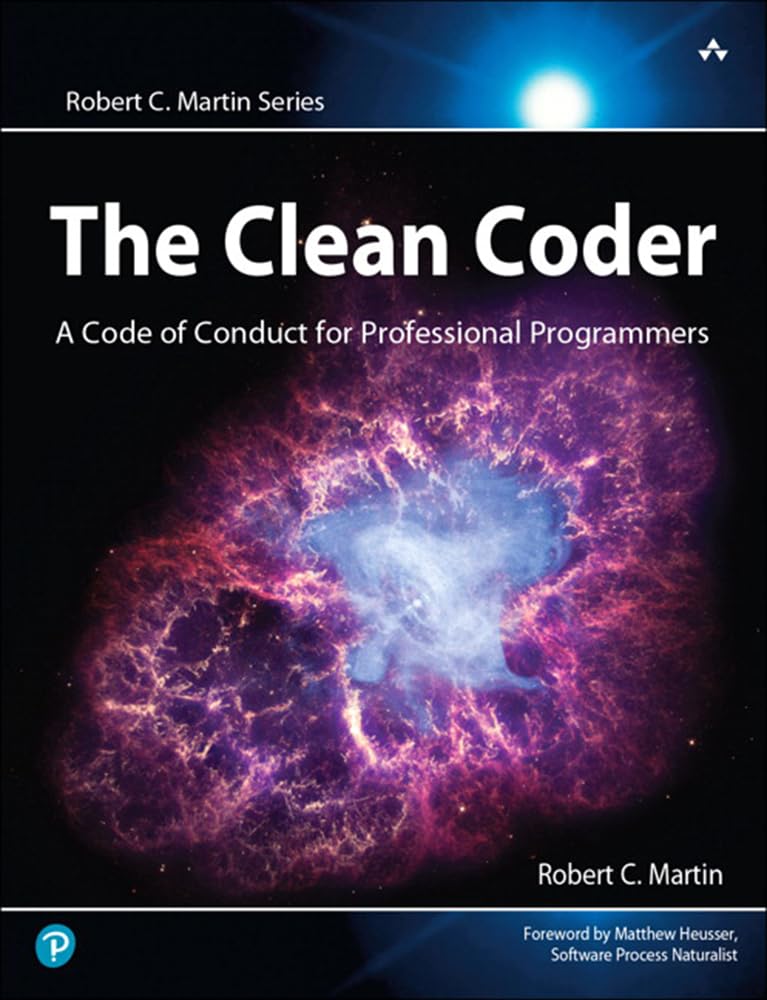
Description:
Reviews:
5.0 out of 5 stars Essential read for any software professional
Absolute must read for any software professional. Has tremendously improved my professional output, discipline and confidence to influence the success of my team.
5.0 out of 5 stars I wish I'd been taught the lessons in this book years ago.
While reading this book, I could relate to a lot of Robert C Martin's stories about unrealistic deadlines, poor requirements, inaccurate estimates and intense pressure to perform miracles. This book spends a lot of time examining the way that non-technical people perceive (and attempt to control) software development, and how all of these have a direct effect on the people who write the software, and ultimately quality of the software they produce, as well as the inevitable tension which emerges when things go wrong.I've personally experienced all of those things, and they aren't fun; the resulting software does not make me feel good either. I've had to deal with the tension and the office politics, deal with the poor quality rushed code merely weeks after asserting "We will do this properly", fix the buggy/broken software, explain missed deadlines, listen to disappointed customers.A part of me had been resigned to the fact that non-technical people just don't understand software, and that they are the cause of these problems. Explaining development to these people sometimes has felt like bailing out the titanic with a thimble, and it's tempting to believe that we have no way whatsoever to keep their wild expectations, their false assumptions and their mis-understandings in-check, or even that there's anything we as programmers can do to stop all that from derailing the efforts we put in to our software. Since reading this book, I've started to re-think my stance, and realised that there may be effective ways to handle these situations; maybe for their benefit but primarily for my own.I've made many of the same mistakes described in this book, and many of them without even realising that the mistake was even mine in the first place. Robert Martin provides advice and guidelines which arm us as developers to cope with these situations, and ways in which we can actually take control over other peoples' expectations and keep a lot of the mis-guided assumptions and - things which I assumed were out of my control, which may have been more about the way I perceived situations, or the way in which I handled communication with people I work with. I wish somebody had made me read this book years ago.Being able to write great code is necessary for advancing your career, but your career will go further, and it will be more enjoyable and satisfying if you don't always feel like you're losing control of the people issues. Furthermore, companies are likely to be enthusiastic about hiring programmers who know how to say the word "NO" when they're asked to do the impossible, and who know how to push for clear requirements, as well as knowing how to deal with all the other people issues.If you are a programmer, if you work with people (either technical or non-technical), and if you want to be a better programmer, then you will find plenty of good (yet surprisingly simple and common-sense) advice; this is a book about lessons learned from many years' of experience, and it's certainly easier to learn them from a book than by finding yourself in the middle of a failing project.
4.0 out of 5 stars Part of "must have, must read" collection
A very good book that every and I mean EVERY software developer (and not only because the book is more about professionalism than coding) must read. If you are just getting started in the field and have a lot going on, put everything else on pause, read the book then go on. If it did not change anything in your attitude towards work then good for you (you are already behaving like a professional or are to ignorant to care for the job you are doing. In case of the latter you should be slapped until you wake up to reality, nobody keeps a careless person around regardless of their skill, attitude is above skill. You need both, but attitude can compensate for skill while skill will not compensate for attitude).If you have thoughts about how a software developer should behave, what are the responsibilities of an organization towards their developer employees and the responsibilities of an employee towards his/hers employer and the work he/she is doing in a field so dynamic then read this book. It will shed some light on the path, confirm (or infirm) assumptions about how developers should do their job.Do not think this book will tell you how to write better code, it will but it is besides its focus (you have Clean Code for that). This book is all about attitude. It is about how we do what we do as developers and I do not mean how we write code, I mean how we communicate with our team, how we tell the management that the forced deadline cannot be met. Why and how we should do estimates. Last but not least understanding how a reply to a request is understood (e.g.: "I'll try to get it done by Monday" means that you will do your best to get the task done by that deadline, in other words it is mostly interpreted as "I'll get it done by Monday even if it costs me a few extra work hours and the weekend" otherwise it will be considered as you did not try hard enough). The management will try to pull every squeeze everything they can out of their developers (they probably will not go as far as blackmailing them but you can expect some sort of manipulation attempts) by asking to meet unreasonable deadlines (not always, but it happens often enough) and it is the job of the developer to tell the management that the respective deadline cannot be meet, developers must know how much work then can do and offer proper estimates (even though sometimes they are off, but they are estimates after all).I'm not giving this book 5 stars because it is somewhat repetitive and I would of liked more detail. Collaborating with QA, managers, fellow developers. How does Agile blend into all this. I would of liked more detail on forming teams (gelled teams are best, cool. How do we get there? If a team does not have a project to work on then why should that team exist? How is a gelled team forged? It needs to go though soft and hard times to properly form itself).
5.0 out of 5 stars An excellent read
A brilliant read. Don't get this book if you are looking for a read about actual coding practices or design patterns - this book is more about core behaviours of a developer as a person in a team, using examples taken from a long career where the author has spent time as a junior developer up to team leader / architect etc. etc..A lot of the content sounds obvious when you read it, but it's put together extremely well and will almost certainly relate to issues that you've had to deal with in your career, be it difficult colleagues or untrusting managers. It's easy to read and will probably open your eyes to becoming a more professional software developer who is better able to take responsibility for their work.
5.0 out of 5 stars Required reading for all software engineers
It's mandatory reading. If your career transitioned like mine or you are entering your first job, it has all the info you need to think, act, and work like a professional software developer. It will put you way in front of your peers if they haven't read it.
-
-
I think every programmer should read this book very early in their career.
Another great book from Uncle Bob. This time it is not about the program but the programmer. I think every programmer should read this book very early in their career. What Bob writes about professionalism is spot on.
A must read for any serious professional
I'm about halfway through and already its one of the most meaningful books in my career. It tackles a lot of the non-code issues in programming, such as being consistent on deliverables and communicating effectively.No matter how good of a coder you are, following the advice in this book will make you a better professional and more employable. Absolutely worth every penny.
Excellent book!!
This book is perfect for those who want to see and learn tips to improve as a professional, an excellent book for my taste.
Un ottimo libro
Non troverete una riga di codice in questo libro, ma molte indicazioni su come un professionista si formi, pianifichi, reagisca alle emergenze e in generale si comporti. Per la serie "allora non ero pazzo io".
Visit the Addison-Wesley Store
The Clean Coder: A Code of Conduct for Professional Programmers (Robert C. Martin Series)
AED30829
Quantity:
Order today to get by 7-14 business days
This item qualifies for free delivery
Imported From: United Kingdom
At BOLO, we work hard to ensure the products you receive are new, genuine, and sourced from reputable suppliers.
BOLO is not an authorized or official retailer for most brands, nor are we affiliated with manufacturers unless specifically stated on a product page. Instead, we source verified sellers, authorized distributors or directly from the manufacturer.
Each product undergoes thorough inspection and verification at our consolidation and fulfilment centers to ensure it meets our strict authenticity and quality standards before being shipped and delivered to you.
If you ever have concerns regarding the authenticity of a product purchased from us, please contact Bolo Support. We will review your inquiry promptly and, if necessary, provide documentation verifying authenticity or offer a suitable resolution.
Your trust is our top priority, and we are committed to maintaining transparency and integrity in every transaction.
All product information, images, descriptions, and reviews originate from the manufacturer or from trusted sellers overseas. BOLO is not affiliated with, endorsed by, or an authorized retailer for most brands listed on our website unless stated otherwise.
While we strive to display accurate information, variations in packaging, labeling, instructions, or formulation may occasionally occur due to regional differences or supplier updates. For detailed or manufacturer-specific information, please contact the brand directly or reach out to BOLO Support for assistance.
Unless otherwise stated, all prices displayed on the product page include applicable taxes and import duties.
BOLO operates in accordance with the laws and regulations of United Arab Emirates. Any items found to be restricted or prohibited for sale within the UAE will be cancelled prior to shipment. We take proactive measures to ensure that only products permitted for sale in United Arab Emirates are listed on our website.
All items are shipped by air, and any products classified as “Dangerous Goods (DG)” under IATA regulations will be removed from the order and cancelled.
All orders are processed manually, and we make every effort to process them promptly once confirmed. Products cancelled due to the above reasons will be permanently removed from listings across the website.
Similar suggestions by Bolo
More from this brand
Similar items from “Software Architecture”
Share with
Or share with link
https://www.bolo.ae/products/K0137081073
Visit the Addison-Wesley Store
The Clean Coder: A Code of Conduct for Professional Programmers (Robert C. Martin Series)

AED30829
Quantity:
Order today to get by 7-14 business days
This item qualifies for free delivery
Imported From: United Kingdom
At BOLO, we work hard to ensure the products you receive are new, genuine, and sourced from reputable suppliers.
BOLO is not an authorized or official retailer for most brands, nor are we affiliated with manufacturers unless specifically stated on a product page. Instead, we source verified sellers, authorized distributors or directly from the manufacturer.
Each product undergoes thorough inspection and verification at our consolidation and fulfilment centers to ensure it meets our strict authenticity and quality standards before being shipped and delivered to you.
If you ever have concerns regarding the authenticity of a product purchased from us, please contact Bolo Support. We will review your inquiry promptly and, if necessary, provide documentation verifying authenticity or offer a suitable resolution.
Your trust is our top priority, and we are committed to maintaining transparency and integrity in every transaction.
All product information, images, descriptions, and reviews originate from the manufacturer or from trusted sellers overseas. BOLO is not affiliated with, endorsed by, or an authorized retailer for most brands listed on our website unless stated otherwise.
While we strive to display accurate information, variations in packaging, labeling, instructions, or formulation may occasionally occur due to regional differences or supplier updates. For detailed or manufacturer-specific information, please contact the brand directly or reach out to BOLO Support for assistance.
Unless otherwise stated, all prices displayed on the product page include applicable taxes and import duties.
BOLO operates in accordance with the laws and regulations of United Arab Emirates. Any items found to be restricted or prohibited for sale within the UAE will be cancelled prior to shipment. We take proactive measures to ensure that only products permitted for sale in United Arab Emirates are listed on our website.
All items are shipped by air, and any products classified as “Dangerous Goods (DG)” under IATA regulations will be removed from the order and cancelled.
All orders are processed manually, and we make every effort to process them promptly once confirmed. Products cancelled due to the above reasons will be permanently removed from listings across the website.
Description:
Reviews:
5.0 out of 5 stars Essential read for any software professional
Absolute must read for any software professional. Has tremendously improved my professional output, discipline and confidence to influence the success of my team.
5.0 out of 5 stars I wish I'd been taught the lessons in this book years ago.
While reading this book, I could relate to a lot of Robert C Martin's stories about unrealistic deadlines, poor requirements, inaccurate estimates and intense pressure to perform miracles. This book spends a lot of time examining the way that non-technical people perceive (and attempt to control) software development, and how all of these have a direct effect on the people who write the software, and ultimately quality of the software they produce, as well as the inevitable tension which emerges when things go wrong.I've personally experienced all of those things, and they aren't fun; the resulting software does not make me feel good either. I've had to deal with the tension and the office politics, deal with the poor quality rushed code merely weeks after asserting "We will do this properly", fix the buggy/broken software, explain missed deadlines, listen to disappointed customers.A part of me had been resigned to the fact that non-technical people just don't understand software, and that they are the cause of these problems. Explaining development to these people sometimes has felt like bailing out the titanic with a thimble, and it's tempting to believe that we have no way whatsoever to keep their wild expectations, their false assumptions and their mis-understandings in-check, or even that there's anything we as programmers can do to stop all that from derailing the efforts we put in to our software. Since reading this book, I've started to re-think my stance, and realised that there may be effective ways to handle these situations; maybe for their benefit but primarily for my own.I've made many of the same mistakes described in this book, and many of them without even realising that the mistake was even mine in the first place. Robert Martin provides advice and guidelines which arm us as developers to cope with these situations, and ways in which we can actually take control over other peoples' expectations and keep a lot of the mis-guided assumptions and - things which I assumed were out of my control, which may have been more about the way I perceived situations, or the way in which I handled communication with people I work with. I wish somebody had made me read this book years ago.Being able to write great code is necessary for advancing your career, but your career will go further, and it will be more enjoyable and satisfying if you don't always feel like you're losing control of the people issues. Furthermore, companies are likely to be enthusiastic about hiring programmers who know how to say the word "NO" when they're asked to do the impossible, and who know how to push for clear requirements, as well as knowing how to deal with all the other people issues.If you are a programmer, if you work with people (either technical or non-technical), and if you want to be a better programmer, then you will find plenty of good (yet surprisingly simple and common-sense) advice; this is a book about lessons learned from many years' of experience, and it's certainly easier to learn them from a book than by finding yourself in the middle of a failing project.
4.0 out of 5 stars Part of "must have, must read" collection
A very good book that every and I mean EVERY software developer (and not only because the book is more about professionalism than coding) must read. If you are just getting started in the field and have a lot going on, put everything else on pause, read the book then go on. If it did not change anything in your attitude towards work then good for you (you are already behaving like a professional or are to ignorant to care for the job you are doing. In case of the latter you should be slapped until you wake up to reality, nobody keeps a careless person around regardless of their skill, attitude is above skill. You need both, but attitude can compensate for skill while skill will not compensate for attitude).If you have thoughts about how a software developer should behave, what are the responsibilities of an organization towards their developer employees and the responsibilities of an employee towards his/hers employer and the work he/she is doing in a field so dynamic then read this book. It will shed some light on the path, confirm (or infirm) assumptions about how developers should do their job.Do not think this book will tell you how to write better code, it will but it is besides its focus (you have Clean Code for that). This book is all about attitude. It is about how we do what we do as developers and I do not mean how we write code, I mean how we communicate with our team, how we tell the management that the forced deadline cannot be met. Why and how we should do estimates. Last but not least understanding how a reply to a request is understood (e.g.: "I'll try to get it done by Monday" means that you will do your best to get the task done by that deadline, in other words it is mostly interpreted as "I'll get it done by Monday even if it costs me a few extra work hours and the weekend" otherwise it will be considered as you did not try hard enough). The management will try to pull every squeeze everything they can out of their developers (they probably will not go as far as blackmailing them but you can expect some sort of manipulation attempts) by asking to meet unreasonable deadlines (not always, but it happens often enough) and it is the job of the developer to tell the management that the respective deadline cannot be meet, developers must know how much work then can do and offer proper estimates (even though sometimes they are off, but they are estimates after all).I'm not giving this book 5 stars because it is somewhat repetitive and I would of liked more detail. Collaborating with QA, managers, fellow developers. How does Agile blend into all this. I would of liked more detail on forming teams (gelled teams are best, cool. How do we get there? If a team does not have a project to work on then why should that team exist? How is a gelled team forged? It needs to go though soft and hard times to properly form itself).
5.0 out of 5 stars An excellent read
A brilliant read. Don't get this book if you are looking for a read about actual coding practices or design patterns - this book is more about core behaviours of a developer as a person in a team, using examples taken from a long career where the author has spent time as a junior developer up to team leader / architect etc. etc..A lot of the content sounds obvious when you read it, but it's put together extremely well and will almost certainly relate to issues that you've had to deal with in your career, be it difficult colleagues or untrusting managers. It's easy to read and will probably open your eyes to becoming a more professional software developer who is better able to take responsibility for their work.
5.0 out of 5 stars Required reading for all software engineers
It's mandatory reading. If your career transitioned like mine or you are entering your first job, it has all the info you need to think, act, and work like a professional software developer. It will put you way in front of your peers if they haven't read it.
-
-
I think every programmer should read this book very early in their career.
Another great book from Uncle Bob. This time it is not about the program but the programmer. I think every programmer should read this book very early in their career. What Bob writes about professionalism is spot on.
A must read for any serious professional
I'm about halfway through and already its one of the most meaningful books in my career. It tackles a lot of the non-code issues in programming, such as being consistent on deliverables and communicating effectively.No matter how good of a coder you are, following the advice in this book will make you a better professional and more employable. Absolutely worth every penny.
Excellent book!!
This book is perfect for those who want to see and learn tips to improve as a professional, an excellent book for my taste.
Un ottimo libro
Non troverete una riga di codice in questo libro, ma molte indicazioni su come un professionista si formi, pianifichi, reagisca alle emergenze e in generale si comporti. Per la serie "allora non ero pazzo io".
Similar suggestions by Bolo
More from this brand
Similar items from “Software Architecture”
Share with
Or share with link
https://www.bolo.ae/products/K0137081073