Deliver toUnited Arab Emirates
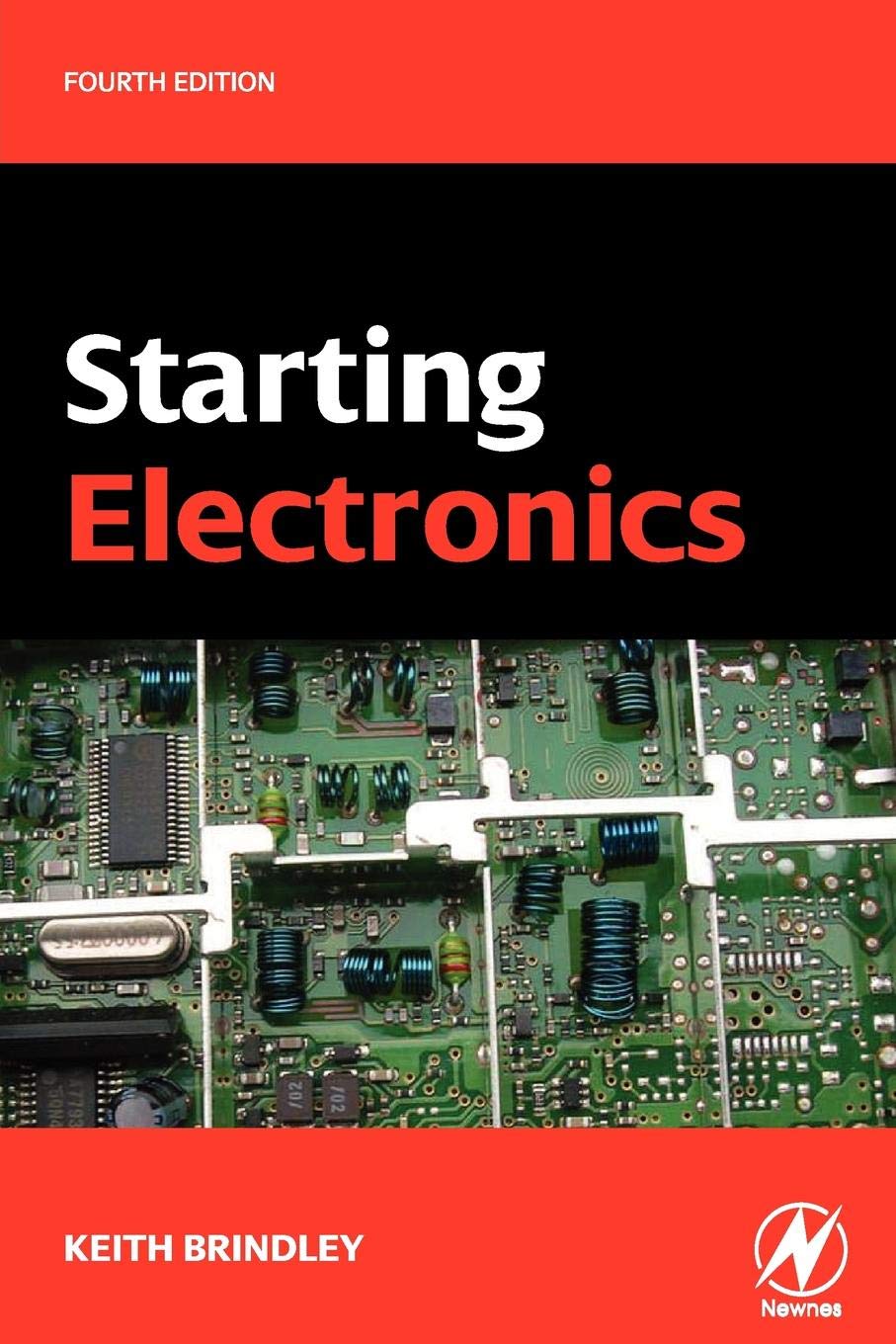
Starting Electronics

Description:

Starting Electronics is unrivalled as a highly practical introduction for technicians, non-electronic engineers, software engineers, students, and hobbyists. Keith Brindley introduces readers to the functions of the main component types, their uses, and the basic principles of building and designing electronic circuits. Breadboard layouts make this very much a ready-to-run book for the experimenter, and the use of readily available, inexpensive components makes this practical exploration of electronics easily accessible to all levels of engineer and hobbyist. Other books tell readers what to do, but sometimes fail to explain why - Brindley gives readers hands-on confidence in addition to real scientific knowledge, and insight into the principles as well as the practice. All written explanations and steps are supplemented with numerous photos, charts, tables and graphs. Concepts and practical aspects are explained thoroughly with mathematical formulae and technical schematic drawings. Each chapter introduces a concept or tool, explains the basic theory, and provides clear instructions for a simple experiment to apply the concept or tool, with quiz sections and answers, at the end of each chapter. New chapters on multimeters and soldering will be added, covering the fundamentals and experiments, with a basic parts list and an expanded and updated buyer's guide.


Review

Amazon reviews - selected quotes: "I am ever so grateful to have found this amazing little book. I am a completely devoted fan of this book. I give this book ALL the credit for helping me pass my college course! This book gave me the skills and the confidence to figure out how to put together very simple robots and circuit boards. This book starts with the very, very basics, but it gives you the fundamentals very well so that you can tackle things on your own." - Kelly Jones "Outstanding book... plain and simple. If this book cost twice the amount it does, you would still be getting a deal." - Howard R. Lee "This is a great book. To admit one thing, I knew NOTHING about electronics. Coming from a software development background I wanted to see how the other side worked, and this book did an amazing job at explaining. Nothing could be done to make this book better, it's perfect!" - Kyle Goslin "This is great and has finally made the subject accessible to me. it's the way you wish your teacher had done things. I've picked things up in minutes from this book that I've seen other books spend hours talking about." - G. Graham --Kelly Jones

Review

Get hands-on confidence with this practical guide to electronics construction and the design of simple circuits – no experience required!

Reviews:

5.0 out of 5 stars Book

m.n. · 13 October 2025

Good

4.0 out of 5 stars Highly recommended

D.O.J.E. · 18 February 2014

I studied chemistry and physics many years ago and went down the chemistry road as a career, so was looking for a basic electronics book to get a new understanding of this complex subject. I bought this book and found the writing style to be very enjoyable; the subject matter does move along quite quickly and many of the complex fundamentals are omitted so as to gain an easier understanding of the subject. There are a few mistakes throughout the book which did niggle and slow me down a little, but all in all it is a really enjoyable introduction to electronics. I would highly recommend it!

5.0 out of 5 stars Excellent Publication

M.J. · 6 April 2013

This really is a book for the beginner. It offers information on the basic tools required then guides you through identification and purpose of the various components and methods of construction. Finally explaining Integrated Circuits both Analogue and Digital.

5.0 out of 5 stars A good starting point for learning electronics

d. · 31 January 2015

An excellent book and I would certainly buy it again. I started electronics 50 years ago but stillfound useful stuff in the book for helping others get going.

2.0 out of 5 stars Beginners Guide? I dont think so.

b.s. · 7 January 2021

One or two books I've come across claiming to be for beginners, seem to, regardless of the subject, start off gentle and then escalate at a ridiculous rate of knots as the authors seem to get carried away in their own private world. This book though takes the biscuit as it goes from zero to a hundred in the first few chapters. I've had a career as an electrician and I am no stranger to the basics of electrics, and schematic drawing of complex control panels are not a problem, but electronics has always held a fascination. At the start of the book, dealing with volts, amp and ohms etc and the milli, micro and mega values and powers of ten etc. there was no problem. The maths involved was pretty straight forward too. The quizzes at the end of the first few chapters were well defined as to be challenging and made you really delve into what you had already learned. But then, off it went into electronic jumps and leaps, and language was not as simple as promised. I found myself with an abundance of questions with no one to ask for answers. There was one question in the quiz about capacitors that was impossible to work out with the information given. The answer, a simple '8' seems to have come from nowhere and the most annoying things is, none of the answers to any of the quizzes is explained. I actually had to look on youtube at another tutorial to fathom how the answer was arrived at. A few pages further in the land of capacitors, it got a bit difficult. But that ok, coz it made sense, just took some thinking, then an equation appears with an unrecognisable constant. Not that it says its a constant?. Its just a figure that appears in an equation with no explanation to where it has come from. At this point it there didn't seem much point in carrying on. This book is not for the beginner at all. Its a flight of fancy for a chap who obviously knows his subject too well to realize just how complicated it can be to the novice. Too many details are left out, and not providing the workings out of the answers to the quizzes just leave one hanging. Not recommended for a beginner at all.

5.0 out of 5 stars Great little book if you are starting out in electronics

G. · 19 June 2016

Great little book if you are starting out in electronics, I use this along with other sources of reading.To understand some of the equations though and how they are arrived at, you may need to look elsewhere for more information.

4.0 out of 5 stars A useful start

P.A. · 4 July 2017

I started electronics back in 1971 but stopped doing any in the mid 80s, I found this book a useful start, I enjoyed being able to make up the circuits in this book and learn by doing as well as reading. The only thing the book lacked for me - was clear advise on where to go next.

5.0 out of 5 stars Amazing Buy

C. · 12 January 2012

if you wish for an electronic book that's not busy in terms of layout and approach, this your book. It approaches items individually and writes in a step by step manner.

Satisfied

H.K. · 12 March 2021

Received in good condition and on time.

De très bonnes bases pour se lancer

D.H. · 30 October 2016

Cela faisait déjà 3 ans que je m'étais mis à l'électronique au sein d'un fablab, sans plus de formation que ce que j'avais pu étudier en cours de technologie au collège il y a plus de 20 ans. A force de répliquer des schémas récupérés à gauche et à droite sur le web, et surtout après avoir créé et commencé à débugger mes premiers schémas sans microcontrôleur, je me suis dit qu'il fallait que je fasse un retour aux basiques.Ce livre très bien écrit a parfaitement rempli sa fonction : non seulement il m'a aidé à mieux comprendre les composants et le fonctionnement détaillé des circuits que je reproduisais, mais en plus il m'a permis d'enrichir ma culture électronique et de donner de nouvelles pistes et idées d'applications. Il donne envie d'en apprendre plus, et d'expérimenter plus : je recommande chaudement !

Excellent beginner book...

L. · 3 May 2013

My son (11) and I are new to electronics. This book has been a great introduction so far. We've only ready the first few chapters, but the fornat is consistant and helpful.Each chapter ends with a simple quiz (answers in back of the book), which helps underscore important points thay were made.The book also lists typical equipment that is necessary, and illustrations and photos are used to show proper usage. In addition, there are sections where the reader is asked to use a multimeter to check resistance, voltage level, and/or current, and there are illustrations of where you should place the test leads in the circuit when getting the values. I find that incredibly useful, since it helps remove guess work on my part.

Get the Book, Get Your Parts, Get Started!

n. · 24 October 2016

This is a great introduction to electronics. The fourth edition offers an updated, more modern print layout, plus a chapter on soldering.Unfortunately, the parts list from the third edition seems to have disappeared. This, plus the author's habit of showing only a partial parts list at the start of each chapter, then describing additional parts needed in the text of the chapter, makes it a little rough to get started.The following are equipment and parts lists to help you get started:EQUIPMENT:General:(1) Needle-nose pliers (small)(1) Wire cutters (small)(1) Digital multimeter(1) Breadboard(1) Breadboard hookup wires (set)(2) 9V batteriesChapter 12, Soldering:(1) Hookup wire package (multiple spools)(1) Prototyping board (package of multiple recommended)(1) Wire strippers(1) Soldering iron(1) Soldering iron stand(1) Solder (spool)(1) Solder extractor(1) Solder wick (spool)For convenience, here is an Bolo wish list of these items that you can use as a shopping list. Note that products change all the time on Bolo, and I cannot guarantee availability of any of these items at the time you read this review: https://Bolo.com/registry/wishlist/4YLFYJ61GBD2PARTS (read notes further on!):Resistors:(2) 150 ohm (1/2W) [660-MF1/2DC1500F](2) 1.5K ohm [603-MFR-25FBF52-1K5](1) 4.7K ohm [603-MFR-25FBF52-4K7](3) 10K ohm [603-MFR-25FBF52-10K](2) 15K ohm [603-MFR-25FBF52-15K](1) 22K ohm [603-MFR-25FTE52-22K](3) 47K ohm [603-MFR-25FBF52-47K](2) 100K ohm [603-MFR-25FBF52-100K](1) 220K ohm [603-MFR-25FBF52-220K]Potentiometers:(1) 1K ohm miniature horizontal preset (linear trimmer) [652-3386P-1-102LF](1) 47K ohm miniature horizontal preset (linear trimmer) [652-3362P-1-473LF]Capacitors:(1) 1nF [594-H102K25X7RL63J5R](2) 10nF [594-S103K75Y5PN83K0R](2) 100nF [581-SR211C104KARTR1](1) 1uF electrolytic [647-UKL1H010KDDANATD](1) 10uF electrolytic [140-RN100K1HBK0811P](1) 22uF electrolytic [647-UKL1E220KDDANA](1) 220uF electrolytic [647-UKL1E221KPD](1) 470uF electrolytic [647-UKL1E471KHD]Integrated Circuits (ICs):(1) 555 timer [512-LM555CN](1) 741 op-amp [926-LM741CN/NOPB](1) 4001 NOR gate [595-CD4001BE](1) 4011 NAND gate [595-CD4011BE](1) 4049 hex inverter [595-CD4049UBE](1) 4071 OR gate [595-CD4071BE](1) 4081 AND gate [595-CD4081BE]Other Semiconductors:(1) 2N3053 transistor [610-2N3053](1) 3V0 Zener diode [78-BZX85B3V0](1) 4001 diode (rectifier) [863-1N4001G](1) OA47 diode (or suitable substitute) [621-SBR10U40CTFP](3) LEDs [859-LTL-4231N]Mechanical Parts:(1) Single pole, single throw (SPST) switch [611-BD08](2) 9V battery connector [123-5006-GR]Bolo is not an electronics parts supplier, so you will need to order these from a separate company. Bolo also does not allow links to other sites, but the list above includes part numbers for Mouser in square brackets. For example, to pull up suitable 150 ohm, 1/2W resistors, use part number 660-MF1/2DC1500F on Mouser's site. Make sure you're looking only at parts in stock, as ordering a non-stocked part will result in a backorder that could take several months. There are several other suppliers, including DigiKey, Jameco, Allied, and Fry's, where you should also be able to order these components, if you want to look for them yourself; they are very generic.Note that products change all the time with any supplier, and I cannot guarantee availability of any of these specific part numbers at the time you read this review.NOTES:The breadboard hookup wires provided in the equipment list eliminate the need for cutting and tinning your own wires; you only need the spools of wire if you intend to do Chapter 12, Soldering. Also, the battery connectors recommended in the parts list are pre-tinned, so you can eliminate the soldering equipment entirely if you choose not to do Chapter 12.In general, resistors can be low-wattage (1/4W is sufficient and a fairly handy size to work with). The 150 ohm resistors are specifically stated as 1/2W in the book.There seems to be a mistake in a few of the digital projects, where a 100K ohm resistor is used with an LED, instead of a 10K ohm. The parts list from the third edition of the book, as well as looking at the circuit, indicates this is wrong (you'll note there are two other LEDs in the same circuits that use 10K ohm resistors). The list provided in this review plans on using (3) 10K ohm resistors, and only (2) 100K ohm resistors. If you want to follow the book to the letter, instead get (2) 10K ohm resistors and (3) 100K ohm resistors.Voltages on capacitors should be at least 9V. Electrolytic capacitors in these sizes are commonly and cheaply available in 16V, 25V, and 50V, so this shouldn't be any problem.The book talks about miniature horizontal presets. You can use a trimmer potentiometer ("pot") for these. You want it to be linear (as opposed to, say, logarithmic). You also want it to fit into the breadboard, so look for through-hole components with a leg spacing of 2.54mm (0.10in).The OA47 diode isn't so easy to get these days. It was an old-school germanium diode, in a cute glass tube. The idea of it in the book is to be another point of reference in your experiments, so you can see it has different characteristics from the other two diodes as you make measurements. A Schottky diode with a low voltage drop will do the trick. The one listed from Mouser is actually two diodes in a single package. It's a little black box that looks nothing like the other diodes--it has three pins. When you get to Chapter 6, Diodes I, you can simply use one end pin (the anode) and the center pin (the cathode), and ignore the other end pin (the second diode's anode)--or, if it really bothers you, you can clip off one end pin with your wire cutters. There! Now you have only two pins! (I'm actually serious--this will work fine.)The integrated circuits and other semiconductors are somewhat delicate. Many of them can easily be burned out by mistakes. (A common early mistake is to want to see an LED light and hook it up directly to the battery, without any resistance--it will be gone very quickly!) It's probably a good idea to order redundant parts of some of these, particularly cheap ones, just in case there's an accident.LEDs can be whatever color you like. Green, red, and amber tend to be quite cheap, although you may find prices you can stand for spiffy blue or white ones. The ones listed from Mouser are green LEDs, fairly bright (LEDs come in different brightnesses, measured in mcd, or millicandela), and are diffused (the light is spread out to make it easier to see from different angles when they're lit).The switch listed from Mouser is actually eight switches in a single package. It plugs into the breadboard. You can get single switches, or pairs, or whatever you like; they tend to be a similar price, and having more switches to play with could be useful for future projects. If you get a different model, just make sure the leg spacing is 2.54mm (0.10in), so it fits in your breadboard.Chapter 11, Digital Integrated Circuits II, is entirely theoretical--there are no circuits given to build. Thus, none of the components mentioned in that chapter are provided in the parts list.

Easy to understand

D.A. · 31 August 2019

Perfect for us beginners. I realy like reading it and learned a lot from it. Now is it the practical left in the repeating passage. Good book...

Starting Electronics

Product ID: K0080969925
Condition: New

4.3

AED18893

Price includes VAT & Import Duties
Type: Paperback
Availability: In Stock

Quantity:

|

Order today to get by 7-14 business days

Delivery fee of AED 20. Free for orders above AED 200.

Returns & Warranty policies

Imported From: United Kingdom

At BOLO, we work hard to ensure the products you receive are new, genuine, and sourced from reputable suppliers.

BOLO is not an authorized or official retailer for most brands, nor are we affiliated with manufacturers unless specifically stated on a product page. Instead, we source verified sellers, authorized distributors or directly from the manufacturer.

Each product undergoes thorough inspection and verification at our consolidation and fulfilment centers to ensure it meets our strict authenticity and quality standards before being shipped and delivered to you.

If you ever have concerns regarding the authenticity of a product purchased from us, please contact Bolo Support. We will review your inquiry promptly and, if necessary, provide documentation verifying authenticity or offer a suitable resolution.

Your trust is our top priority, and we are committed to maintaining transparency and integrity in every transaction.

All product information, images, descriptions, and reviews originate from the manufacturer or from trusted sellers overseas. BOLO is not affiliated with, endorsed by, or an authorized retailer for most brands listed on our website unless stated otherwise.

While we strive to display accurate information, variations in packaging, labeling, instructions, or formulation may occasionally occur due to regional differences or supplier updates. For detailed or manufacturer-specific information, please contact the brand directly or reach out to BOLO Support for assistance.

Unless otherwise stated, all prices displayed on the product page include applicable taxes and import duties.

BOLO operates in accordance with the laws and regulations of United Arab Emirates. Any items found to be restricted or prohibited for sale within the UAE will be cancelled prior to shipment. We take proactive measures to ensure that only products permitted for sale in United Arab Emirates are listed on our website.

All items are shipped by air, and any products classified as “Dangerous Goods (DG)” under IATA regulations will be removed from the order and cancelled.

All orders are processed manually, and we make every effort to process them promptly once confirmed. Products cancelled due to the above reasons will be permanently removed from listings across the website.

Similar suggestions by Bolo

More from this brand

Similar items from “Circuits”

Starting Electronics

Product ID: K0080969925
Condition: New

4.3

Starting Electronics-0
Type: Paperback

AED18893

Price includes VAT & Import Duties
Availability: In Stock

Quantity:

|

Order today to get by 7-14 business days

Delivery fee of AED 20. Free for orders above AED 200.

Returns & Warranty policies

Imported From: United Kingdom

At BOLO, we work hard to ensure the products you receive are new, genuine, and sourced from reputable suppliers.

BOLO is not an authorized or official retailer for most brands, nor are we affiliated with manufacturers unless specifically stated on a product page. Instead, we source verified sellers, authorized distributors or directly from the manufacturer.

Each product undergoes thorough inspection and verification at our consolidation and fulfilment centers to ensure it meets our strict authenticity and quality standards before being shipped and delivered to you.

If you ever have concerns regarding the authenticity of a product purchased from us, please contact Bolo Support. We will review your inquiry promptly and, if necessary, provide documentation verifying authenticity or offer a suitable resolution.

Your trust is our top priority, and we are committed to maintaining transparency and integrity in every transaction.

All product information, images, descriptions, and reviews originate from the manufacturer or from trusted sellers overseas. BOLO is not affiliated with, endorsed by, or an authorized retailer for most brands listed on our website unless stated otherwise.

While we strive to display accurate information, variations in packaging, labeling, instructions, or formulation may occasionally occur due to regional differences or supplier updates. For detailed or manufacturer-specific information, please contact the brand directly or reach out to BOLO Support for assistance.

Unless otherwise stated, all prices displayed on the product page include applicable taxes and import duties.

BOLO operates in accordance with the laws and regulations of United Arab Emirates. Any items found to be restricted or prohibited for sale within the UAE will be cancelled prior to shipment. We take proactive measures to ensure that only products permitted for sale in United Arab Emirates are listed on our website.

All items are shipped by air, and any products classified as “Dangerous Goods (DG)” under IATA regulations will be removed from the order and cancelled.

All orders are processed manually, and we make every effort to process them promptly once confirmed. Products cancelled due to the above reasons will be permanently removed from listings across the website.

Description:

Starting Electronics is unrivalled as a highly practical introduction for technicians, non-electronic engineers, software engineers, students, and hobbyists. Keith Brindley introduces readers to the functions of the main component types, their uses, and the basic principles of building and designing electronic circuits. Breadboard layouts make this very much a ready-to-run book for the experimenter, and the use of readily available, inexpensive components makes this practical exploration of electronics easily accessible to all levels of engineer and hobbyist. Other books tell readers what to do, but sometimes fail to explain why - Brindley gives readers hands-on confidence in addition to real scientific knowledge, and insight into the principles as well as the practice. All written explanations and steps are supplemented with numerous photos, charts, tables and graphs. Concepts and practical aspects are explained thoroughly with mathematical formulae and technical schematic drawings. Each chapter introduces a concept or tool, explains the basic theory, and provides clear instructions for a simple experiment to apply the concept or tool, with quiz sections and answers, at the end of each chapter. New chapters on multimeters and soldering will be added, covering the fundamentals and experiments, with a basic parts list and an expanded and updated buyer's guide.


Review

Amazon reviews - selected quotes: "I am ever so grateful to have found this amazing little book. I am a completely devoted fan of this book. I give this book ALL the credit for helping me pass my college course! This book gave me the skills and the confidence to figure out how to put together very simple robots and circuit boards. This book starts with the very, very basics, but it gives you the fundamentals very well so that you can tackle things on your own." - Kelly Jones "Outstanding book... plain and simple. If this book cost twice the amount it does, you would still be getting a deal." - Howard R. Lee "This is a great book. To admit one thing, I knew NOTHING about electronics. Coming from a software development background I wanted to see how the other side worked, and this book did an amazing job at explaining. Nothing could be done to make this book better, it's perfect!" - Kyle Goslin "This is great and has finally made the subject accessible to me. it's the way you wish your teacher had done things. I've picked things up in minutes from this book that I've seen other books spend hours talking about." - G. Graham --Kelly Jones

Review

Get hands-on confidence with this practical guide to electronics construction and the design of simple circuits – no experience required!

Reviews:

5.0 out of 5 stars Book

m.n. · 13 October 2025

Good

4.0 out of 5 stars Highly recommended

D.O.J.E. · 18 February 2014

I studied chemistry and physics many years ago and went down the chemistry road as a career, so was looking for a basic electronics book to get a new understanding of this complex subject. I bought this book and found the writing style to be very enjoyable; the subject matter does move along quite quickly and many of the complex fundamentals are omitted so as to gain an easier understanding of the subject. There are a few mistakes throughout the book which did niggle and slow me down a little, but all in all it is a really enjoyable introduction to electronics. I would highly recommend it!

5.0 out of 5 stars Excellent Publication

M.J. · 6 April 2013

This really is a book for the beginner. It offers information on the basic tools required then guides you through identification and purpose of the various components and methods of construction. Finally explaining Integrated Circuits both Analogue and Digital.

5.0 out of 5 stars A good starting point for learning electronics

d. · 31 January 2015

An excellent book and I would certainly buy it again. I started electronics 50 years ago but stillfound useful stuff in the book for helping others get going.

2.0 out of 5 stars Beginners Guide? I dont think so.

b.s. · 7 January 2021

One or two books I've come across claiming to be for beginners, seem to, regardless of the subject, start off gentle and then escalate at a ridiculous rate of knots as the authors seem to get carried away in their own private world. This book though takes the biscuit as it goes from zero to a hundred in the first few chapters. I've had a career as an electrician and I am no stranger to the basics of electrics, and schematic drawing of complex control panels are not a problem, but electronics has always held a fascination. At the start of the book, dealing with volts, amp and ohms etc and the milli, micro and mega values and powers of ten etc. there was no problem. The maths involved was pretty straight forward too. The quizzes at the end of the first few chapters were well defined as to be challenging and made you really delve into what you had already learned. But then, off it went into electronic jumps and leaps, and language was not as simple as promised. I found myself with an abundance of questions with no one to ask for answers. There was one question in the quiz about capacitors that was impossible to work out with the information given. The answer, a simple '8' seems to have come from nowhere and the most annoying things is, none of the answers to any of the quizzes is explained. I actually had to look on youtube at another tutorial to fathom how the answer was arrived at. A few pages further in the land of capacitors, it got a bit difficult. But that ok, coz it made sense, just took some thinking, then an equation appears with an unrecognisable constant. Not that it says its a constant?. Its just a figure that appears in an equation with no explanation to where it has come from. At this point it there didn't seem much point in carrying on. This book is not for the beginner at all. Its a flight of fancy for a chap who obviously knows his subject too well to realize just how complicated it can be to the novice. Too many details are left out, and not providing the workings out of the answers to the quizzes just leave one hanging. Not recommended for a beginner at all.

5.0 out of 5 stars Great little book if you are starting out in electronics

G. · 19 June 2016

Great little book if you are starting out in electronics, I use this along with other sources of reading.To understand some of the equations though and how they are arrived at, you may need to look elsewhere for more information.

4.0 out of 5 stars A useful start

P.A. · 4 July 2017

I started electronics back in 1971 but stopped doing any in the mid 80s, I found this book a useful start, I enjoyed being able to make up the circuits in this book and learn by doing as well as reading. The only thing the book lacked for me - was clear advise on where to go next.

5.0 out of 5 stars Amazing Buy

C. · 12 January 2012

if you wish for an electronic book that's not busy in terms of layout and approach, this your book. It approaches items individually and writes in a step by step manner.

Satisfied

H.K. · 12 March 2021

Received in good condition and on time.

De très bonnes bases pour se lancer

D.H. · 30 October 2016

Cela faisait déjà 3 ans que je m'étais mis à l'électronique au sein d'un fablab, sans plus de formation que ce que j'avais pu étudier en cours de technologie au collège il y a plus de 20 ans. A force de répliquer des schémas récupérés à gauche et à droite sur le web, et surtout après avoir créé et commencé à débugger mes premiers schémas sans microcontrôleur, je me suis dit qu'il fallait que je fasse un retour aux basiques.Ce livre très bien écrit a parfaitement rempli sa fonction : non seulement il m'a aidé à mieux comprendre les composants et le fonctionnement détaillé des circuits que je reproduisais, mais en plus il m'a permis d'enrichir ma culture électronique et de donner de nouvelles pistes et idées d'applications. Il donne envie d'en apprendre plus, et d'expérimenter plus : je recommande chaudement !

Excellent beginner book...

L. · 3 May 2013

My son (11) and I are new to electronics. This book has been a great introduction so far. We've only ready the first few chapters, but the fornat is consistant and helpful.Each chapter ends with a simple quiz (answers in back of the book), which helps underscore important points thay were made.The book also lists typical equipment that is necessary, and illustrations and photos are used to show proper usage. In addition, there are sections where the reader is asked to use a multimeter to check resistance, voltage level, and/or current, and there are illustrations of where you should place the test leads in the circuit when getting the values. I find that incredibly useful, since it helps remove guess work on my part.

Get the Book, Get Your Parts, Get Started!

n. · 24 October 2016

This is a great introduction to electronics. The fourth edition offers an updated, more modern print layout, plus a chapter on soldering.Unfortunately, the parts list from the third edition seems to have disappeared. This, plus the author's habit of showing only a partial parts list at the start of each chapter, then describing additional parts needed in the text of the chapter, makes it a little rough to get started.The following are equipment and parts lists to help you get started:EQUIPMENT:General:(1) Needle-nose pliers (small)(1) Wire cutters (small)(1) Digital multimeter(1) Breadboard(1) Breadboard hookup wires (set)(2) 9V batteriesChapter 12, Soldering:(1) Hookup wire package (multiple spools)(1) Prototyping board (package of multiple recommended)(1) Wire strippers(1) Soldering iron(1) Soldering iron stand(1) Solder (spool)(1) Solder extractor(1) Solder wick (spool)For convenience, here is an Bolo wish list of these items that you can use as a shopping list. Note that products change all the time on Bolo, and I cannot guarantee availability of any of these items at the time you read this review: https://Bolo.com/registry/wishlist/4YLFYJ61GBD2PARTS (read notes further on!):Resistors:(2) 150 ohm (1/2W) [660-MF1/2DC1500F](2) 1.5K ohm [603-MFR-25FBF52-1K5](1) 4.7K ohm [603-MFR-25FBF52-4K7](3) 10K ohm [603-MFR-25FBF52-10K](2) 15K ohm [603-MFR-25FBF52-15K](1) 22K ohm [603-MFR-25FTE52-22K](3) 47K ohm [603-MFR-25FBF52-47K](2) 100K ohm [603-MFR-25FBF52-100K](1) 220K ohm [603-MFR-25FBF52-220K]Potentiometers:(1) 1K ohm miniature horizontal preset (linear trimmer) [652-3386P-1-102LF](1) 47K ohm miniature horizontal preset (linear trimmer) [652-3362P-1-473LF]Capacitors:(1) 1nF [594-H102K25X7RL63J5R](2) 10nF [594-S103K75Y5PN83K0R](2) 100nF [581-SR211C104KARTR1](1) 1uF electrolytic [647-UKL1H010KDDANATD](1) 10uF electrolytic [140-RN100K1HBK0811P](1) 22uF electrolytic [647-UKL1E220KDDANA](1) 220uF electrolytic [647-UKL1E221KPD](1) 470uF electrolytic [647-UKL1E471KHD]Integrated Circuits (ICs):(1) 555 timer [512-LM555CN](1) 741 op-amp [926-LM741CN/NOPB](1) 4001 NOR gate [595-CD4001BE](1) 4011 NAND gate [595-CD4011BE](1) 4049 hex inverter [595-CD4049UBE](1) 4071 OR gate [595-CD4071BE](1) 4081 AND gate [595-CD4081BE]Other Semiconductors:(1) 2N3053 transistor [610-2N3053](1) 3V0 Zener diode [78-BZX85B3V0](1) 4001 diode (rectifier) [863-1N4001G](1) OA47 diode (or suitable substitute) [621-SBR10U40CTFP](3) LEDs [859-LTL-4231N]Mechanical Parts:(1) Single pole, single throw (SPST) switch [611-BD08](2) 9V battery connector [123-5006-GR]Bolo is not an electronics parts supplier, so you will need to order these from a separate company. Bolo also does not allow links to other sites, but the list above includes part numbers for Mouser in square brackets. For example, to pull up suitable 150 ohm, 1/2W resistors, use part number 660-MF1/2DC1500F on Mouser's site. Make sure you're looking only at parts in stock, as ordering a non-stocked part will result in a backorder that could take several months. There are several other suppliers, including DigiKey, Jameco, Allied, and Fry's, where you should also be able to order these components, if you want to look for them yourself; they are very generic.Note that products change all the time with any supplier, and I cannot guarantee availability of any of these specific part numbers at the time you read this review.NOTES:The breadboard hookup wires provided in the equipment list eliminate the need for cutting and tinning your own wires; you only need the spools of wire if you intend to do Chapter 12, Soldering. Also, the battery connectors recommended in the parts list are pre-tinned, so you can eliminate the soldering equipment entirely if you choose not to do Chapter 12.In general, resistors can be low-wattage (1/4W is sufficient and a fairly handy size to work with). The 150 ohm resistors are specifically stated as 1/2W in the book.There seems to be a mistake in a few of the digital projects, where a 100K ohm resistor is used with an LED, instead of a 10K ohm. The parts list from the third edition of the book, as well as looking at the circuit, indicates this is wrong (you'll note there are two other LEDs in the same circuits that use 10K ohm resistors). The list provided in this review plans on using (3) 10K ohm resistors, and only (2) 100K ohm resistors. If you want to follow the book to the letter, instead get (2) 10K ohm resistors and (3) 100K ohm resistors.Voltages on capacitors should be at least 9V. Electrolytic capacitors in these sizes are commonly and cheaply available in 16V, 25V, and 50V, so this shouldn't be any problem.The book talks about miniature horizontal presets. You can use a trimmer potentiometer ("pot") for these. You want it to be linear (as opposed to, say, logarithmic). You also want it to fit into the breadboard, so look for through-hole components with a leg spacing of 2.54mm (0.10in).The OA47 diode isn't so easy to get these days. It was an old-school germanium diode, in a cute glass tube. The idea of it in the book is to be another point of reference in your experiments, so you can see it has different characteristics from the other two diodes as you make measurements. A Schottky diode with a low voltage drop will do the trick. The one listed from Mouser is actually two diodes in a single package. It's a little black box that looks nothing like the other diodes--it has three pins. When you get to Chapter 6, Diodes I, you can simply use one end pin (the anode) and the center pin (the cathode), and ignore the other end pin (the second diode's anode)--or, if it really bothers you, you can clip off one end pin with your wire cutters. There! Now you have only two pins! (I'm actually serious--this will work fine.)The integrated circuits and other semiconductors are somewhat delicate. Many of them can easily be burned out by mistakes. (A common early mistake is to want to see an LED light and hook it up directly to the battery, without any resistance--it will be gone very quickly!) It's probably a good idea to order redundant parts of some of these, particularly cheap ones, just in case there's an accident.LEDs can be whatever color you like. Green, red, and amber tend to be quite cheap, although you may find prices you can stand for spiffy blue or white ones. The ones listed from Mouser are green LEDs, fairly bright (LEDs come in different brightnesses, measured in mcd, or millicandela), and are diffused (the light is spread out to make it easier to see from different angles when they're lit).The switch listed from Mouser is actually eight switches in a single package. It plugs into the breadboard. You can get single switches, or pairs, or whatever you like; they tend to be a similar price, and having more switches to play with could be useful for future projects. If you get a different model, just make sure the leg spacing is 2.54mm (0.10in), so it fits in your breadboard.Chapter 11, Digital Integrated Circuits II, is entirely theoretical--there are no circuits given to build. Thus, none of the components mentioned in that chapter are provided in the parts list.

Easy to understand

D.A. · 31 August 2019

Perfect for us beginners. I realy like reading it and learned a lot from it. Now is it the practical left in the repeating passage. Good book...

Similar suggestions by Bolo

More from this brand

Similar items from “Circuits”