Description:
Review
"No one in my experience can explicate such complex material with the grace and clarity that seem so effortless to Stephen Meyer. With meticulous rational analysis of the latest discoveries in cosmology, physics, and biology, Meyer confirms a truth ideologues find too frightening to consider. Their ad hominem attacks on his brilliant work, confirm its importance." --Dean Koontz, New York Times #1 bestselling author
"A meticulously researched, lavishly illustrated, and thoroughly argued case against the new atheism. Even if your mind is made up―especially if it is―Meyer’s refreshing take on the origins of the Universe is a joy to read. You may not come away convinced, but you’ll be richer for the journey." --Dr. Brian Keating, Chancellor’s Distinguished Professor of Physics, University of California, San Diego, and author of Losing the Nobel Prize.
About the Author
Stephen C. Meyer received his Ph.D. from the University of Cambridge in the philosophy of science after working as an oil industry geophysicist. He now directs the Center for Science and Culture at the Discovery Institute in Seattle, Washington. He authored Signature in the Cell, a (London) Times Literary Supplement Book of the Year.
Reviews:
5.0 out of 5 stars Logical, empirical and scientific. Read this .
As with his previous books, Stephen Meyers latest book uses a rigorous process of elimination to assess competing worldviews about the origin of life .Atheism is eliminated as a poor explanation on the basis that evidence for the ‘ big bang’ implies that the universe had a beginning; which implies something or someone started everything off in the first place .Deism is eliminated because of the inability of Darwin’s Theory of Evolution to explain the transition from geochemistry to biochemistry , implying an intelligence intervened at at least one point in the earths geological past .Pantheism is eliminated for similar reasons as Atheism . The idea of ‘ space aliens ‘ engineering life else where and seeding it on earth, is also eliminated as these creatures would have needed to have been around before the universe existed to have started the ball rolling as it were.Alternatives such as a Universe from nothing , and the Multiverse hypothesis, are revealed as entirely hypothetical mathematical constructions ( as acknowledged by at least one of their authors ) these being based on equations which tacitly , if not explicitly, assume a beginning, which in turn has theological implications .Combined with facts from computing, that in our experience, intelligence is the only known generator of information rich super - systems , such as those found in biological organisms from the DNA upwards ; and the only remaining credible explanation is assumed to be Theism, ie the God hypothesis .Please discard a one star review above stating that this book is nonsense because’ we cannot conclude that intelligent design is the best explanation as there are lots of other potential explanations apart from intelligent design all of which we may have yet to discover. ‘If this were the case then neither evolution , special creation nor ANY OTHER explanation could be considered good explanations because of the infinite number of alternative hypotheses available .My only criticism of this book is that it is too technical in places for the average non science reader ; but excellent and a must read neverless. Well done Proff Meyer !
5.0 out of 5 stars Is Theism compatible with Science?
In this book, Stephen Meyer holds the view that theism and science are actually best buddies; they complement one another. Meyer argues why intelligent design (God) is the only solution to several key questions in science. He reminds us that Isaac Newton [and no doubt Nicolaus Copernicus and Galileo Galilei] agreed with him. Most scientists, especially physicists, are skilled in advanced mathematics and assume this makes them good philosophers and logicians. Clearly it doesn't and it takes a philosopher like Meyer to critique their thinking. Mathematics is a precise language for manipulating abstract concepts. Scientists use it to describe the natural world, but they sometimes forget that mathematics has no causative powers. Like a figurative work of art, mathematicians “imagine” the natural world through mathematical modelling. This model becomes science only when scientists find some evidence to connect it with physical reality.Meyer highlights some evidence-free claims by several physicists and biologists - however he fails to include his own evidence-free claim for the existence of God; a case of the pot calling the kettle black. Next, Meyer turns to more fundamental issues: how do you get something from nothing? Not even a philosopher can answer that question - although Meyer points out the contradictions when some physicists (namely Lawrence Krauss) misleadingly claim to have done so, or when physicists try to ignore the issue altogether, as is found in the steady state/multiverse/vacuum energy theories. Meyer goes on to consider scientific attempts to explain how atoms combined to form protein molecules, which eventually gave rise to living creatures, when the probabilities of doing so by chance are infinitesimally small. Clearly it DID happen, yet no scientist has demonstrated experimentally how it happened in pre-biotic conditions on the Earth. For many in the West, “Science” is the new religion. Science has replaced “God” in the modern age, with scientists as its “bishops”, teachers as its “priests” and the rest of us its “disciples”, naively following the diktats of Science, faithfully reading its books and magazines, while gullibly watching sometimes evidence-free “sermons” on TV and YT [YouTube] by the bishops of Science.Scientists tell us that traditional religions are the cause of all the trouble in the world. We’re told religions are all out-of-date and out-of-touch with the scientific world and modern society. How quickly they forgot that Hitler and Communism performed evil deeds without appealing to religion. Indeed, most wars in history were unaffected by religion.It’s my own belief that religions were developed by humans not only to explain the world around us but also to enable us to reflect on how our individual actions impact our family, our community and the wider world.Too easily we forget that traditional religions answer questions that science cannot ever answer. Religions appeal to our personal (i.e. spiritual) needs, challenging us to lead a “good” life. Religions question and monitor our own behaviour and set standards for us to follow. Science is dumb and blind to these issues. Every person alive today has to comprehend their own unique state of mind, their own personal issues, as well as staying physically secure. Science has nothing to say about these invisible, personal needs; it only talks about observable phenomena. I have yet to see a paper in the journal Nature explaining the mind of Edward Grabczewski (or anyone else for that matter) and how he should lead his life.Meyer goes on to discuss several philosophical topics regarding knowledge and the difference between science and naturalism, leading to some important insights. His book addresses several issues with impressive clarity - however anthropomorphism creeps into his arguments. Darwin and Wallace proposed that life evolves through variation and "natural selection", suggesting that Nature is capable of “selecting” a species. Ordinary “selection” implies intention (conscious or otherwise) by an intelligent agent, whereas "natural selection" does not (unless Nature is your god). Similarly the word "information" implies intention, whereas “data” does not. Meyer prefers the word "information" over "data" to describe the first ever DNA sequence, inferring that an intelligent agent initially arranged the sequence of nucleotides in the first DNA strands. He believes this to be true primarily because the probability of it happening “naturally” is unbelievably small. Meyer accepts that "natural selection” is possible, but NOT that a natural DNA sequence is possible. He accepts that a species can be "naturally selected" without the intervention of an intelligent agent, but NOT that the “data” in a DNA sequence could be organised naturally. Is it really so impossible to conceive a DNA sequence forming naturally? Perhaps the problem is that he believes an over-simplified, probabilistic calculation by an uninformed mathematician. Maybe we should all wait for an inspired scientist to demonstrate how it might have really happened. Why does Meyer have more faith in mathematicians than in scientists? If it's true that intelligence creates information (otherwise it's just data) then it follows that intelligence is required to interpret or "understand" that data (otherwise it's not information). Ribosomes interpret RNA to produce proteins. Is a ribosome "intelligent" because it "understands" the data in a RNA strand? Is a Jacquard loom intelligent because it “understands” punched cards? Is a computer processor intelligent because it “understands” a computer program? Clearly a ribosome, Jacquard loom and computer processor are types of machine. Clearly these machines “understand” information is some sense. If a machine can “understand” information then can a machine create information? If it can then is it “intelligent”?A ribosome processes amino acids under the instruction of nucleic acid. A Jacquard loom processes textile fibre under the instruction of punched cards. A computer processor processes data under the instruction of data. Hence a computer processor is unique in that its instructions and throughput comprise the same material, namely “data”. This allows for data feedback, so the output can potentially become an instruction – given the right architecture. (Feedback is how pressure valves and thermostats work.)The brain is similar in that it has electrochemical signals as input, electrochemical signals as output, and a network architecture that allows for electrochemical feedback. This feedback allows the machine to control itself, independently of any external instruction. Is “deciding for yourself”, or self-determination, a feature of intelligence? Can a machine be self-determining and therefore intelligent? (Are pressure valves and thermostats in some sense intelligent?) Has Nature created self-determining, intelligent machines? Is “Nature” another name for God? Are “Natural philosophers” actually priests?Currently, “Generative AI” is like a ribosome or a Jacquard loom: it processes and stores a lot of old data, transforming it on demand. This is characteristic of a machine. In the future, when feedback loops are introduced into AI networks, then we might see the first inklings of self-instruction, leading to some kind of artificial “intelligence”. And to be current, it will need fresh data input (through its “senses”). There are many unanswered questions in science. Faith in scientists will be necessary to believe that science will eventually solve some of our current problems. Unfortunately some problems are beyond science.I believe people will always have a need for that most revered anthropomorphism – God. They need to be comforted and believe there is SOME hope in this hostile world. For them, help will always be found in God. Fanaticism is a human condition and many forms of fanaticism, whether scientific or religious, end in human suffering. Believers of science and of religion need to understand the limitations of what they can know. Scientists must understand themselves before they can be objective, however science tells us nothing about ourselves. Theists need to understand themselves before they can know God, however they confuse their own desires for those of God. In my own case, my former Catholic upbringing never progressed beyond the age of 14, largely because of the incredible stories I was told about “God”. For those who are searching for a better understanding of God, I can recommend two approaches, based on my own experience: 1) Read the book “God in Us” by Anthony Freeman. This priest focuses on why the CONCEPT of God is an important one for humans, even though it's a very human God. 2) Read Meyer’s book (“Return of the God Hypothesis”). It dispels several misconceptions by scientists and argues in favour of an “intelligent being” - in Meyer's view, a supernatural God. If nothing else, these books will widen your understanding and help you to be more critical of scientific claims, and possibly reconsider your current beliefs.
5.0 out of 5 stars Excellent book
Very well-argued and presented, in my opinion deals a serious, perhaps lethal, blow to nearly all forms of atheism.The idea of conserving information in particular is a legitimate thorn in the backside for a lot of theorists, who postulate complex entities such as black hole firewalls to prevent any violation of this principle, generally considered irrefutable.Surprisingly for me, the author always kept to a respectful tone when making his arguments, completely unlike the irritated, anger-filled passages of Dawkins's book.As someone agnostic at the time I read both books, this book seemed far more logical and rational to me than Dawkins's. And don't be concerned by some dieharders railing against the author or his theory as pseudoscience- after all, rogue waves were regarded as a pseudoscience as well once, and those who try to discredit a theory by pointing out some 'negative' characteristic (ie not enjoyed by scientists) commit what is generally described as a logical fallacy.If you are agnostic and want to hear both sides of the story, read this, don't get caught up in any atheism or religious circus of criticism, and decide for yourself which is more rational for you
5.0 out of 5 stars A great read!
Fantastic read, thoroughly well researched and informative!
Intelligent designer must exist
It is a huge and comprhensive study...a synopsis of all that is said and written would be most welcome.
Every skeptic should read this.
This is one of the best works I've read on whether the belief in God is supported by reason and evidence. It deals with alternative views fairly and with considerable detail while presenting a very well researched case for belief as a most reasonable conclusion.Those who dismiss the concept of God can not read this book and honestly say that there is insufficient reasons to believe. Every objection raised by atheists is answered scientifically.
My Brain Just Did a Marathon (and Might Believe in Miracles Now!)
You know, I picked up "Return of the God Hypothesis" thinking, "Okay, let's see what this is all about. Science and... Yahweh? This should be interesting." What I didn't expect was for my brain to feel like it had just run a marathon through the cosmos, the Big Bang, and the intricate machinery of life itself.Stephen C. Meyer is clearly a very smart person. Like, "explains complex physics and biology in a way that makes my head spin but also kind of makes sense" smart. Reading this book felt like sitting in on a lecture from a brilliant but slightly mischievous professor who keeps pulling back the curtain on the universe and saying, "See? Isn't that weird?"He takes you on a journey through some seriously mind-bending scientific discoveries – the fine-tuning of the universe, the origin of life's information, and other things that previously existed only as vague concepts in my head. And then he lays out the case for the "God hypothesis" as a compelling explanation for why all this stuff looks so... designed.It's not a light read, mind you. There were moments where I had to reread paragraphs (sometimes multiple times) and stare blankly into space while my brain processed concepts like entropy and irreducible complexity. My cat seemed concerned by my sudden periods of deep, furrowed-brow contemplation.But Meyer has a knack for making these complex ideas accessible, even for someone whose last science class involved dissecting a frog (a traumatic event we won't dwell on). He's witty, he's thorough, and he doesn't shy away from the big questions. It's like a really well-written detective story, but the mystery is "How did all this exist?" and the prime suspect is... well, you get the idea.Whether you agree with his hypothesis or not, the journey through the scientific evidence is fascinating. It makes you think. It challenges assumptions. And it's delivered with a confidence and clarity that's genuinely impressive.If you're curious about the intersection of science and faith, enjoy having your brain stretched in new and interesting ways, and appreciate a well-argued case for a provocative idea, pick up this book. It's a intellectual workout that's both challenging and incredibly rewarding. My brain is tired, but it feels smarter, and I'm thoroughly impressed by the case Meyer presents. And I've always believed in God anyway.
Knowledgeable author - detailed research
Stephen Meyers' ongoing presence online is greatly needed in our agnostic and materialist Western society. In this 550 pages book with ample supporting sources and notes, he responds to all the atheist objections, at the bio-chemical and cosmological level, based on detailed interviews with experts in each domain. Stephen is also a great philosopher and known apologist.
Aleluia!
O autor renova a Filosofia da Ciência, restaurando a racionalidade máxima possível, que aponta para a existência de Deus e para sua ação como Criador de todas as coisas, e que atua no curso da história cósmica.O livro representa um marco na revolução pelo que passa o pensamento contemporâneo, superando as insuficiências das ideias materialistas seculares.Esperei mais de um ano pelo lançamento, com a encomenda feita muito antecipadamente, tendo minhas expectativas sido satisfeitas e superadas.
Visit the HarperOne Store
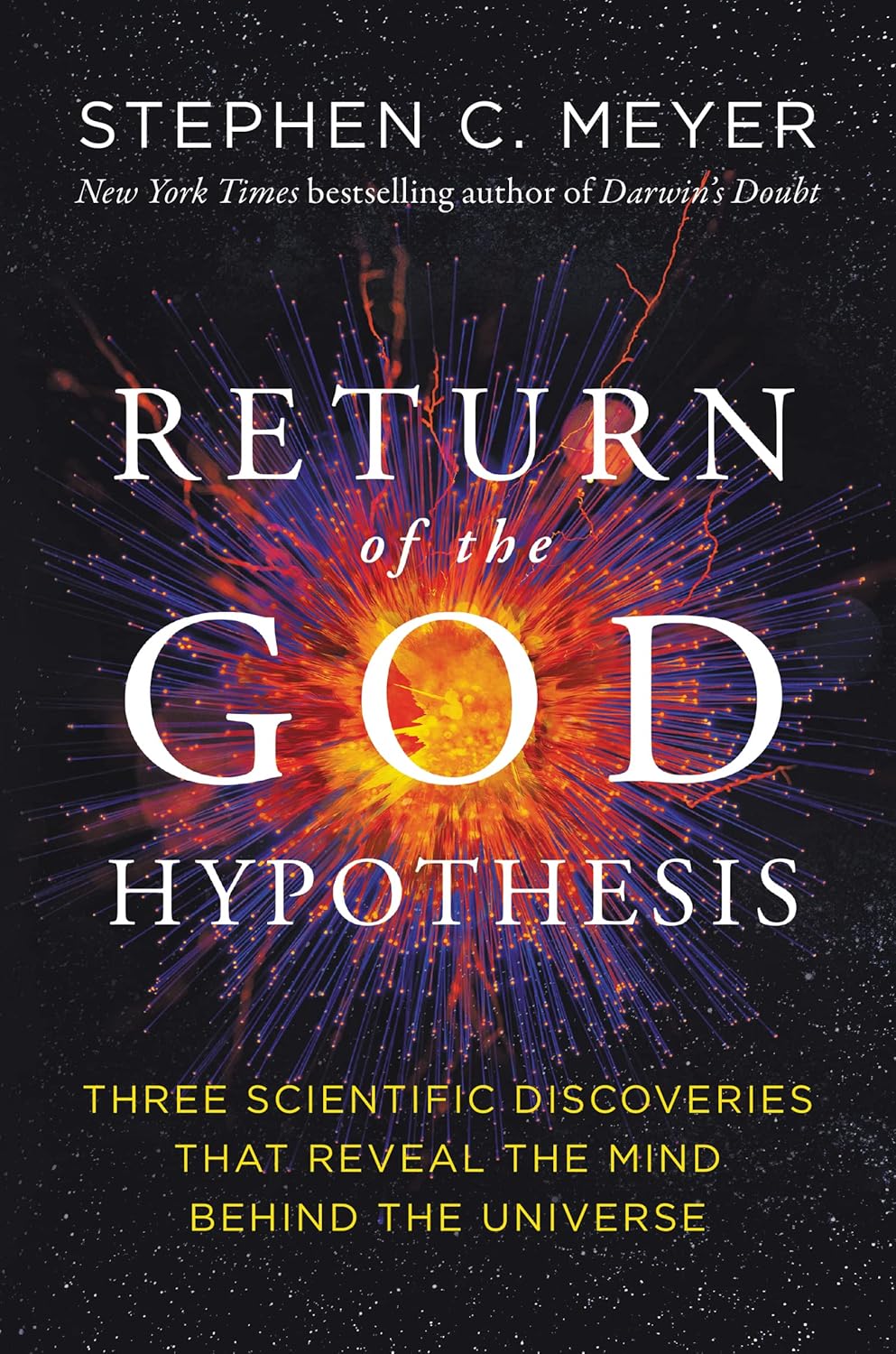
Return of the God Hypothesis: Three Scientific Discoveries Revealing the Mind Behind the Universe
AED17487
Quantity:
Order today to get by 7-14 business days
Delivery fee of AED 20. Free for orders above AED 200.
Imported From: United Kingdom
At BOLO, we work hard to ensure the products you receive are new, genuine, and sourced from reputable suppliers.
BOLO is not an authorized or official retailer for most brands, nor are we affiliated with manufacturers unless specifically stated on a product page. Instead, we source verified sellers, authorized distributors or directly from the manufacturer.
Each product undergoes thorough inspection and verification at our consolidation and fulfilment centers to ensure it meets our strict authenticity and quality standards before being shipped and delivered to you.
If you ever have concerns regarding the authenticity of a product purchased from us, please contact Bolo Support. We will review your inquiry promptly and, if necessary, provide documentation verifying authenticity or offer a suitable resolution.
Your trust is our top priority, and we are committed to maintaining transparency and integrity in every transaction.
All product information, images, descriptions, and reviews originate from the manufacturer or from trusted sellers overseas. BOLO is not affiliated with, endorsed by, or an authorized retailer for most brands listed on our website unless stated otherwise.
While we strive to display accurate information, variations in packaging, labeling, instructions, or formulation may occasionally occur due to regional differences or supplier updates. For detailed or manufacturer-specific information, please contact the brand directly or reach out to BOLO Support for assistance.
Unless otherwise stated, all prices displayed on the product page include applicable taxes and import duties.
BOLO operates in accordance with the laws and regulations of United Arab Emirates. Any items found to be restricted or prohibited for sale within the UAE will be cancelled prior to shipment. We take proactive measures to ensure that only products permitted for sale in United Arab Emirates are listed on our website.
All items are shipped by air, and any products classified as “Dangerous Goods (DG)” under IATA regulations will be removed from the order and cancelled.
All orders are processed manually, and we make every effort to process them promptly once confirmed. Products cancelled due to the above reasons will be permanently removed from listings across the website.
Similar suggestions by Bolo
More from this brand
Similar items from “Science & Religion”
Share with
Or share with link
https://www.bolo.ae/products/K0062071513
Visit the HarperOne Store
Return of the God Hypothesis: Three Scientific Discoveries Revealing the Mind Behind the Universe

AED17487
Quantity:
Order today to get by 7-14 business days
Delivery fee of AED 20. Free for orders above AED 200.
Imported From: United Kingdom
At BOLO, we work hard to ensure the products you receive are new, genuine, and sourced from reputable suppliers.
BOLO is not an authorized or official retailer for most brands, nor are we affiliated with manufacturers unless specifically stated on a product page. Instead, we source verified sellers, authorized distributors or directly from the manufacturer.
Each product undergoes thorough inspection and verification at our consolidation and fulfilment centers to ensure it meets our strict authenticity and quality standards before being shipped and delivered to you.
If you ever have concerns regarding the authenticity of a product purchased from us, please contact Bolo Support. We will review your inquiry promptly and, if necessary, provide documentation verifying authenticity or offer a suitable resolution.
Your trust is our top priority, and we are committed to maintaining transparency and integrity in every transaction.
All product information, images, descriptions, and reviews originate from the manufacturer or from trusted sellers overseas. BOLO is not affiliated with, endorsed by, or an authorized retailer for most brands listed on our website unless stated otherwise.
While we strive to display accurate information, variations in packaging, labeling, instructions, or formulation may occasionally occur due to regional differences or supplier updates. For detailed or manufacturer-specific information, please contact the brand directly or reach out to BOLO Support for assistance.
Unless otherwise stated, all prices displayed on the product page include applicable taxes and import duties.
BOLO operates in accordance with the laws and regulations of United Arab Emirates. Any items found to be restricted or prohibited for sale within the UAE will be cancelled prior to shipment. We take proactive measures to ensure that only products permitted for sale in United Arab Emirates are listed on our website.
All items are shipped by air, and any products classified as “Dangerous Goods (DG)” under IATA regulations will be removed from the order and cancelled.
All orders are processed manually, and we make every effort to process them promptly once confirmed. Products cancelled due to the above reasons will be permanently removed from listings across the website.
Description:
Review
"No one in my experience can explicate such complex material with the grace and clarity that seem so effortless to Stephen Meyer. With meticulous rational analysis of the latest discoveries in cosmology, physics, and biology, Meyer confirms a truth ideologues find too frightening to consider. Their ad hominem attacks on his brilliant work, confirm its importance." --Dean Koontz, New York Times #1 bestselling author
"A meticulously researched, lavishly illustrated, and thoroughly argued case against the new atheism. Even if your mind is made up―especially if it is―Meyer’s refreshing take on the origins of the Universe is a joy to read. You may not come away convinced, but you’ll be richer for the journey." --Dr. Brian Keating, Chancellor’s Distinguished Professor of Physics, University of California, San Diego, and author of Losing the Nobel Prize.
About the Author
Stephen C. Meyer received his Ph.D. from the University of Cambridge in the philosophy of science after working as an oil industry geophysicist. He now directs the Center for Science and Culture at the Discovery Institute in Seattle, Washington. He authored Signature in the Cell, a (London) Times Literary Supplement Book of the Year.
Reviews:
5.0 out of 5 stars Logical, empirical and scientific. Read this .
As with his previous books, Stephen Meyers latest book uses a rigorous process of elimination to assess competing worldviews about the origin of life .Atheism is eliminated as a poor explanation on the basis that evidence for the ‘ big bang’ implies that the universe had a beginning; which implies something or someone started everything off in the first place .Deism is eliminated because of the inability of Darwin’s Theory of Evolution to explain the transition from geochemistry to biochemistry , implying an intelligence intervened at at least one point in the earths geological past .Pantheism is eliminated for similar reasons as Atheism . The idea of ‘ space aliens ‘ engineering life else where and seeding it on earth, is also eliminated as these creatures would have needed to have been around before the universe existed to have started the ball rolling as it were.Alternatives such as a Universe from nothing , and the Multiverse hypothesis, are revealed as entirely hypothetical mathematical constructions ( as acknowledged by at least one of their authors ) these being based on equations which tacitly , if not explicitly, assume a beginning, which in turn has theological implications .Combined with facts from computing, that in our experience, intelligence is the only known generator of information rich super - systems , such as those found in biological organisms from the DNA upwards ; and the only remaining credible explanation is assumed to be Theism, ie the God hypothesis .Please discard a one star review above stating that this book is nonsense because’ we cannot conclude that intelligent design is the best explanation as there are lots of other potential explanations apart from intelligent design all of which we may have yet to discover. ‘If this were the case then neither evolution , special creation nor ANY OTHER explanation could be considered good explanations because of the infinite number of alternative hypotheses available .My only criticism of this book is that it is too technical in places for the average non science reader ; but excellent and a must read neverless. Well done Proff Meyer !
5.0 out of 5 stars Is Theism compatible with Science?
In this book, Stephen Meyer holds the view that theism and science are actually best buddies; they complement one another. Meyer argues why intelligent design (God) is the only solution to several key questions in science. He reminds us that Isaac Newton [and no doubt Nicolaus Copernicus and Galileo Galilei] agreed with him. Most scientists, especially physicists, are skilled in advanced mathematics and assume this makes them good philosophers and logicians. Clearly it doesn't and it takes a philosopher like Meyer to critique their thinking. Mathematics is a precise language for manipulating abstract concepts. Scientists use it to describe the natural world, but they sometimes forget that mathematics has no causative powers. Like a figurative work of art, mathematicians “imagine” the natural world through mathematical modelling. This model becomes science only when scientists find some evidence to connect it with physical reality.Meyer highlights some evidence-free claims by several physicists and biologists - however he fails to include his own evidence-free claim for the existence of God; a case of the pot calling the kettle black. Next, Meyer turns to more fundamental issues: how do you get something from nothing? Not even a philosopher can answer that question - although Meyer points out the contradictions when some physicists (namely Lawrence Krauss) misleadingly claim to have done so, or when physicists try to ignore the issue altogether, as is found in the steady state/multiverse/vacuum energy theories. Meyer goes on to consider scientific attempts to explain how atoms combined to form protein molecules, which eventually gave rise to living creatures, when the probabilities of doing so by chance are infinitesimally small. Clearly it DID happen, yet no scientist has demonstrated experimentally how it happened in pre-biotic conditions on the Earth. For many in the West, “Science” is the new religion. Science has replaced “God” in the modern age, with scientists as its “bishops”, teachers as its “priests” and the rest of us its “disciples”, naively following the diktats of Science, faithfully reading its books and magazines, while gullibly watching sometimes evidence-free “sermons” on TV and YT [YouTube] by the bishops of Science.Scientists tell us that traditional religions are the cause of all the trouble in the world. We’re told religions are all out-of-date and out-of-touch with the scientific world and modern society. How quickly they forgot that Hitler and Communism performed evil deeds without appealing to religion. Indeed, most wars in history were unaffected by religion.It’s my own belief that religions were developed by humans not only to explain the world around us but also to enable us to reflect on how our individual actions impact our family, our community and the wider world.Too easily we forget that traditional religions answer questions that science cannot ever answer. Religions appeal to our personal (i.e. spiritual) needs, challenging us to lead a “good” life. Religions question and monitor our own behaviour and set standards for us to follow. Science is dumb and blind to these issues. Every person alive today has to comprehend their own unique state of mind, their own personal issues, as well as staying physically secure. Science has nothing to say about these invisible, personal needs; it only talks about observable phenomena. I have yet to see a paper in the journal Nature explaining the mind of Edward Grabczewski (or anyone else for that matter) and how he should lead his life.Meyer goes on to discuss several philosophical topics regarding knowledge and the difference between science and naturalism, leading to some important insights. His book addresses several issues with impressive clarity - however anthropomorphism creeps into his arguments. Darwin and Wallace proposed that life evolves through variation and "natural selection", suggesting that Nature is capable of “selecting” a species. Ordinary “selection” implies intention (conscious or otherwise) by an intelligent agent, whereas "natural selection" does not (unless Nature is your god). Similarly the word "information" implies intention, whereas “data” does not. Meyer prefers the word "information" over "data" to describe the first ever DNA sequence, inferring that an intelligent agent initially arranged the sequence of nucleotides in the first DNA strands. He believes this to be true primarily because the probability of it happening “naturally” is unbelievably small. Meyer accepts that "natural selection” is possible, but NOT that a natural DNA sequence is possible. He accepts that a species can be "naturally selected" without the intervention of an intelligent agent, but NOT that the “data” in a DNA sequence could be organised naturally. Is it really so impossible to conceive a DNA sequence forming naturally? Perhaps the problem is that he believes an over-simplified, probabilistic calculation by an uninformed mathematician. Maybe we should all wait for an inspired scientist to demonstrate how it might have really happened. Why does Meyer have more faith in mathematicians than in scientists? If it's true that intelligence creates information (otherwise it's just data) then it follows that intelligence is required to interpret or "understand" that data (otherwise it's not information). Ribosomes interpret RNA to produce proteins. Is a ribosome "intelligent" because it "understands" the data in a RNA strand? Is a Jacquard loom intelligent because it “understands” punched cards? Is a computer processor intelligent because it “understands” a computer program? Clearly a ribosome, Jacquard loom and computer processor are types of machine. Clearly these machines “understand” information is some sense. If a machine can “understand” information then can a machine create information? If it can then is it “intelligent”?A ribosome processes amino acids under the instruction of nucleic acid. A Jacquard loom processes textile fibre under the instruction of punched cards. A computer processor processes data under the instruction of data. Hence a computer processor is unique in that its instructions and throughput comprise the same material, namely “data”. This allows for data feedback, so the output can potentially become an instruction – given the right architecture. (Feedback is how pressure valves and thermostats work.)The brain is similar in that it has electrochemical signals as input, electrochemical signals as output, and a network architecture that allows for electrochemical feedback. This feedback allows the machine to control itself, independently of any external instruction. Is “deciding for yourself”, or self-determination, a feature of intelligence? Can a machine be self-determining and therefore intelligent? (Are pressure valves and thermostats in some sense intelligent?) Has Nature created self-determining, intelligent machines? Is “Nature” another name for God? Are “Natural philosophers” actually priests?Currently, “Generative AI” is like a ribosome or a Jacquard loom: it processes and stores a lot of old data, transforming it on demand. This is characteristic of a machine. In the future, when feedback loops are introduced into AI networks, then we might see the first inklings of self-instruction, leading to some kind of artificial “intelligence”. And to be current, it will need fresh data input (through its “senses”). There are many unanswered questions in science. Faith in scientists will be necessary to believe that science will eventually solve some of our current problems. Unfortunately some problems are beyond science.I believe people will always have a need for that most revered anthropomorphism – God. They need to be comforted and believe there is SOME hope in this hostile world. For them, help will always be found in God. Fanaticism is a human condition and many forms of fanaticism, whether scientific or religious, end in human suffering. Believers of science and of religion need to understand the limitations of what they can know. Scientists must understand themselves before they can be objective, however science tells us nothing about ourselves. Theists need to understand themselves before they can know God, however they confuse their own desires for those of God. In my own case, my former Catholic upbringing never progressed beyond the age of 14, largely because of the incredible stories I was told about “God”. For those who are searching for a better understanding of God, I can recommend two approaches, based on my own experience: 1) Read the book “God in Us” by Anthony Freeman. This priest focuses on why the CONCEPT of God is an important one for humans, even though it's a very human God. 2) Read Meyer’s book (“Return of the God Hypothesis”). It dispels several misconceptions by scientists and argues in favour of an “intelligent being” - in Meyer's view, a supernatural God. If nothing else, these books will widen your understanding and help you to be more critical of scientific claims, and possibly reconsider your current beliefs.
5.0 out of 5 stars Excellent book
Very well-argued and presented, in my opinion deals a serious, perhaps lethal, blow to nearly all forms of atheism.The idea of conserving information in particular is a legitimate thorn in the backside for a lot of theorists, who postulate complex entities such as black hole firewalls to prevent any violation of this principle, generally considered irrefutable.Surprisingly for me, the author always kept to a respectful tone when making his arguments, completely unlike the irritated, anger-filled passages of Dawkins's book.As someone agnostic at the time I read both books, this book seemed far more logical and rational to me than Dawkins's. And don't be concerned by some dieharders railing against the author or his theory as pseudoscience- after all, rogue waves were regarded as a pseudoscience as well once, and those who try to discredit a theory by pointing out some 'negative' characteristic (ie not enjoyed by scientists) commit what is generally described as a logical fallacy.If you are agnostic and want to hear both sides of the story, read this, don't get caught up in any atheism or religious circus of criticism, and decide for yourself which is more rational for you
5.0 out of 5 stars A great read!
Fantastic read, thoroughly well researched and informative!
Intelligent designer must exist
It is a huge and comprhensive study...a synopsis of all that is said and written would be most welcome.
Every skeptic should read this.
This is one of the best works I've read on whether the belief in God is supported by reason and evidence. It deals with alternative views fairly and with considerable detail while presenting a very well researched case for belief as a most reasonable conclusion.Those who dismiss the concept of God can not read this book and honestly say that there is insufficient reasons to believe. Every objection raised by atheists is answered scientifically.
My Brain Just Did a Marathon (and Might Believe in Miracles Now!)
You know, I picked up "Return of the God Hypothesis" thinking, "Okay, let's see what this is all about. Science and... Yahweh? This should be interesting." What I didn't expect was for my brain to feel like it had just run a marathon through the cosmos, the Big Bang, and the intricate machinery of life itself.Stephen C. Meyer is clearly a very smart person. Like, "explains complex physics and biology in a way that makes my head spin but also kind of makes sense" smart. Reading this book felt like sitting in on a lecture from a brilliant but slightly mischievous professor who keeps pulling back the curtain on the universe and saying, "See? Isn't that weird?"He takes you on a journey through some seriously mind-bending scientific discoveries – the fine-tuning of the universe, the origin of life's information, and other things that previously existed only as vague concepts in my head. And then he lays out the case for the "God hypothesis" as a compelling explanation for why all this stuff looks so... designed.It's not a light read, mind you. There were moments where I had to reread paragraphs (sometimes multiple times) and stare blankly into space while my brain processed concepts like entropy and irreducible complexity. My cat seemed concerned by my sudden periods of deep, furrowed-brow contemplation.But Meyer has a knack for making these complex ideas accessible, even for someone whose last science class involved dissecting a frog (a traumatic event we won't dwell on). He's witty, he's thorough, and he doesn't shy away from the big questions. It's like a really well-written detective story, but the mystery is "How did all this exist?" and the prime suspect is... well, you get the idea.Whether you agree with his hypothesis or not, the journey through the scientific evidence is fascinating. It makes you think. It challenges assumptions. And it's delivered with a confidence and clarity that's genuinely impressive.If you're curious about the intersection of science and faith, enjoy having your brain stretched in new and interesting ways, and appreciate a well-argued case for a provocative idea, pick up this book. It's a intellectual workout that's both challenging and incredibly rewarding. My brain is tired, but it feels smarter, and I'm thoroughly impressed by the case Meyer presents. And I've always believed in God anyway.
Knowledgeable author - detailed research
Stephen Meyers' ongoing presence online is greatly needed in our agnostic and materialist Western society. In this 550 pages book with ample supporting sources and notes, he responds to all the atheist objections, at the bio-chemical and cosmological level, based on detailed interviews with experts in each domain. Stephen is also a great philosopher and known apologist.
Aleluia!
O autor renova a Filosofia da Ciência, restaurando a racionalidade máxima possível, que aponta para a existência de Deus e para sua ação como Criador de todas as coisas, e que atua no curso da história cósmica.O livro representa um marco na revolução pelo que passa o pensamento contemporâneo, superando as insuficiências das ideias materialistas seculares.Esperei mais de um ano pelo lançamento, com a encomenda feita muito antecipadamente, tendo minhas expectativas sido satisfeitas e superadas.
Similar suggestions by Bolo
More from this brand
Similar items from “Science & Religion”
Share with
Or share with link
https://www.bolo.ae/products/K0062071513